

Computer analysis
Date were analyzed using the MINT program for numerical taxonomy (involving the
Jaccard’s similarity coefficient and the U.P.G.M.A. method of clustering).
Heavy metal analysis
The heavy metal content of sediments was analyzed as described by Modamio (1983).
RESULTS
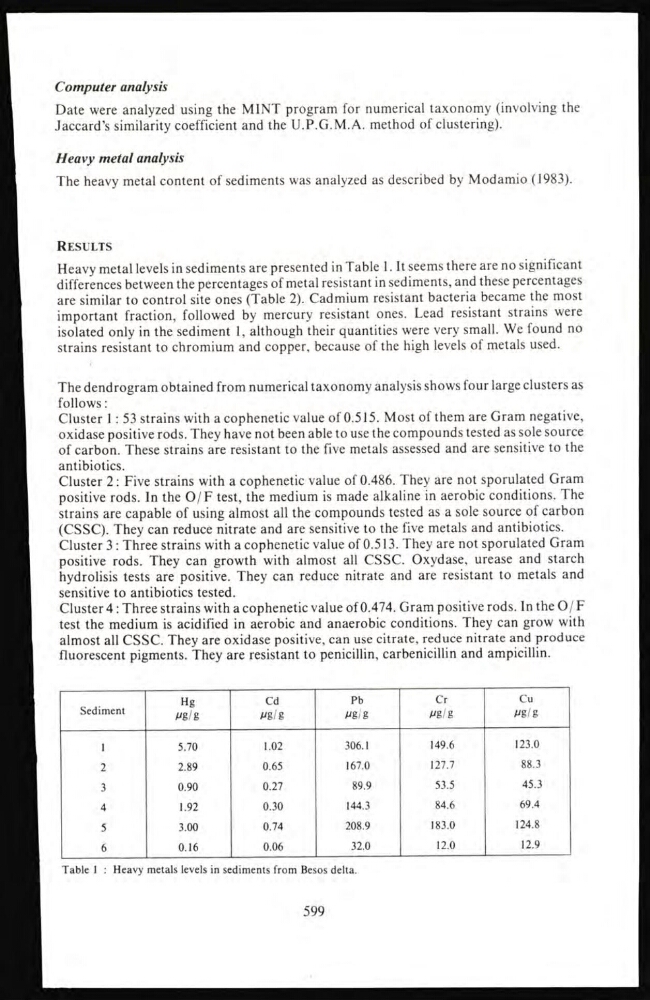
Heavy metal levels in sediments are presented in Table 1. It seems there are no significant
differences between the percentages of metal resistant in sediments, and these percentages
are similar to control site ones (Table 2). Cadmium resistant bacteria became the most
important fraction, followed by mercury resistant ones. Lead resistant strains were
isolated only in the sediment 1, although their quantities were very small. We found no
strains resistant to chromium and copper, because of the high levels of metals used.
The dendrogram obtained from numerical taxonomy analysis shows four large clusters as
follows :
Cluster 1: 53 strains with a cophenetic value of 0.515. Most of them are Gram negative,
oxidase positive rods. They have not been able to use the compounds tested as sole source
of carbon. These strains are resistant to the five metals assessed and are sensitive to the
antibiotics.
Cluster 2 : Five strains with a cophenetic value of 0.486. They are not sporulated Gram
positive rods. In the O/F test, the medium is made alkaline in aerobic conditions. The
strains are capable of using almost all the compounds tested as a sole source of carbon
(CSSC). They can reduce nitrate and are sensitive to the five metals and antibiotics.
Cluster 3 : Three strains with a cophenetic value of 0.513. They are not sporulated Gram
positive rods. They can growth with almost all CSSC. Oxydase, urease and starch
hydrolisis tests are positive. They can reduce nitrate and are resistant to metals and
sensitive to antibiotics tested.
Cluster 4 : Three strains with a cophenetic value of 0.474. Gram positive rods. In the O/ F
test the medium is acidified in aerobic and anaerobic conditions. They can grow with
almost all CSSC. They are oxidase positive, can use citrate, reduce nitrate and produce
fluorescent pigments. They are resistant to penicillin, carbenicillin and ampicillin.
Sediment
Hg
µg/ g
Cd
µg/g
Pb
µg/g
Cr
µg/g
Cu
µg/g
1
5.70
1.02
306.1
149.6
123.0
2
2.89
0.65
167.0
127.7
88.3
3
0.90
0.27
89.9
53.5
45.3
4
1.92
0.30
144.3
84.6
69.4
5
3.00
0.74
208.9
183.0
124.8
6
0.16
0.06
32.0
12.0
12.9
Table 1 : Heavy metals levels in sediments from Besos delta.
599
Date were analyzed using the MINT program for numerical taxonomy (involving the
Jaccard’s similarity coefficient and the U.P.G.M.A. method of clustering).
Heavy metal analysis
The heavy metal content of sediments was analyzed as described by Modamio (1983).
RESULTS
Heavy metal levels in sediments are presented in Table 1. It seems there are no significant
differences between the percentages of metal resistant in sediments, and these percentages
are similar to control site ones (Table 2). Cadmium resistant bacteria became the most
important fraction, followed by mercury resistant ones. Lead resistant strains were
isolated only in the sediment 1, although their quantities were very small. We found no
strains resistant to chromium and copper, because of the high levels of metals used.
The dendrogram obtained from numerical taxonomy analysis shows four large clusters as
follows :
Cluster 1: 53 strains with a cophenetic value of 0.515. Most of them are Gram negative,
oxidase positive rods. They have not been able to use the compounds tested as sole source
of carbon. These strains are resistant to the five metals assessed and are sensitive to the
antibiotics.
Cluster 2 : Five strains with a cophenetic value of 0.486. They are not sporulated Gram
positive rods. In the O/F test, the medium is made alkaline in aerobic conditions. The
strains are capable of using almost all the compounds tested as a sole source of carbon
(CSSC). They can reduce nitrate and are sensitive to the five metals and antibiotics.
Cluster 3 : Three strains with a cophenetic value of 0.513. They are not sporulated Gram
positive rods. They can growth with almost all CSSC. Oxydase, urease and starch
hydrolisis tests are positive. They can reduce nitrate and are resistant to metals and
sensitive to antibiotics tested.
Cluster 4 : Three strains with a cophenetic value of 0.474. Gram positive rods. In the O/ F
test the medium is acidified in aerobic and anaerobic conditions. They can grow with
almost all CSSC. They are oxidase positive, can use citrate, reduce nitrate and produce
fluorescent pigments. They are resistant to penicillin, carbenicillin and ampicillin.
Sediment
Hg
µg/ g
Cd
µg/g
Pb
µg/g
Cr
µg/g
Cu
µg/g
1
5.70
1.02
306.1
149.6
123.0
2
2.89
0.65
167.0
127.7
88.3
3
0.90
0.27
89.9
53.5
45.3
4
1.92
0.30
144.3
84.6
69.4
5
3.00
0.74
208.9
183.0
124.8
6
0.16
0.06
32.0
12.0
12.9
Table 1 : Heavy metals levels in sediments from Besos delta.
599