

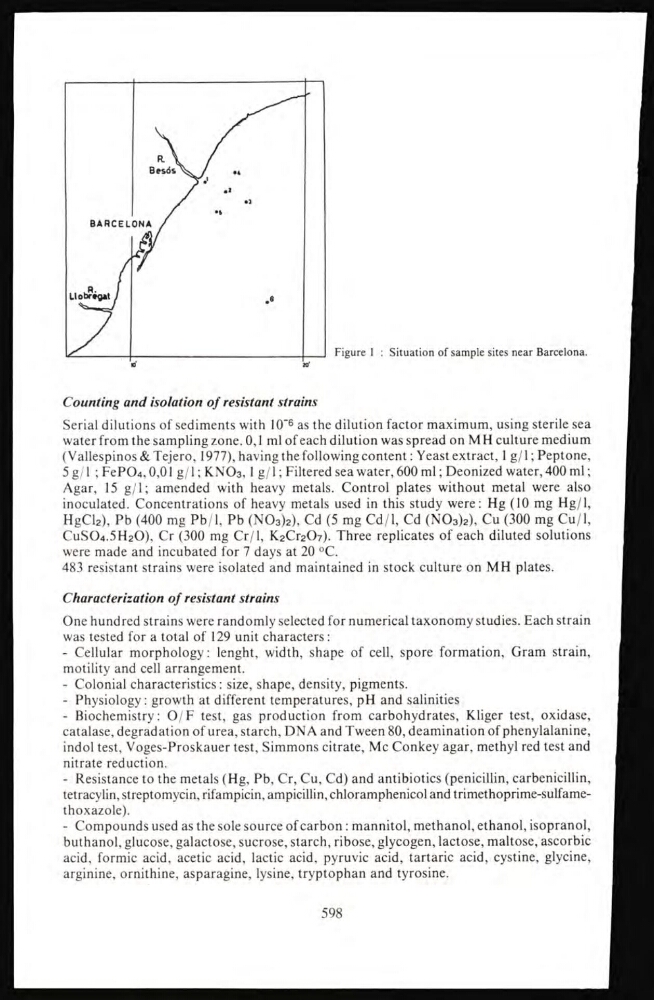
Counting and isolation of resistant strains
Serial dilutions of sediments with 10' 6 as the dilution factor maximum, using sterile sea
water from the sampling zone. 0,1 ml of each dilution was spread on M H culture medium
(Vallespinos&Tejero, 1977), having the following content: Yeast extract, 1 g/l ; Peptone,
5 g/l ; FePO4,0,01 g/l ; K.NO 3 ,1 g/l ; Filtered seawater, 600 ml ; Deonized water, 400 ml ;
Agar, 15 g/l ; amended with heavy metals. Control plates without metal were also
inoculated. Concentrations of heavy metals used in this study were: Hg (10 mg Hg/l,
HgCl 2 ), Pb (400 mg Pb/1, Pb (NO 3 ) 2 ), Cd (5 mg Cd/l, Cd (NO 3 ) 2 ), Cu (300 mg Cu/l,
CuSO 4 .5H 2 0), Cr (300 mg Cr/l, K 2 Cr 2 O 7 ). Three replicates of each diluted solutions
were made and incubated for 7 days at 20 °C.
483 resistant strains were isolated and maintained in stock culture on MH plates.
Characterization of resistant strains
One hundred strains were randomly selected for numerical taxonomy studies. Each strain
was tested for a total of 129 unit characters :
- Cellular morphology: lenght, width, shape of cell, spore formation, Gram strain,
motility and cell arrangement.
- Colonial characteristics : size, shape, density, pigments.
- Physiology: growth at different temperatures, pH and salinities
- Biochemistry: O/F test, gas production from carbohydrates, Kliger test, oxidase,
catalase, degradation of urea, starch, DNA and Tween 80, deamination of phenylalanine,
indol test, Voges-Proskauer test, Simmons citrate. Mc Conkey agar, methyl red test and
nitrate reduction.
- Resistance to the metals (Hg, Pb, Cr, Cu, Cd) and antibiotics (penicillin, carbenicillin,
tetracylin, streptomycin, rifampicin, ampicillin, chloramphenicol and trimethoprime-sulfamethoxazole).
- Compounds used as the sole source of carbon : mannitol, methanol, ethanol, isopranol,
buthanol, glucose, galactose, sucrose, starch, ribose, glycogen, lactose, maltose, ascorbic
acid, formic acid, acetic acid, lactic acid, pyruvic acid, tartaric acid, cystine, glycine,
arginine, ornithine, asparagine, lysine, tryptophan and tyrosine.
598
Serial dilutions of sediments with 10' 6 as the dilution factor maximum, using sterile sea
water from the sampling zone. 0,1 ml of each dilution was spread on M H culture medium
(Vallespinos&Tejero, 1977), having the following content: Yeast extract, 1 g/l ; Peptone,
5 g/l ; FePO4,0,01 g/l ; K.NO 3 ,1 g/l ; Filtered seawater, 600 ml ; Deonized water, 400 ml ;
Agar, 15 g/l ; amended with heavy metals. Control plates without metal were also
inoculated. Concentrations of heavy metals used in this study were: Hg (10 mg Hg/l,
HgCl 2 ), Pb (400 mg Pb/1, Pb (NO 3 ) 2 ), Cd (5 mg Cd/l, Cd (NO 3 ) 2 ), Cu (300 mg Cu/l,
CuSO 4 .5H 2 0), Cr (300 mg Cr/l, K 2 Cr 2 O 7 ). Three replicates of each diluted solutions
were made and incubated for 7 days at 20 °C.
483 resistant strains were isolated and maintained in stock culture on MH plates.
Characterization of resistant strains
One hundred strains were randomly selected for numerical taxonomy studies. Each strain
was tested for a total of 129 unit characters :
- Cellular morphology: lenght, width, shape of cell, spore formation, Gram strain,
motility and cell arrangement.
- Colonial characteristics : size, shape, density, pigments.
- Physiology: growth at different temperatures, pH and salinities
- Biochemistry: O/F test, gas production from carbohydrates, Kliger test, oxidase,
catalase, degradation of urea, starch, DNA and Tween 80, deamination of phenylalanine,
indol test, Voges-Proskauer test, Simmons citrate. Mc Conkey agar, methyl red test and
nitrate reduction.
- Resistance to the metals (Hg, Pb, Cr, Cu, Cd) and antibiotics (penicillin, carbenicillin,
tetracylin, streptomycin, rifampicin, ampicillin, chloramphenicol and trimethoprime-sulfamethoxazole).
- Compounds used as the sole source of carbon : mannitol, methanol, ethanol, isopranol,
buthanol, glucose, galactose, sucrose, starch, ribose, glycogen, lactose, maltose, ascorbic
acid, formic acid, acetic acid, lactic acid, pyruvic acid, tartaric acid, cystine, glycine,
arginine, ornithine, asparagine, lysine, tryptophan and tyrosine.
598