

CarbonExchanger
0 6 m 2
Rotating
Pump
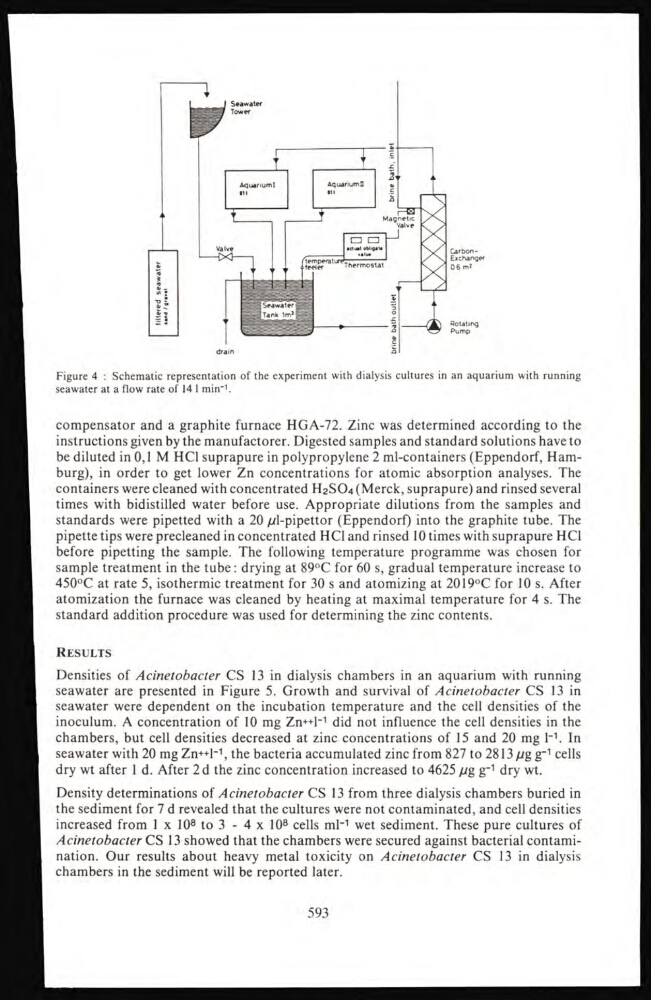
Figure 4 : Schematic representation of the experiment with dialysis cultures in an aquarium with running
seawater at a flow rate of 14 1 min -1 .
compensator and a graphite furnace HGA-72. Zinc was determined according to the
instructions given by the manufactorer. Digested samples and standard solutions have to
be diluted in 0,1 M HCl suprapure in polypropylene 2 ml-containers (Eppendorf, Hamburg), in order to get lower Zn concentrations for atomic absorption analyses. The
containers were cleaned with concentrated H2SO4 (Merck, suprapure) and rinsed several
times with bidistilled water before use. Appropriate dilutions from the samples and
standards were pipetted with a 20 /zl-pipettor (Eppendorf) into the graphite tube. The
pipette tips were precleaned in concentrated HCl and rinsed 10 times with suprapure HC1
before pipetting the sample. The following temperature programme was chosen for
sample treatment in the tube : drying at 89°C for 60 s, gradual temperature increase to
450°C at rate 5, isothermic treatment for 30 s and atomizing at 2019°C for 10 s. After
atomization the furnace was cleaned by heating at maximal temperature for 4 s. The
standard addition procedure was used for determining the zinc contents.
RESULTS
Densities of Acinetobacter CS 13 in dialysis chambers in an aquarium with running
seawater are presented in Figure 5. Growth and survival of Acinetobacter CS 13 in
seawater were dependent on the incubation temperature and the cell densities of the
inoculum. A concentration of 10 mg Zn++l -1 did not influence the cell densities in the
chambers, but cell densities decreased at zinc concentrations of 15 and 20 mg l -1 . In
seawater with 20 mg Zn++l -1 , the bacteria accumulated zinc from 827 to 2813 µg g -1 cells
dry wt after 1 d. After 2d the zinc concentration increased to 4625 µg g -1 dry wt.
Density determinations of Acinetobacter CS 13 from three dialysis chambers buried in
the sediment for 7 d revealed that the cultures were not contaminated, and cell densities
increased from 1 x 10 8 to 3 - 4 x 10 8 cells ml -1 wet sediment. These pure cultures of
Acinetobacter CS 13 showed that the chambers were secured against bacterial contamination. Our results about heavy metal toxicity on Acinetobacter CS 13 in dialysis
chambers in the sediment will be reported later.
593
0 6 m 2
Rotating
Pump
Figure 4 : Schematic representation of the experiment with dialysis cultures in an aquarium with running
seawater at a flow rate of 14 1 min -1 .
compensator and a graphite furnace HGA-72. Zinc was determined according to the
instructions given by the manufactorer. Digested samples and standard solutions have to
be diluted in 0,1 M HCl suprapure in polypropylene 2 ml-containers (Eppendorf, Hamburg), in order to get lower Zn concentrations for atomic absorption analyses. The
containers were cleaned with concentrated H2SO4 (Merck, suprapure) and rinsed several
times with bidistilled water before use. Appropriate dilutions from the samples and
standards were pipetted with a 20 /zl-pipettor (Eppendorf) into the graphite tube. The
pipette tips were precleaned in concentrated HCl and rinsed 10 times with suprapure HC1
before pipetting the sample. The following temperature programme was chosen for
sample treatment in the tube : drying at 89°C for 60 s, gradual temperature increase to
450°C at rate 5, isothermic treatment for 30 s and atomizing at 2019°C for 10 s. After
atomization the furnace was cleaned by heating at maximal temperature for 4 s. The
standard addition procedure was used for determining the zinc contents.
RESULTS
Densities of Acinetobacter CS 13 in dialysis chambers in an aquarium with running
seawater are presented in Figure 5. Growth and survival of Acinetobacter CS 13 in
seawater were dependent on the incubation temperature and the cell densities of the
inoculum. A concentration of 10 mg Zn++l -1 did not influence the cell densities in the
chambers, but cell densities decreased at zinc concentrations of 15 and 20 mg l -1 . In
seawater with 20 mg Zn++l -1 , the bacteria accumulated zinc from 827 to 2813 µg g -1 cells
dry wt after 1 d. After 2d the zinc concentration increased to 4625 µg g -1 dry wt.
Density determinations of Acinetobacter CS 13 from three dialysis chambers buried in
the sediment for 7 d revealed that the cultures were not contaminated, and cell densities
increased from 1 x 10 8 to 3 - 4 x 10 8 cells ml -1 wet sediment. These pure cultures of
Acinetobacter CS 13 showed that the chambers were secured against bacterial contamination. Our results about heavy metal toxicity on Acinetobacter CS 13 in dialysis
chambers in the sediment will be reported later.
593