

For experiments in seawater aquariums, the chamber was put on a magnetic stirrer holder
(Fig. 2) and rotated by means of a magnetic stirrer. Polycarbonate membrane filters
(Nuclepore Corp., Pleasanton, Calif.), pore width 0,1 µm and 50 mm in diameter, were
used for all experiments. For application in the sediment, the membrane has to be
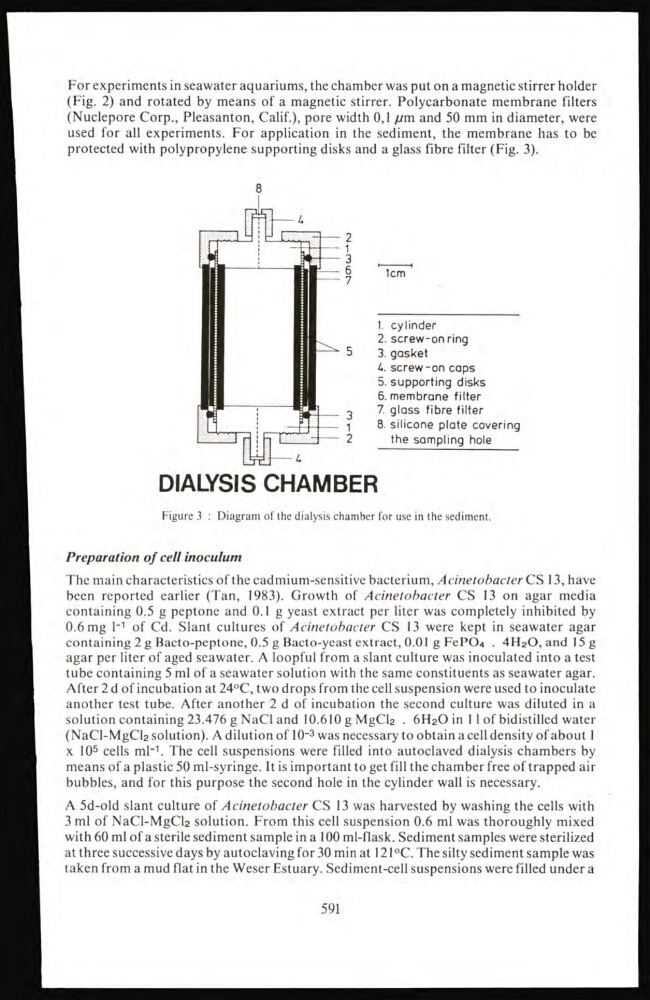
protected with polypropylene supporting disks and a glass fibre filter (Fig. 3).
8
1cm
1. cylinder
2. screw-on ring
3. gasket
4. screw-on caps
5. supporting disks
6. membrane filter
7. glass fibre filter
8. silicone plate covering
the sampling hole
DIALYSIS CHAMBER
Figure 3 : Diagram of the dialysis chamber for use in the sediment.
Preparation of cell inoculum
The main characteristics of the cadmium-sensitive bacterium, Acinetobacter CS 13, have
been reported earlier (Tan, 1983). Growth of Acinetobacter CS 13 on agar media
containing 0.5 g peptone and 0.1 g yeast extract per liter was completely inhibited by
0.6 mg l -1 of Cd. Slant cultures of Acinetobacter CS 13 were kept in seawater agar
containing 2 g Bacto-peptone, 0.5 g Bacto-yeast extract, 0.01 g FeP0 4 .4H 2 O, and 15 g
agar per liter of aged seawater. A loopful from a slant culture was inoculated into a test
tube containing 5 ml of a seawater solution with the same constituents as seawater agar.
After 2 d of incubation at 24°C, two drops from the cell suspension were used to inoculate
another test tube. After another 2 d of incubation the second culture was diluted in a
solution containing 23.476 g NaCl and 10.610 g MgCl 2 . 6H 2 0 in 11 of bidistilled water
(NaCl-MgCl 2 solution). A dilution of 10" 3 was necessary to obtain a cell density of about 1
x 10 5 cells ml -1 . The cell suspensions were filled into autoclaved dialysis chambers by
means of a plastic 50 ml-syringe. It is important to get fill the chamber free of trapped air
bubbles, and for this purpose the second hole in the cylinder wall is necessary.
A 5d-old slant culture of Acinetobacter CS 13 was harvested by washing the cells with
3 ml of NaCl-MgCl 2 solution. From this cell suspension 0.6 ml was thoroughly mixed
with 60 ml of a sterile sediment sample in a 100 ml-flask. Sediment samples were sterilized
at three successive days by autoclaving for 30 min at 121 °C. The silty sediment sample was
taken from a mud flat in the Weser Estuary. Sediment-cell suspensions were filled under a
591
(Fig. 2) and rotated by means of a magnetic stirrer. Polycarbonate membrane filters
(Nuclepore Corp., Pleasanton, Calif.), pore width 0,1 µm and 50 mm in diameter, were
used for all experiments. For application in the sediment, the membrane has to be
protected with polypropylene supporting disks and a glass fibre filter (Fig. 3).
8
1cm
1. cylinder
2. screw-on ring
3. gasket
4. screw-on caps
5. supporting disks
6. membrane filter
7. glass fibre filter
8. silicone plate covering
the sampling hole
DIALYSIS CHAMBER
Figure 3 : Diagram of the dialysis chamber for use in the sediment.
Preparation of cell inoculum
The main characteristics of the cadmium-sensitive bacterium, Acinetobacter CS 13, have
been reported earlier (Tan, 1983). Growth of Acinetobacter CS 13 on agar media
containing 0.5 g peptone and 0.1 g yeast extract per liter was completely inhibited by
0.6 mg l -1 of Cd. Slant cultures of Acinetobacter CS 13 were kept in seawater agar
containing 2 g Bacto-peptone, 0.5 g Bacto-yeast extract, 0.01 g FeP0 4 .4H 2 O, and 15 g
agar per liter of aged seawater. A loopful from a slant culture was inoculated into a test
tube containing 5 ml of a seawater solution with the same constituents as seawater agar.
After 2 d of incubation at 24°C, two drops from the cell suspension were used to inoculate
another test tube. After another 2 d of incubation the second culture was diluted in a
solution containing 23.476 g NaCl and 10.610 g MgCl 2 . 6H 2 0 in 11 of bidistilled water
(NaCl-MgCl 2 solution). A dilution of 10" 3 was necessary to obtain a cell density of about 1
x 10 5 cells ml -1 . The cell suspensions were filled into autoclaved dialysis chambers by
means of a plastic 50 ml-syringe. It is important to get fill the chamber free of trapped air
bubbles, and for this purpose the second hole in the cylinder wall is necessary.
A 5d-old slant culture of Acinetobacter CS 13 was harvested by washing the cells with
3 ml of NaCl-MgCl 2 solution. From this cell suspension 0.6 ml was thoroughly mixed
with 60 ml of a sterile sediment sample in a 100 ml-flask. Sediment samples were sterilized
at three successive days by autoclaving for 30 min at 121 °C. The silty sediment sample was
taken from a mud flat in the Weser Estuary. Sediment-cell suspensions were filled under a
591