

bacteria in natural waters (McFeters and Stuart, 1972 ; Vasconcelos and Swartz, 1976 ;
Rhodes et al, 1983 ; Lessard and Sieburth, 1983). In situ diffusion chambers have also
been used to study the dynamics of microbial plankton communities (Landry et al., 1984).
McFeters and Stuart (1972) described a membrane filter diffusion chamber made from
Plexiglass. Their membrane filter chamber was later improved by the insertion of O-rings
to prevent leakage and contamination, and a polycarbonate plastic to withstand repeated
autoclaving was used instead of Plexiglass (Rhodes et al., 1983). The development of
membrane filter chambers and its applications for studies in situ was the subject of the
review article by McFeters and Stuart (1981).
A Teflon dialysis chamber has been used for investigating the toxicity of ZnCl2 on a
cadmium-sensitive bacterium, Acinetobacter CS 13, in seawater aquariums. Acinetobacter CS 13 was also cultivated in sterilized sediment samples in three dialysis chambers, and
the chambers were buried in the sediment of a mud flat in the Weser Estuary. The results
are reported here.
MATERIALS AND METHODS
Dialysis chamber
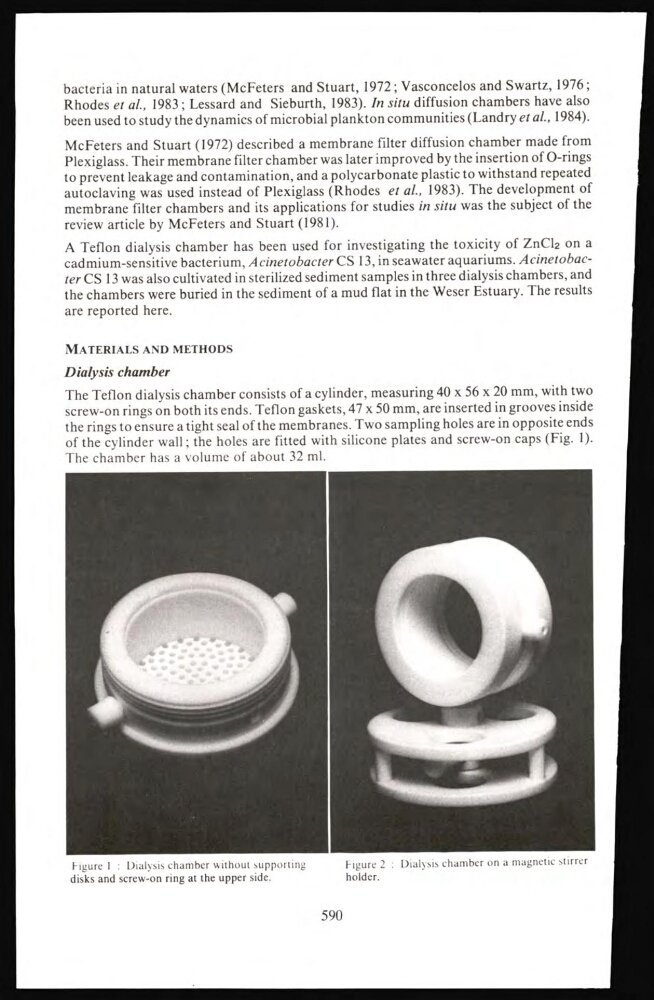
The Teflon dialysis chamber consists of a cylinder, measuring 40 x 56 x 20 mm, with two
screw-on rings on both its ends. Teflon gaskets, 47 x 50 mm, are inserted in grooves inside
the rings to ensure a tight seal of the membranes. Two sampling holes are in opposite ends
of the cylinder wall ; the holes are fitted with silicone plates and screw-on caps (Fig. 1).
The chamber has a volume of about 32 ml.
Figure 1 : Dialysis chamber without supporting
Figure 2 : Dialysis chamber on a magnetic stirrer
disks and screw-on ring at the upper side.
holder.
590
Rhodes et al, 1983 ; Lessard and Sieburth, 1983). In situ diffusion chambers have also
been used to study the dynamics of microbial plankton communities (Landry et al., 1984).
McFeters and Stuart (1972) described a membrane filter diffusion chamber made from
Plexiglass. Their membrane filter chamber was later improved by the insertion of O-rings
to prevent leakage and contamination, and a polycarbonate plastic to withstand repeated
autoclaving was used instead of Plexiglass (Rhodes et al., 1983). The development of
membrane filter chambers and its applications for studies in situ was the subject of the
review article by McFeters and Stuart (1981).
A Teflon dialysis chamber has been used for investigating the toxicity of ZnCl2 on a
cadmium-sensitive bacterium, Acinetobacter CS 13, in seawater aquariums. Acinetobacter CS 13 was also cultivated in sterilized sediment samples in three dialysis chambers, and
the chambers were buried in the sediment of a mud flat in the Weser Estuary. The results
are reported here.
MATERIALS AND METHODS
Dialysis chamber
The Teflon dialysis chamber consists of a cylinder, measuring 40 x 56 x 20 mm, with two
screw-on rings on both its ends. Teflon gaskets, 47 x 50 mm, are inserted in grooves inside
the rings to ensure a tight seal of the membranes. Two sampling holes are in opposite ends
of the cylinder wall ; the holes are fitted with silicone plates and screw-on caps (Fig. 1).
The chamber has a volume of about 32 ml.
Figure 1 : Dialysis chamber without supporting
Figure 2 : Dialysis chamber on a magnetic stirrer
disks and screw-on ring at the upper side.
holder.
590