

NFEs in the sediments
Salinity-tolerant NFEs are found in sediments throughout Morecambe Bay where they
are thought to contribute as nitrogen fixers in both uncolonised sediments (Jones, 1982a
and 1982b) and those colonised by Spartina anglica C.E. Hubbard (Wolfenden, 1984). It
has also been proposed that the source of these bacteria is the sewage effluent released into
the rivers, which after mixing with seawater, inoculates the sediments with the incoming
tide. This is corroborated by NFEs estimations of intertidal sediments taken before and
after tidal cover which show an increase from 57,290 to 95,900 NFEs g -1 dry weight
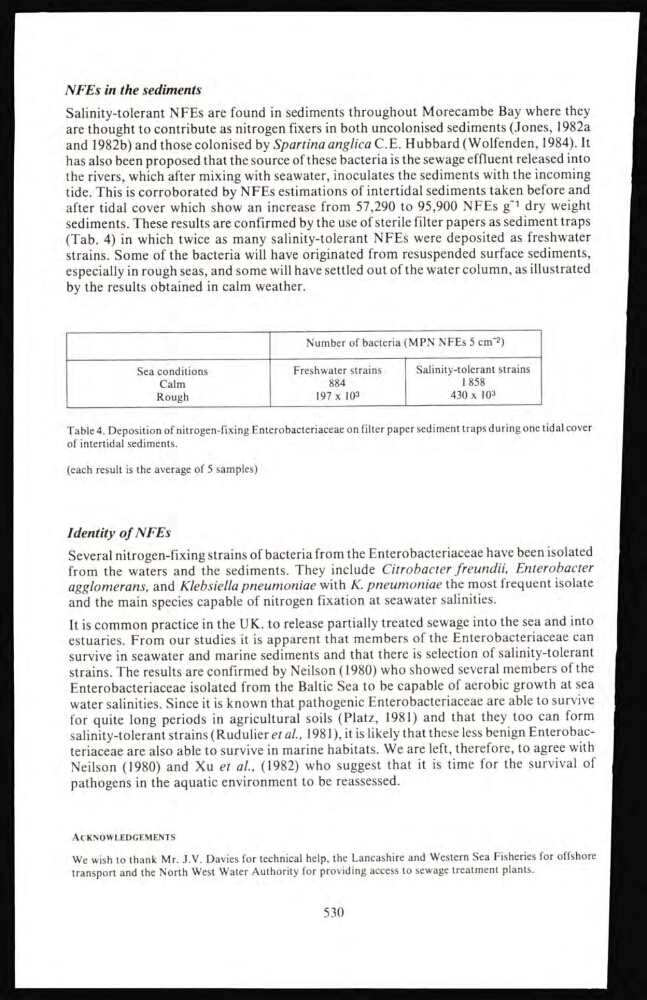
sediments. These results are confirmed by the use of sterile filter papers as sediment traps
(Tab. 4) in which twice as many salinity-tolerant NFEs were deposited as freshwater
strains. Some of the bacteria will have originated from resuspended surface sediments,
especially in rough seas, and some will have settled out of the water column, as illustrated
by the results obtained in calm weather.
Number of bacteria (MPN NFEs 5 cm" 2 )
Sea conditions
Freshwater strains
Salinity-tolerant strains
Calm
884
1 858
Rough
197 x 10 3
430 x 10 3
Table 4. Deposition of nitrogen-fixing Enterobacteriaceae on filter paper sediment traps during one tidal cover
of intertidal sediments.
(each result is the average of 5 samples)
Identity of NFEs
Several nitrogen-fixing strains of bacteria from the Enterobacteriaceae have been isolated
from the waters and the sediments. They include Citrobacter freundii, Enterobacter
agglomerans, and Klebsiella pneumoniae with K. pneumoniae the most frequent isolate
and the main species capable of nitrogen fixation at seawater salinities.
It is common practice in the UK. to release partially treated sewage into the sea and into
estuaries. From our studies it is apparent that members of the Enterobacteriaceae can
survive in seawater and marine sediments and that there is selection of salinity-tolerant
strains. The results are confirmed by Neilson (1980) who showed several members of the
Enterobacteriaceae isolated from the Baltic Sea to be capable of aerobic growth at sea
water salinities. Since it is known that pathogenic Enterobacteriaceae are able to survive
for quite long periods in agricultural soils (Platz, 1981) and that they too can form
salinity-tolerant strains (Rudulier et al., 1981), it is likely that these less benign Enterobacteriaceae are also able to survive in marine habitats. We are left, therefore, to agree with
Neilson (1980) and Xu et al., (1982) who suggest that it is time for the survival of
pathogens in the aquatic environment to be reassessed.
ACKNOWLEDGEMENTS
We wish to thank Mr. J.V. Davies for technical help, the Lancashire and Western Sea Fisheries for offshore
transport and the North West Water Authority for providing access to sewage treatment plants.
530
Salinity-tolerant NFEs are found in sediments throughout Morecambe Bay where they
are thought to contribute as nitrogen fixers in both uncolonised sediments (Jones, 1982a
and 1982b) and those colonised by Spartina anglica C.E. Hubbard (Wolfenden, 1984). It
has also been proposed that the source of these bacteria is the sewage effluent released into
the rivers, which after mixing with seawater, inoculates the sediments with the incoming
tide. This is corroborated by NFEs estimations of intertidal sediments taken before and
after tidal cover which show an increase from 57,290 to 95,900 NFEs g -1 dry weight
sediments. These results are confirmed by the use of sterile filter papers as sediment traps
(Tab. 4) in which twice as many salinity-tolerant NFEs were deposited as freshwater
strains. Some of the bacteria will have originated from resuspended surface sediments,
especially in rough seas, and some will have settled out of the water column, as illustrated
by the results obtained in calm weather.
Number of bacteria (MPN NFEs 5 cm" 2 )
Sea conditions
Freshwater strains
Salinity-tolerant strains
Calm
884
1 858
Rough
197 x 10 3
430 x 10 3
Table 4. Deposition of nitrogen-fixing Enterobacteriaceae on filter paper sediment traps during one tidal cover
of intertidal sediments.
(each result is the average of 5 samples)
Identity of NFEs
Several nitrogen-fixing strains of bacteria from the Enterobacteriaceae have been isolated
from the waters and the sediments. They include Citrobacter freundii, Enterobacter
agglomerans, and Klebsiella pneumoniae with K. pneumoniae the most frequent isolate
and the main species capable of nitrogen fixation at seawater salinities.
It is common practice in the UK. to release partially treated sewage into the sea and into
estuaries. From our studies it is apparent that members of the Enterobacteriaceae can
survive in seawater and marine sediments and that there is selection of salinity-tolerant
strains. The results are confirmed by Neilson (1980) who showed several members of the
Enterobacteriaceae isolated from the Baltic Sea to be capable of aerobic growth at sea
water salinities. Since it is known that pathogenic Enterobacteriaceae are able to survive
for quite long periods in agricultural soils (Platz, 1981) and that they too can form
salinity-tolerant strains (Rudulier et al., 1981), it is likely that these less benign Enterobacteriaceae are also able to survive in marine habitats. We are left, therefore, to agree with
Neilson (1980) and Xu et al., (1982) who suggest that it is time for the survival of
pathogens in the aquatic environment to be reassessed.
ACKNOWLEDGEMENTS
We wish to thank Mr. J.V. Davies for technical help, the Lancashire and Western Sea Fisheries for offshore
transport and the North West Water Authority for providing access to sewage treatment plants.
530