

NFES are also found in the North Sea off Felixstowe and the English Channel off
Brighton, with again, the salinity tolerant strains more common. It seems likely that such
bacteria are widespread in UK. rivers and coastal waters. In other studies, Herbert (1975)
found freshwater NFEs in Scottish marine sediments and Werner et al (1974) partially
salinity-tolerant strains in North American waters, however, one of us, K. Jones, made
repeated but unsuccessful efforts to isolate NFEs from Tampa Bay, Florida, USA. It may
be that the tertiary treatment of sewage by chlorination, which is common practice in the
USA, prevents their survival.
NFEs in the estuary
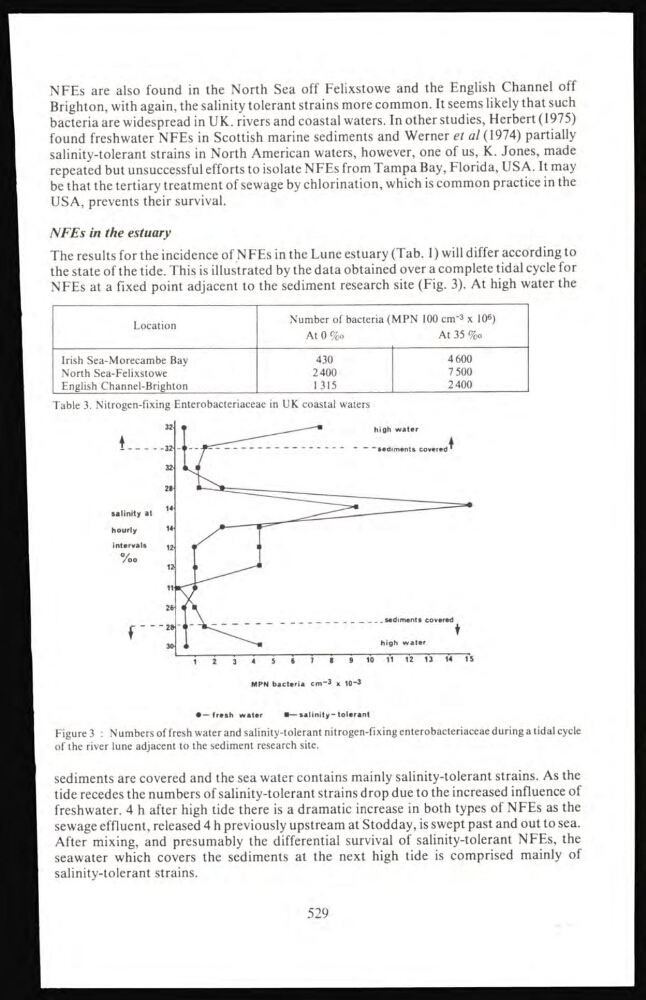
The results for the incidence of NFEs in the Lune estuary (Tab. 1) will differ according to
the state of the tide. This is illustrated by the data obtained over a complete tidal cycle for
NFEs at a fixed point adjacent to the sediment research site (Fig. 3). At high water the
Location
Number of bacteria (MPN 100 cm" 3 x 10 6 )
At 0 %o
At 35 ‰
Irish Sea-Morecambe Bay
430
4600
North Sea-Felixstowe
2400
7 500
English Channel-Brighton
1315
2 400
Table 3. Nitrogen-fixing Enterobacteriaceae in UK coastal waters
• —fresh water
■—salinity-tolerant
Figure 3 : Numbers of fresh water and salinity-tolerant nitrogen-fixing enterobacteriaceae during a tidal cycle
of the river lune adjacent to the sediment research site.
sediments are covered and the sea water contains mainly salinity-tolerant strains. As the
tide recedes the numbers of salinity-tolerant strains drop due to the increased influence of
freshwater. 4 h after high tide there is a dramatic increase in both types of NFEs as the
sewage effluent, released 4 h previously upstream at Stodday, is swept past and out to sea.
After mixing, and presumably the differential survival of salinity-tolerant NFEs, the
seawater which covers the sediments at the next high tide is comprised mainly of
salinity-tolerant strains.
529
Brighton, with again, the salinity tolerant strains more common. It seems likely that such
bacteria are widespread in UK. rivers and coastal waters. In other studies, Herbert (1975)
found freshwater NFEs in Scottish marine sediments and Werner et al (1974) partially
salinity-tolerant strains in North American waters, however, one of us, K. Jones, made
repeated but unsuccessful efforts to isolate NFEs from Tampa Bay, Florida, USA. It may
be that the tertiary treatment of sewage by chlorination, which is common practice in the
USA, prevents their survival.
NFEs in the estuary
The results for the incidence of NFEs in the Lune estuary (Tab. 1) will differ according to
the state of the tide. This is illustrated by the data obtained over a complete tidal cycle for
NFEs at a fixed point adjacent to the sediment research site (Fig. 3). At high water the
Location
Number of bacteria (MPN 100 cm" 3 x 10 6 )
At 0 %o
At 35 ‰
Irish Sea-Morecambe Bay
430
4600
North Sea-Felixstowe
2400
7 500
English Channel-Brighton
1315
2 400
Table 3. Nitrogen-fixing Enterobacteriaceae in UK coastal waters
• —fresh water
■—salinity-tolerant
Figure 3 : Numbers of fresh water and salinity-tolerant nitrogen-fixing enterobacteriaceae during a tidal cycle
of the river lune adjacent to the sediment research site.
sediments are covered and the sea water contains mainly salinity-tolerant strains. As the
tide recedes the numbers of salinity-tolerant strains drop due to the increased influence of
freshwater. 4 h after high tide there is a dramatic increase in both types of NFEs as the
sewage effluent, released 4 h previously upstream at Stodday, is swept past and out to sea.
After mixing, and presumably the differential survival of salinity-tolerant NFEs, the
seawater which covers the sediments at the next high tide is comprised mainly of
salinity-tolerant strains.
529