

digestive ferments (Zhukova, 1963) might have been responsible in controlling the size of
the bacterial population in the gut of these animals.
As reported in an earlier study (Ramesh et al., 1983b) no relationship was found between
luminous microbiota of the gastropods and the environmental factors (Tab. 1). In this
context it may be inferred that generally the bacteria harboured in the gut are insensitive
to changes in the environment due to the protective situation inside the gut (Liston, 1957).
Animals
Month
Gut
(CFU/Gm dry wt
of gut contents)
*TCFU
*LCFU
Water (CFU/ml)
*TCFU
*LCFU
Sediment
(CFU/ gm dry weight)
*TCFU
*LCFU
A. benedicti
June, 1982
1.05 x 10 5
5.40 x 10 4
102
24
3.40 x 10 4
7.60 x 10 3
July
7.26 x 10 4
2.51 x 10 4
155
18
3.60 x 10⁴
5.00 x 10 3
August
8.47 x 10 4
1.85 x 10 4
251
36
4.85 x 10 4
3.00 x 10 3
A. tranquebaria
June, 1982
4.34 x 10 5
1.54 x 10 4
296
74
7.55 x 10 4
3.57 x 10 3
July
5.24 x 10 4
3.07 x 10 4
208
39
4.48 x 10 4
8.20 x 10 3
August
2.58 x 10 4
8.59 x 10 4
236
28
2.6 x 10 4
3.60 x 10 3
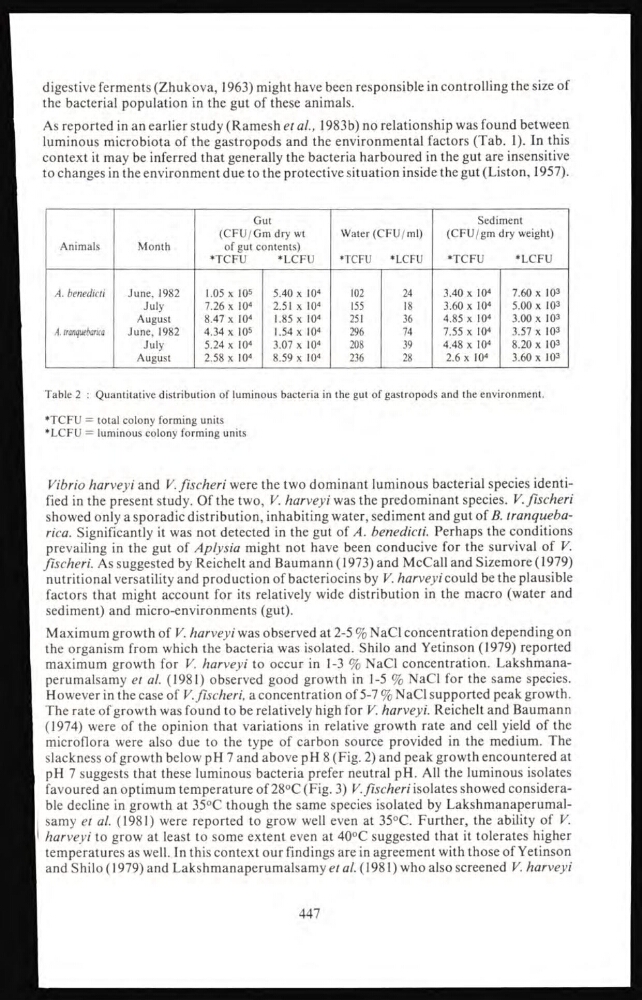
Table 2 : Quantitative distribution of luminous bacteria in the gut of gastropods and the environment.
*TCFU = total colony forming units
*LCFU = luminous colony forming units
Vibrio harveyi and V.fischeri were the two dominant luminous bacterial species identified in the present study. Of the two, V. harveyi was the predominant species. V. fischeri
showed only a sporadic distribution, inhabiting water, sediment and gut of B. tranquebarica. Significantly it was not detected in the gut of A. benedicti. Perhaps the conditions
prevailing in the gut of Aplysia might not have been conducive for the survival of V.
fischeri. As suggested by Reichelt and Baumann (1973) and McCall and Sizemore (1979)
nutritional versatility and production of bacteriocins by V. harveyi could be the plausible
factors that might account for its relatively wide distribution in the macro (water and
sediment) and micro-environments (gut).
Maximum growth of V. harveyi was observed at 2-5 % NaCl concentration depending on
the organism from which the bacteria was isolated. Shilo and Yetinson (1979) reported
maximum growth for V. harveyi to occur in 1-3 % NaCl concentration. Lakshmanaperumalsamy et al. (1981) observed good growth in 1-5 % NaCl for the same species.
However in the case of V. fischeri, a concentration of 5-7 % NaCl supported peak growth.
The rate of growth was found to be relatively high for V. harveyi. Reichelt and Baumann
(1974) were of the opinion that variations in relative growth rate and cell yield of the
microflora were also due to the type of carbon source provided in the medium. The
slackness of growth below pH 7 and above pH 8 (Fig. 2) and peak growth encountered at
pH 7 suggests that these luminous bacteria prefer neutral pH. All the luminous isolates
favoured an optimum temperature of 28°C (Fig. 3) V.fischeri isolates showed considerable decline in growth at 35°C though the same species isolated by Lakshmanaperumalsamy et al. (1981) were reported to grow well even at 35°C. Further, the ability of V.
harveyi to grow at least to some extent even at 40°C suggested that it tolerates higher
temperatures as well. In this context our findings are in agreement with those of Yetinson
and Shilo (1979) and Lakshmanaperumalsamy et al. (1981) who also screened V. harveyi
447
the bacterial population in the gut of these animals.
As reported in an earlier study (Ramesh et al., 1983b) no relationship was found between
luminous microbiota of the gastropods and the environmental factors (Tab. 1). In this
context it may be inferred that generally the bacteria harboured in the gut are insensitive
to changes in the environment due to the protective situation inside the gut (Liston, 1957).
Animals
Month
Gut
(CFU/Gm dry wt
of gut contents)
*TCFU
*LCFU
Water (CFU/ml)
*TCFU
*LCFU
Sediment
(CFU/ gm dry weight)
*TCFU
*LCFU
A. benedicti
June, 1982
1.05 x 10 5
5.40 x 10 4
102
24
3.40 x 10 4
7.60 x 10 3
July
7.26 x 10 4
2.51 x 10 4
155
18
3.60 x 10⁴
5.00 x 10 3
August
8.47 x 10 4
1.85 x 10 4
251
36
4.85 x 10 4
3.00 x 10 3
A. tranquebaria
June, 1982
4.34 x 10 5
1.54 x 10 4
296
74
7.55 x 10 4
3.57 x 10 3
July
5.24 x 10 4
3.07 x 10 4
208
39
4.48 x 10 4
8.20 x 10 3
August
2.58 x 10 4
8.59 x 10 4
236
28
2.6 x 10 4
3.60 x 10 3
Table 2 : Quantitative distribution of luminous bacteria in the gut of gastropods and the environment.
*TCFU = total colony forming units
*LCFU = luminous colony forming units
Vibrio harveyi and V.fischeri were the two dominant luminous bacterial species identified in the present study. Of the two, V. harveyi was the predominant species. V. fischeri
showed only a sporadic distribution, inhabiting water, sediment and gut of B. tranquebarica. Significantly it was not detected in the gut of A. benedicti. Perhaps the conditions
prevailing in the gut of Aplysia might not have been conducive for the survival of V.
fischeri. As suggested by Reichelt and Baumann (1973) and McCall and Sizemore (1979)
nutritional versatility and production of bacteriocins by V. harveyi could be the plausible
factors that might account for its relatively wide distribution in the macro (water and
sediment) and micro-environments (gut).
Maximum growth of V. harveyi was observed at 2-5 % NaCl concentration depending on
the organism from which the bacteria was isolated. Shilo and Yetinson (1979) reported
maximum growth for V. harveyi to occur in 1-3 % NaCl concentration. Lakshmanaperumalsamy et al. (1981) observed good growth in 1-5 % NaCl for the same species.
However in the case of V. fischeri, a concentration of 5-7 % NaCl supported peak growth.
The rate of growth was found to be relatively high for V. harveyi. Reichelt and Baumann
(1974) were of the opinion that variations in relative growth rate and cell yield of the
microflora were also due to the type of carbon source provided in the medium. The
slackness of growth below pH 7 and above pH 8 (Fig. 2) and peak growth encountered at
pH 7 suggests that these luminous bacteria prefer neutral pH. All the luminous isolates
favoured an optimum temperature of 28°C (Fig. 3) V.fischeri isolates showed considerable decline in growth at 35°C though the same species isolated by Lakshmanaperumalsamy et al. (1981) were reported to grow well even at 35°C. Further, the ability of V.
harveyi to grow at least to some extent even at 40°C suggested that it tolerates higher
temperatures as well. In this context our findings are in agreement with those of Yetinson
and Shilo (1979) and Lakshmanaperumalsamy et al. (1981) who also screened V. harveyi
447