

tion, cycling and production of particulate matter and relationship with other organisms
in marine environment is well known (Rheinheimer, 1980). However, reports on the
seasonal distribution of various microbial taxa (bacteria, actinomycetes and fungi) in the
marine and estuarine environments are limited (Grein and Meyers, 1958; Boeye el al,
1975; Walker and Colwell, 1975; Erkenbrecher and Stevenson, 1977). During recent
years, few studies have been conducted on the quantitative distribution of heterotrophic
bacteria in Indian estuarine sediments (Dhevendaran, 1977) and information on bacteria,
actinomycetes and fungi is totally lacking. This prompted us to attempt on the distribution of bacteria, actinomycetes, fungi and total microbial population (TMP i.e. bacteria,
actinomycetes and fungi) in the sediments of a tropical estuary like Vellar. This paper
reports the seasonal variation and the influence of physico-chemical parameters on the
number and distribution of the microbial taxa in the sediments of Vellar estuary, South
India.
MATERIALS AND METHODS
Sampling area
Vellar estuary (lat 11°29’N and long 79°47’E) is comparatively a shallow estuary within
an average depth of about 2 m. This estuary is demarcated and defined, in terms of
salinity characteristics, into four zones viz marine zone, gradient zone, tidal zone and
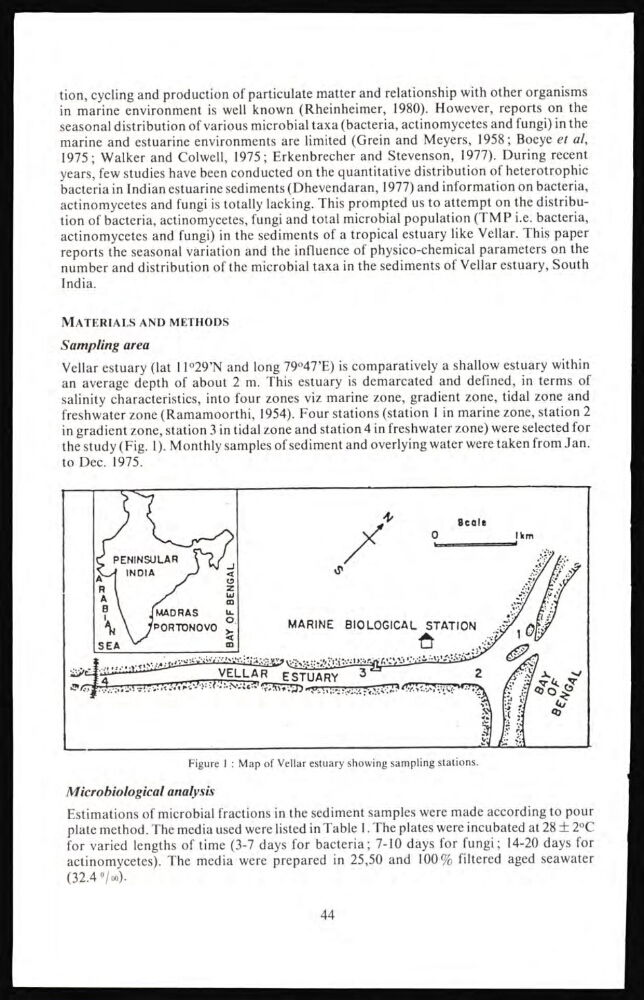
freshwater zone (Ramamoorthi, 1954). Four stations (station 1 in marine zone, station 2
in gradient zone, station 3 in tidal zone and station 4 in freshwater zone) were selected for
the study (Fig. 1). Monthly samples of sediment and overlying water were taken from Jan.
to Dec. 1975.
Figure 1 : Map of Vellar estuary showing sampling stations.
Microbiological analysis
Estimations of microbial fractions in the sediment samples were made according to pour
plate method. The media used were listed in Table 1. The plates were incubated at 28 ± 2°C
for varied lengths of time (3-7 days for bacteria; 7-10 days for fungi; 14-20 days for
actinomycetes). The media were prepared in 25,50 and 100% filtered aged seawater
(32.4 °/oo).
44
in marine environment is well known (Rheinheimer, 1980). However, reports on the
seasonal distribution of various microbial taxa (bacteria, actinomycetes and fungi) in the
marine and estuarine environments are limited (Grein and Meyers, 1958; Boeye el al,
1975; Walker and Colwell, 1975; Erkenbrecher and Stevenson, 1977). During recent
years, few studies have been conducted on the quantitative distribution of heterotrophic
bacteria in Indian estuarine sediments (Dhevendaran, 1977) and information on bacteria,
actinomycetes and fungi is totally lacking. This prompted us to attempt on the distribution of bacteria, actinomycetes, fungi and total microbial population (TMP i.e. bacteria,
actinomycetes and fungi) in the sediments of a tropical estuary like Vellar. This paper
reports the seasonal variation and the influence of physico-chemical parameters on the
number and distribution of the microbial taxa in the sediments of Vellar estuary, South
India.
MATERIALS AND METHODS
Sampling area
Vellar estuary (lat 11°29’N and long 79°47’E) is comparatively a shallow estuary within
an average depth of about 2 m. This estuary is demarcated and defined, in terms of
salinity characteristics, into four zones viz marine zone, gradient zone, tidal zone and
freshwater zone (Ramamoorthi, 1954). Four stations (station 1 in marine zone, station 2
in gradient zone, station 3 in tidal zone and station 4 in freshwater zone) were selected for
the study (Fig. 1). Monthly samples of sediment and overlying water were taken from Jan.
to Dec. 1975.
Figure 1 : Map of Vellar estuary showing sampling stations.
Microbiological analysis
Estimations of microbial fractions in the sediment samples were made according to pour
plate method. The media used were listed in Table 1. The plates were incubated at 28 ± 2°C
for varied lengths of time (3-7 days for bacteria; 7-10 days for fungi; 14-20 days for
actinomycetes). The media were prepared in 25,50 and 100% filtered aged seawater
(32.4 °/oo).
44