

approximately 9°C impinges on the kelp bed, there is a considerable reduction in
phytoplankton available for consumption by the filter-feeders (see Field et al, 1977,
1980a, b, 1981). Turnover of style enzymes can take place within 18 hours (Seiderer et al.
1982) and abrupt increases of lytic activity were observed within 24 hours of the onset of
up welling. These temporal variations in the activity of lysozyme-like enzymes in the style
therefore appear to be actively induced by changes in environmental conditions during
the upwelling cycle.
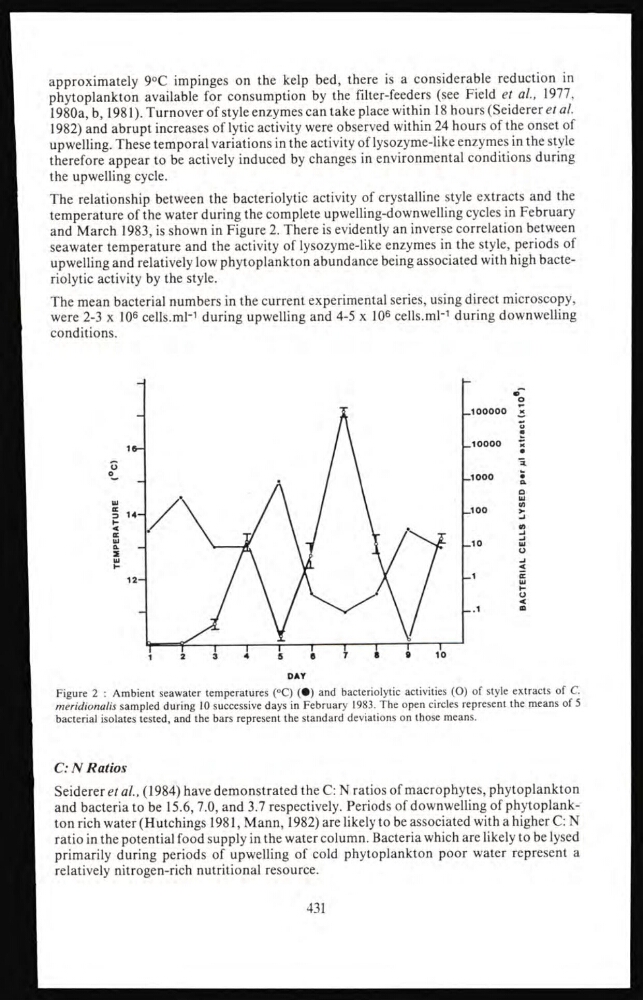
The relationship between the bacteriolytic activity of crystalline style extracts and the
temperature of the water during the complete upwelling-downwelling cycles in February
and March 1983, is shown in Figure 2. There is evidently an inverse correlation between
seawater temperature and the activity of lysozyme-like enzymes in the style, periods of
upwelling and relatively low phytoplankton abundance being associated with high bacteriolytic activity by the style.
The mean bacterial numbers in the current experimental series, using direct microscopy,
were 2-3 x 10
6 cells.ml -1 during upwelling and 4-5 x 10 6 cells.ml -1 during downwelling
conditions.
Figure 2 : Ambient seawater temperatures (°C) (•) and bacteriolytic activities (O) of style extracts of C.
meridionalis sampled during 10 successive days in February 1983. The open circles represent the means of 5
bacterial isolates tested, and the bars represent the standard deviations on those means.
C: N Ratios
Seiderer et al, (1984) have demonstrated the C: N ratios of macrophytes, phytoplankton
and bacteria to be 15.6, 7.0, and 3.7 respectively. Periods of downwelling of phytoplankton rich water (Hutchings 1981, Mann, 1982) are likely to be associated with a higher C: N
ratio in the potential food supply in the water column. Bacteria which are likely to be lysed
primarily during periods of upwelling of cold phytoplankton poor water represent a
relatively nitrogen-rich nutritional resource.
431
phytoplankton available for consumption by the filter-feeders (see Field et al, 1977,
1980a, b, 1981). Turnover of style enzymes can take place within 18 hours (Seiderer et al.
1982) and abrupt increases of lytic activity were observed within 24 hours of the onset of
up welling. These temporal variations in the activity of lysozyme-like enzymes in the style
therefore appear to be actively induced by changes in environmental conditions during
the upwelling cycle.
The relationship between the bacteriolytic activity of crystalline style extracts and the
temperature of the water during the complete upwelling-downwelling cycles in February
and March 1983, is shown in Figure 2. There is evidently an inverse correlation between
seawater temperature and the activity of lysozyme-like enzymes in the style, periods of
upwelling and relatively low phytoplankton abundance being associated with high bacteriolytic activity by the style.
The mean bacterial numbers in the current experimental series, using direct microscopy,
were 2-3 x 10
6 cells.ml -1 during upwelling and 4-5 x 10 6 cells.ml -1 during downwelling
conditions.
Figure 2 : Ambient seawater temperatures (°C) (•) and bacteriolytic activities (O) of style extracts of C.
meridionalis sampled during 10 successive days in February 1983. The open circles represent the means of 5
bacterial isolates tested, and the bars represent the standard deviations on those means.
C: N Ratios
Seiderer et al, (1984) have demonstrated the C: N ratios of macrophytes, phytoplankton
and bacteria to be 15.6, 7.0, and 3.7 respectively. Periods of downwelling of phytoplankton rich water (Hutchings 1981, Mann, 1982) are likely to be associated with a higher C: N
ratio in the potential food supply in the water column. Bacteria which are likely to be lysed
primarily during periods of upwelling of cold phytoplankton poor water represent a
relatively nitrogen-rich nutritional resource.
431