

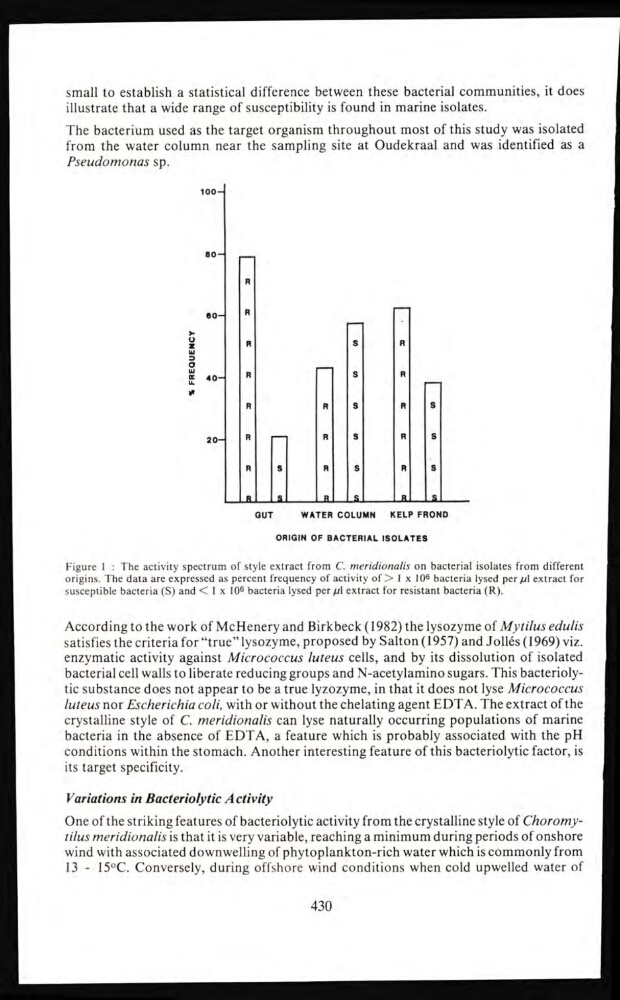
small to establish a statistical difference between these bacterial communities, it does
illustrate that a wide range of susceptibility is found in marine isolates.
The bacterium used as the target organism throughout most of this study was isolated
from the water column near the sampling site at Oudekraal and was identified as a
Pseudomonas sp.
ORIGIN OF BACTERIAL ISOLATES
Figure 1 : The activity spectrum of style extract from C. meridionals on bacterial isolates from different
origins. The data are expressed as percent frequency of activity of > 1 x 10 6 bacteria lysed per/d extract for
susceptible bacteria (S) and < 1 x 10 6 bacteria lysed per/id extract for resistant bacteria (R).
According to the work of McHenery and Birkbeck (1982) the lysozyme of Mytilus edulis
satisfies the criteria for “true” lysozyme, proposed by Salton (1957) and Jollés (1969) viz.
enzymatic activity against Micrococcus luteus cells, and by its dissolution of isolated
bacterial cell walls to liberate reducing groups and N-acetylamino sugars. This bacteriolytic substance does not appear to be a true lyzozyme, in that it does not lyse Micrococcus
luteus nor Escherichia coli, with or without the chelating agent EDTA. The extract of the
crystalline style of C. meridionalis can lyse naturally occurring populations of marine
bacteria in the absence of EDTA, a feature which is probably associated with the pH
conditions within the stomach. Another interesting feature of this bacteriolytic factor, is
its target specificity.
Variations in Bacteriolytic Activity
One of the striking features of bacteriolytic activity from the crystalline style of Choromytilus meridionalis is that it is very variable, reaching a minimum during periods of onshore
wind with associated downwelling of phytoplankton-rich water which is commonly from
13 - 15°C. Conversely, during offshore wind conditions when cold upwelled water of
430
illustrate that a wide range of susceptibility is found in marine isolates.
The bacterium used as the target organism throughout most of this study was isolated
from the water column near the sampling site at Oudekraal and was identified as a
Pseudomonas sp.
ORIGIN OF BACTERIAL ISOLATES
Figure 1 : The activity spectrum of style extract from C. meridionals on bacterial isolates from different
origins. The data are expressed as percent frequency of activity of > 1 x 10 6 bacteria lysed per/d extract for
susceptible bacteria (S) and < 1 x 10 6 bacteria lysed per/id extract for resistant bacteria (R).
According to the work of McHenery and Birkbeck (1982) the lysozyme of Mytilus edulis
satisfies the criteria for “true” lysozyme, proposed by Salton (1957) and Jollés (1969) viz.
enzymatic activity against Micrococcus luteus cells, and by its dissolution of isolated
bacterial cell walls to liberate reducing groups and N-acetylamino sugars. This bacteriolytic substance does not appear to be a true lyzozyme, in that it does not lyse Micrococcus
luteus nor Escherichia coli, with or without the chelating agent EDTA. The extract of the
crystalline style of C. meridionalis can lyse naturally occurring populations of marine
bacteria in the absence of EDTA, a feature which is probably associated with the pH
conditions within the stomach. Another interesting feature of this bacteriolytic factor, is
its target specificity.
Variations in Bacteriolytic Activity
One of the striking features of bacteriolytic activity from the crystalline style of Choromytilus meridionalis is that it is very variable, reaching a minimum during periods of onshore
wind with associated downwelling of phytoplankton-rich water which is commonly from
13 - 15°C. Conversely, during offshore wind conditions when cold upwelled water of
430