

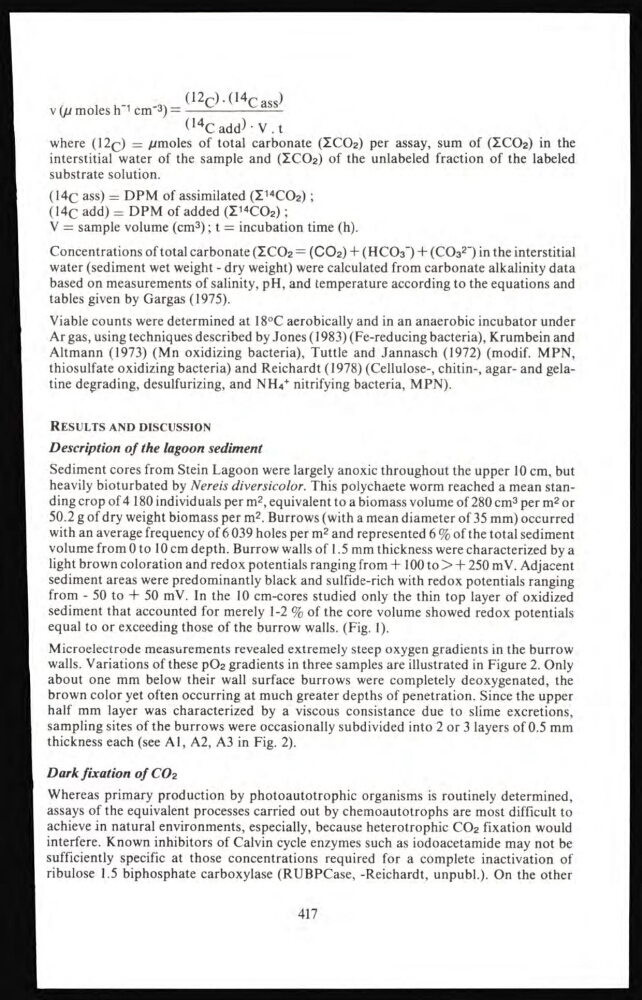
( 12 c)-( 14 Cass)
v (µ moles h 1 cm 3 ) =
( 14 C add) V . t
where (12C) = µmoles of total carbonate (∑CO2) per assay, sum of (∑CO2) in the
interstitial water of the sample and (∑CO2) of the unlabeled fraction of the labeled
substrate solution.
(14C ass) = DPM of assimilated (∑
14 CO2) ;
(14c add) = DPM of added (∑ 14 C O2 ) ;
V = sample volume (cm
3 ) ; t = incubation time (h).
Concentrations of total carbonate (∑CO2 = (CO2) + (HCO3-) + (CO3
2 ") in the interstitial
water (sediment wet weight - dry weight) were calculated from carbonate alkalinity data
based on measurements of salinity, pH, and temperature according to the equations and
tables given by Gargas (1975).
Viable counts were determined at 18°C aerobically and in an anaerobic incubator under
Ar gas, using techniques described by Jones (1983) (Fe-reducing bacteria), Krumbein and
Altmann (1973) (Mn oxidizing bacteria), Tuttle and Jannasch (1972) (modif. MPN,
thiosulfate oxidizing bacteria) and Reichardt (1978) (Cellulose-, chitin-, agar- and gelatine degrading, desulfurizing, and NH4
+ nitrifying bacteria, MPN).
RESULTS AND DISCUSSION
Description of the lagoon sediment
Sediment cores from Stein Lagoon were largely anoxic throughout the upper 10 cm, but
heavily bioturbated by Nereis diversicolor. This polychaete worm reached a mean standing crop of 4 180 individuals per m
2 , equivalent to a biomass volume of 280 cm
3 per m
2 or
50.2 g of dry weight biomass per m
2 . Burrows (with a mean diameter of 35 mm) occurred
with an average frequency of 6 039 holes per m
2 and represented 6 % of the total sediment
volume from 0 to 10 cm depth. Burrow walls of 1.5 mm thickness were characterized by a
light brown coloration and redox potentials ranging from + 100 to > + 250 mV. Adjacent
sediment areas were predominantly black and sulfide-rich with redox potentials ranging
from - 50 to + 50 mV. In the 10 cm-cores studied only the thin top layer of oxidized
sediment that accounted for merely 1-2 % of the core volume showed redox potentials
equal to or exceeding those of the burrow walls. (Fig. 1).
Microelectrode measurements revealed extremely steep oxygen gradients in the burrow
walls. Variations of these pO2 gradients in three samples are illustrated in Figure 2. Only
about one mm below their wall surface burrows were completely deoxygenated, the
brown color yet often occurring at much greater depths of penetration. Since the upper
half mm layer was characterized by a viscous consistance due to slime excretions,
sampling sites of the burrows were occasionally subdivided into 2 or 3 layers of 0.5 mm
thickness each (see A1, A2, A3 in Fig. 2).
Dark fixation of CO2
Whereas primary production by photoautotrophic organisms is routinely determined,
assays of the equivalent processes carried out by chemoautotrophs are most difficult to
achieve in natural environments, especially, because heterotrophic CO2 fixation would
interfere. Known inhibitors of Calvin cycle enzymes such as iodoacetamide may not be
sufficiently specific at those concentrations required for a complete inactivation of
ribulose 1.5 biphosphate carboxylase (RUBPCase, -Reichardt, unpubl.). On the other
417
v (µ moles h 1 cm 3 ) =
( 14 C add) V . t
where (12C) = µmoles of total carbonate (∑CO2) per assay, sum of (∑CO2) in the
interstitial water of the sample and (∑CO2) of the unlabeled fraction of the labeled
substrate solution.
(14C ass) = DPM of assimilated (∑
14 CO2) ;
(14c add) = DPM of added (∑ 14 C O2 ) ;
V = sample volume (cm
3 ) ; t = incubation time (h).
Concentrations of total carbonate (∑CO2 = (CO2) + (HCO3-) + (CO3
2 ") in the interstitial
water (sediment wet weight - dry weight) were calculated from carbonate alkalinity data
based on measurements of salinity, pH, and temperature according to the equations and
tables given by Gargas (1975).
Viable counts were determined at 18°C aerobically and in an anaerobic incubator under
Ar gas, using techniques described by Jones (1983) (Fe-reducing bacteria), Krumbein and
Altmann (1973) (Mn oxidizing bacteria), Tuttle and Jannasch (1972) (modif. MPN,
thiosulfate oxidizing bacteria) and Reichardt (1978) (Cellulose-, chitin-, agar- and gelatine degrading, desulfurizing, and NH4
+ nitrifying bacteria, MPN).
RESULTS AND DISCUSSION
Description of the lagoon sediment
Sediment cores from Stein Lagoon were largely anoxic throughout the upper 10 cm, but
heavily bioturbated by Nereis diversicolor. This polychaete worm reached a mean standing crop of 4 180 individuals per m
2 , equivalent to a biomass volume of 280 cm
3 per m
2 or
50.2 g of dry weight biomass per m
2 . Burrows (with a mean diameter of 35 mm) occurred
with an average frequency of 6 039 holes per m
2 and represented 6 % of the total sediment
volume from 0 to 10 cm depth. Burrow walls of 1.5 mm thickness were characterized by a
light brown coloration and redox potentials ranging from + 100 to > + 250 mV. Adjacent
sediment areas were predominantly black and sulfide-rich with redox potentials ranging
from - 50 to + 50 mV. In the 10 cm-cores studied only the thin top layer of oxidized
sediment that accounted for merely 1-2 % of the core volume showed redox potentials
equal to or exceeding those of the burrow walls. (Fig. 1).
Microelectrode measurements revealed extremely steep oxygen gradients in the burrow
walls. Variations of these pO2 gradients in three samples are illustrated in Figure 2. Only
about one mm below their wall surface burrows were completely deoxygenated, the
brown color yet often occurring at much greater depths of penetration. Since the upper
half mm layer was characterized by a viscous consistance due to slime excretions,
sampling sites of the burrows were occasionally subdivided into 2 or 3 layers of 0.5 mm
thickness each (see A1, A2, A3 in Fig. 2).
Dark fixation of CO2
Whereas primary production by photoautotrophic organisms is routinely determined,
assays of the equivalent processes carried out by chemoautotrophs are most difficult to
achieve in natural environments, especially, because heterotrophic CO2 fixation would
interfere. Known inhibitors of Calvin cycle enzymes such as iodoacetamide may not be
sufficiently specific at those concentrations required for a complete inactivation of
ribulose 1.5 biphosphate carboxylase (RUBPCase, -Reichardt, unpubl.). On the other
417