

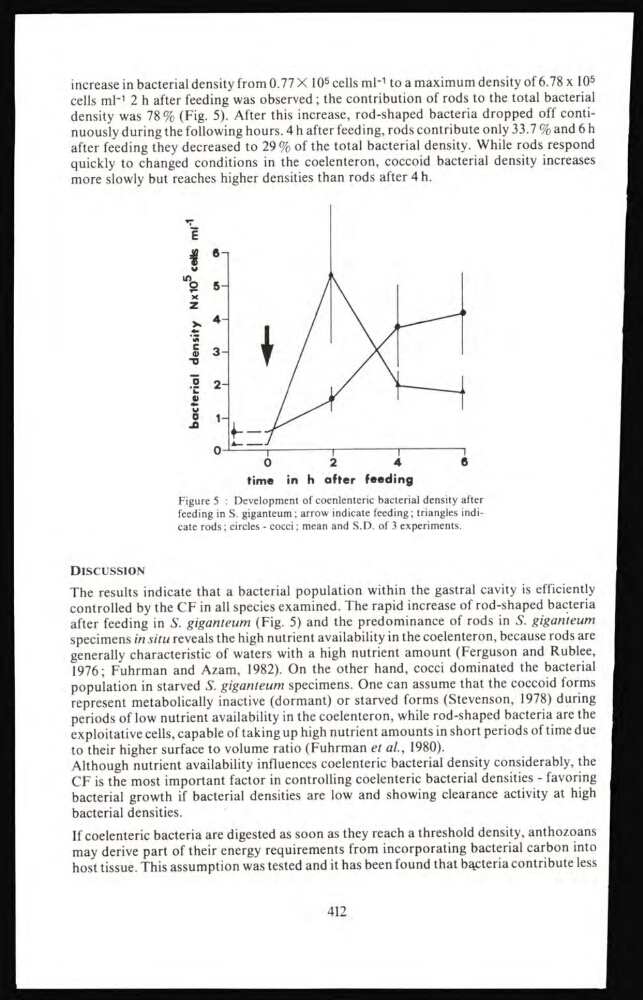
increase in bacterial density from 0.77 X 10 5 cells ml' 1 to a maximum density of 6.78 x 10⁵
cells ml -1 2 h after feeding was observed ; the contribution of rods to the total bacterial
density was 78% (Fig. 5). After this increase, rod-shaped bacteria dropped off continuously during the following hours. 4 h after feeding, rods contribute only 33.7 % and 6 h
after feeding they decreased to 29 % of the total bacterial density. While rods respond
quickly to changed conditions in the coelenteron, coccoid bacterial density increases
more slowly but reaches higher densities than rods after 4h.
Figure 5 : Development of coenlenteric bacterial density after
feeding in S. giganteum ; arrow indicate feeding ; triangles indicate rods ; circles - cocci ; mean and S.D. of 3 experiments.
DISCUSSION
The results indicate that a bacterial population within the gastral cavity is efficiently
controlled by the CF in all species examined. The rapid increase of rod-shaped bacteria
after feeding in S. giganteum (Fig. 5) and the predominance of rods in S. giganteum
specimens in situ reveals the high nutrient availability in the coelenteron, because rods are
generally characteristic of waters with a high nutrient amount (Ferguson and Rublee,
1976; Fuhrman and Azam, 1982). On the other hand, cocci dominated the bacterial
population in starved S. giganteum specimens. One can assume that the coccoid forms
represent metabolically inactive (dormant) or starved forms (Stevenson, 1978) during
periods of low nutrient availability in the coelenteron, while rod-shaped bacteria are the
exploitative cells, capable of taking up high nutrient amounts in short periods of time due
to their higher surface to volume ratio (Fuhrman et al., 1980).
Although nutrient availability influences coelenteric bacterial density considerably, the
CF is the most important factor in controlling coelenteric bacterial densities - favoring
bacterial growth if bacterial densities are low and showing clearance activity at high
bacterial densities.
If coelenteric bacteria are digested as soon as they reach a threshold density, anthozoans
may derive part of their energy requirements from incorporating bacterial carbon into
host tissue. This assumption was tested and it has been found that bacteria contribute less
412
cells ml -1 2 h after feeding was observed ; the contribution of rods to the total bacterial
density was 78% (Fig. 5). After this increase, rod-shaped bacteria dropped off continuously during the following hours. 4 h after feeding, rods contribute only 33.7 % and 6 h
after feeding they decreased to 29 % of the total bacterial density. While rods respond
quickly to changed conditions in the coelenteron, coccoid bacterial density increases
more slowly but reaches higher densities than rods after 4h.
Figure 5 : Development of coenlenteric bacterial density after
feeding in S. giganteum ; arrow indicate feeding ; triangles indicate rods ; circles - cocci ; mean and S.D. of 3 experiments.
DISCUSSION
The results indicate that a bacterial population within the gastral cavity is efficiently
controlled by the CF in all species examined. The rapid increase of rod-shaped bacteria
after feeding in S. giganteum (Fig. 5) and the predominance of rods in S. giganteum
specimens in situ reveals the high nutrient availability in the coelenteron, because rods are
generally characteristic of waters with a high nutrient amount (Ferguson and Rublee,
1976; Fuhrman and Azam, 1982). On the other hand, cocci dominated the bacterial
population in starved S. giganteum specimens. One can assume that the coccoid forms
represent metabolically inactive (dormant) or starved forms (Stevenson, 1978) during
periods of low nutrient availability in the coelenteron, while rod-shaped bacteria are the
exploitative cells, capable of taking up high nutrient amounts in short periods of time due
to their higher surface to volume ratio (Fuhrman et al., 1980).
Although nutrient availability influences coelenteric bacterial density considerably, the
CF is the most important factor in controlling coelenteric bacterial densities - favoring
bacterial growth if bacterial densities are low and showing clearance activity at high
bacterial densities.
If coelenteric bacteria are digested as soon as they reach a threshold density, anthozoans
may derive part of their energy requirements from incorporating bacterial carbon into
host tissue. This assumption was tested and it has been found that bacteria contribute less
412