

gations. Highest clearance rates of up to 1.6 x 10
6 cells ml -1 h
-1 were obtained at an initial
coccoid bacterial density in the coelenteron of 6.5 X 10
6 cells ml -1 . While for coccoid
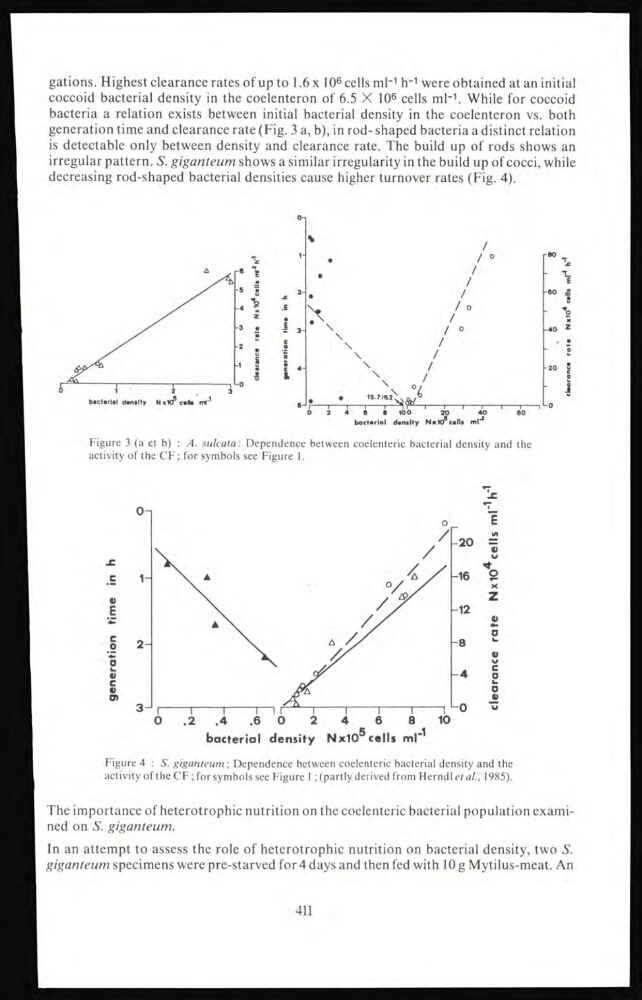
bacteria a relation exists between initial bacterial density in the coelenteron vs. both
generation time and clearance rate (Fig. 3 a, b), in rod- shaped bacteria a distinct relation
is detectable only between density and clearance rate. The build up of rods shows an
irregular pattern. S. giganteum shows a similar irregularity in the build up of cocci, while
decreasing rod-shaped bacterial densities cause higher turnover rates (Fig. 4).
Figure 3 (a et b) : A. sulcata : Dependence between coelenteric bacterial density and the
activity of the CF; for symbols see Figure 1.
Figure 4 : S. giganteum ; Dependence between coelenteric bacterial density and the
activity of the CF ; for symbols see Figure 1 ; (partly derived from Herndl et al., 1985).
The importance of heterotrophic nutrition on the coelenteric bacterial population examined on S. giganteum.
In an attempt to assess the role of heterotrophic nutrition on bacterial density, two S.
giganteum specimens were pre-starved for 4 days and then fed with 10 g Mytilus-meat. An
411
6 cells ml -1 h
-1 were obtained at an initial
coccoid bacterial density in the coelenteron of 6.5 X 10
6 cells ml -1 . While for coccoid
bacteria a relation exists between initial bacterial density in the coelenteron vs. both
generation time and clearance rate (Fig. 3 a, b), in rod- shaped bacteria a distinct relation
is detectable only between density and clearance rate. The build up of rods shows an
irregular pattern. S. giganteum shows a similar irregularity in the build up of cocci, while
decreasing rod-shaped bacterial densities cause higher turnover rates (Fig. 4).
Figure 3 (a et b) : A. sulcata : Dependence between coelenteric bacterial density and the
activity of the CF; for symbols see Figure 1.
Figure 4 : S. giganteum ; Dependence between coelenteric bacterial density and the
activity of the CF ; for symbols see Figure 1 ; (partly derived from Herndl et al., 1985).
The importance of heterotrophic nutrition on the coelenteric bacterial population examined on S. giganteum.
In an attempt to assess the role of heterotrophic nutrition on bacterial density, two S.
giganteum specimens were pre-starved for 4 days and then fed with 10 g Mytilus-meat. An
411