

Louis, MO), 1 and 2 µg Mitomycin Cj ml (Calbiochem, La Jolla, CA), 10, 20 and 30 µg
novobiocin/ml (Sigma), 1 % SDS (Sigma), and temperature treatments of 40°C and 41°C
for 48 h. Filter sterilized curing-agents were added separately to YP broth. Cultures held
overnight at 26°C were used to inoculate the curing agent-containing tubes. Ca. 0.1 ml of
inoculum was used. To establish stressed growth conditions in these experiments, inocula
were subcultured in curing agents thrice (serially), after each incubation period of 18 h at
39°C. After the final treatment, each of the cultures was plated on YP- medium, which
served as the master template plate. Colonies were transferred to selective M-medium and
scored for manganese oxide, using the OTR spot test and additionally tested for the loss
of plasmid DNA by electrophoresis. Temperature treatments, which did not include
curing agents, were carried out as described above.
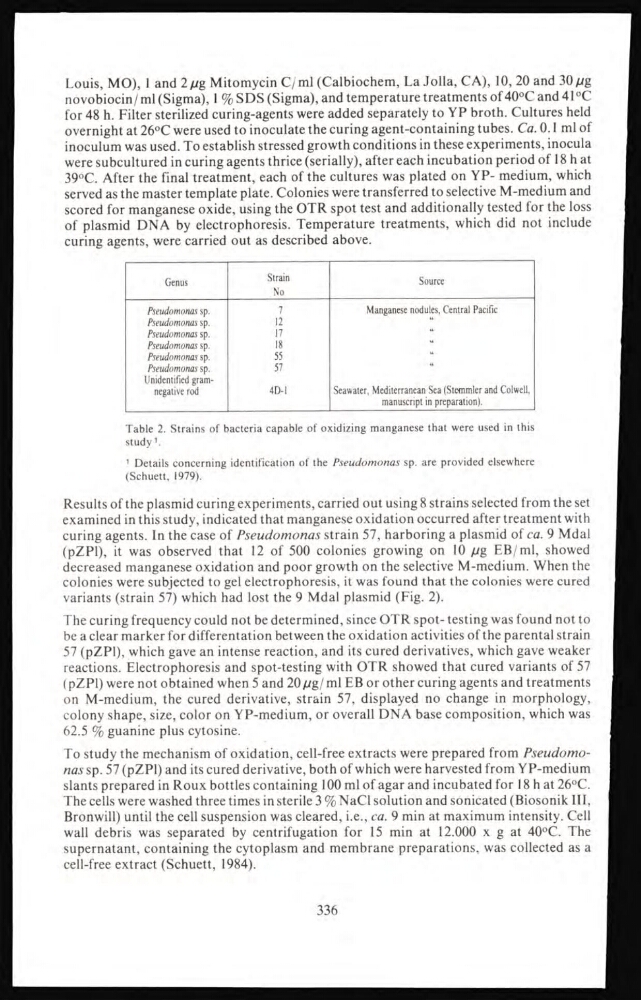
Genus
Strain
No
Source
Pseudomonas sp.
7
Manganese nodules, Central Pacific
Pseudomonas sp.
12
“
Pseudomonas sp.
17
“
Pseudomonas sp.
18
“
Pseudomonas sp.
55
“
Pseudomonas sp.
Unidentified gram57
negative rod
4D-I
Seawater, Mediterranean Sea (Stemmier and Colwell,
manuscript in preparation).
Table 2. Strains of bacteria capable of oxidizing manganese that were used in this
study 1 .
1 Details concerning identification of the Pseudomonas sp. are provided elsewhere
(Schuett, 1979).
Results of the plasmid curing experiments, carried out using 8 strains selected from the set
examined in this study, indicated that manganese oxidation occurred after treatment with
curing agents. In the case of Pseudomonas strain 57, harboring a plasmid of ca. 9 Mdal
(pZPl), it was observed that 12 of 500 colonies growing on 10 µg EB/ml, showed
decreased manganese oxidation and poor growth on the selective M-medium. When the
colonies were subjected to gel electrophoresis, it was found that the colonies were cured
variants (strain 57) which had lost the 9 Mdal plasmid (Fig. 2).
The curing frequency could not be determined, since OTR spot- testing was found not to
be a clear marker for differentation between the oxidation activities of the parental strain
57 (pZPl), which gave an intense reaction, and its cured derivatives, which gave weaker
reactions. Electrophoresis and spot-testing with OTR showed that cured variants of 57
(pZPl) were not obtained when 5 and 20 µg/ ml EB or other curing agents and treatments
on M-medium, the cured derivative, strain 57, displayed no change in morphology,
colony shape, size, color on YP-medium, or overall DNA base composition, which was
62.5 % guanine plus cytosine.
To study the mechanism of oxidation, cell-free extracts were prepared from Pseudomonas sp. 57 (pZPl) and its cured derivative, both of which were harvested from YP-medium
slants prepared in Roux bottles containing 100 ml of agar and incubated for 18 h at 26°C.
The cells were washed three times in sterile 3 % NaCl solution and sonicated (Biosonik III,
Bronwill) until the cell suspension was cleared, i.e., ca. 9 min at maximum intensity. Cell
wall debris was separated by centrifugation for 15 min at 12.000 x g at 40°C. The
supernatant, containing the cytoplasm and membrane preparations, was collected as a
cell-free extract (Schuett, 1984).
336
novobiocin/ml (Sigma), 1 % SDS (Sigma), and temperature treatments of 40°C and 41°C
for 48 h. Filter sterilized curing-agents were added separately to YP broth. Cultures held
overnight at 26°C were used to inoculate the curing agent-containing tubes. Ca. 0.1 ml of
inoculum was used. To establish stressed growth conditions in these experiments, inocula
were subcultured in curing agents thrice (serially), after each incubation period of 18 h at
39°C. After the final treatment, each of the cultures was plated on YP- medium, which
served as the master template plate. Colonies were transferred to selective M-medium and
scored for manganese oxide, using the OTR spot test and additionally tested for the loss
of plasmid DNA by electrophoresis. Temperature treatments, which did not include
curing agents, were carried out as described above.
Genus
Strain
No
Source
Pseudomonas sp.
7
Manganese nodules, Central Pacific
Pseudomonas sp.
12
“
Pseudomonas sp.
17
“
Pseudomonas sp.
18
“
Pseudomonas sp.
55
“
Pseudomonas sp.
Unidentified gram57
negative rod
4D-I
Seawater, Mediterranean Sea (Stemmier and Colwell,
manuscript in preparation).
Table 2. Strains of bacteria capable of oxidizing manganese that were used in this
study 1 .
1 Details concerning identification of the Pseudomonas sp. are provided elsewhere
(Schuett, 1979).
Results of the plasmid curing experiments, carried out using 8 strains selected from the set
examined in this study, indicated that manganese oxidation occurred after treatment with
curing agents. In the case of Pseudomonas strain 57, harboring a plasmid of ca. 9 Mdal
(pZPl), it was observed that 12 of 500 colonies growing on 10 µg EB/ml, showed
decreased manganese oxidation and poor growth on the selective M-medium. When the
colonies were subjected to gel electrophoresis, it was found that the colonies were cured
variants (strain 57) which had lost the 9 Mdal plasmid (Fig. 2).
The curing frequency could not be determined, since OTR spot- testing was found not to
be a clear marker for differentation between the oxidation activities of the parental strain
57 (pZPl), which gave an intense reaction, and its cured derivatives, which gave weaker
reactions. Electrophoresis and spot-testing with OTR showed that cured variants of 57
(pZPl) were not obtained when 5 and 20 µg/ ml EB or other curing agents and treatments
on M-medium, the cured derivative, strain 57, displayed no change in morphology,
colony shape, size, color on YP-medium, or overall DNA base composition, which was
62.5 % guanine plus cytosine.
To study the mechanism of oxidation, cell-free extracts were prepared from Pseudomonas sp. 57 (pZPl) and its cured derivative, both of which were harvested from YP-medium
slants prepared in Roux bottles containing 100 ml of agar and incubated for 18 h at 26°C.
The cells were washed three times in sterile 3 % NaCl solution and sonicated (Biosonik III,
Bronwill) until the cell suspension was cleared, i.e., ca. 9 min at maximum intensity. Cell
wall debris was separated by centrifugation for 15 min at 12.000 x g at 40°C. The
supernatant, containing the cytoplasm and membrane preparations, was collected as a
cell-free extract (Schuett, 1984).
336