

3.5 h and 125 V (-53 mA) in a watercooled flat bed electrophoresis apparatus (Savant
Inc., Hicksville, NY, model No. HGE 1312). Gels were stained with ethidium bromide (1
µg/ml) for 30 mn, destained overnight in distilled water, and photographed using a
transilluminator (Fotodyne model 3-4400) fitted with type 665 film and MP-4 Camera
(from Polaroid Corp.). The film was exposed using Wratten No. 23 A and 2 B gelatin
filters (Eastman Kodak Co., Rochester, NY). In all plasmid DNA experiments, Escherichia coli strain V 517, which harbors 8 plasmids of different sizes (Macrina et ai, 1978),
was used as a control and molecular weight standard. Size estimates of the plasmids were
generated by linear regression analysis.
Results of the plasmid screening indicated that 22 of 47 Mn-oxidizing bacterial strains
were found to contain a single plasmid. Nineteen of the 26 Pseudomonas spp. isolated
from the Central Pacific Ocean possessed a plasmid of ca. 66 Mdal and two strains, 55 and
57, demonstrated a single plasmid of 8 and 9 Mdal, respectively. Strains harboring
plasmids of 66 Mdal had been shown in an earlier study to have very similar biochemical
properties (Schuett, 1979). A faint plasmid band was detected in each of the gels prepared
for the five Vibrio spp. Interestingly, the Alcaligenes strains did not reveal detectable
plasmids. Two of the seven unidentified Mn-oxidizing strains isolated from seawater
samples collected in the Mediterranean contained single plasmids of ca. 50 and 3 Mdal.
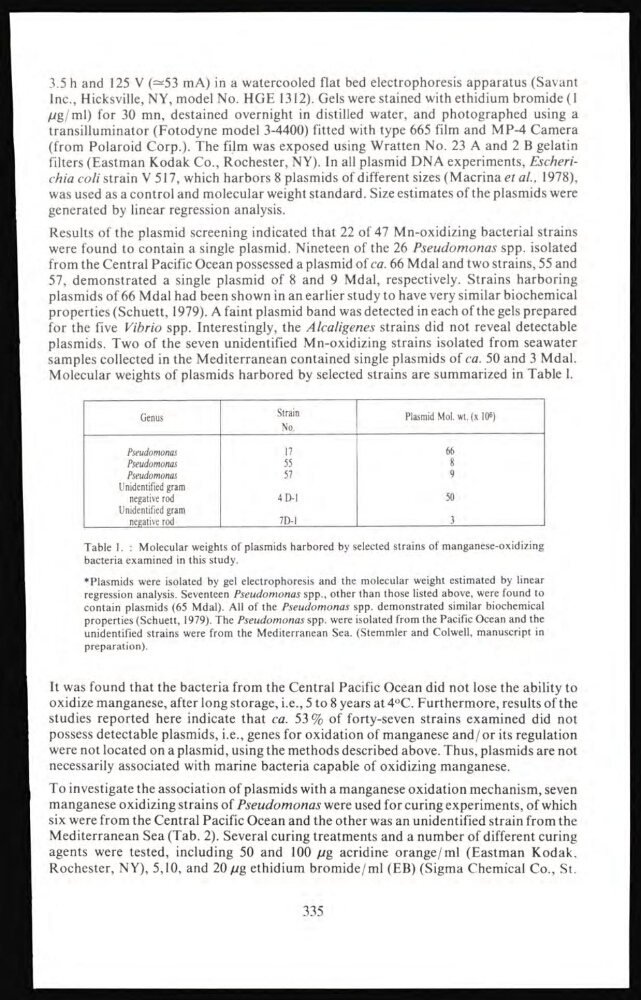
Molecular weights of plasmids harbored by selected strains are summarized in Table 1.
Genus
Strain
No.
Plasmid Mol. wt. (x 10 6 )
Pseudomonas
17
66
Pseudomonas
55
8
Pseudomonas
57
9
Unidentified gram
negative rod
4 D-1
50
Unidentified gram
3
negative rod
7D-I
Table 1. : Molecular weights of plasmids harbored by selected strains of manganese-oxidizing
bacteria examined in this study.
‘Plasmids were isolated by gel electrophoresis and the molecular weight estimated by linear
regression analysis. Seventeen Pseudomonas spp., other than those listed above, were found to
contain plasmids (65 Mdal). All of the Pseudomonas spp. demonstrated similar biochemical
properties (Schuett, 1979). The Pseudomonas spp. were isolated from the Pacific Ocean and the
unidentified strains were from the Mediterranean Sea. (Stemmier and Colwell, manuscript in
preparation).
It was found that the bacteria from the Central Pacific Ocean did not lose the ability to
oxidize manganese, after long storage, i.e., 5 to 8 years at 4°C. Furthermore, results of the
studies reported here indicate that ca. 53% of forty-seven strains examined did not
possess detectable plasmids, i.e., genes for oxidation of manganese and/or its regulation
were not located on a plasmid, using the methods described above. Thus, plasmids are not
necessarily associated with marine bacteria capable of oxidizing manganese.
To investigate the association of plasmids with a manganese oxidation mechanism, seven
manganese oxidizing strains of Pseudomonas were used for curing experiments, of which
six were from the Central Pacific Ocean and the other was an unidentified strain from the
Mediterranean Sea (Tab. 2). Several curing treatments and a number of different curing
agents were tested, including 50 and 100 µg acridine orange/ml (Eastman Kodak,
Rochester, NY), 5,10, and 20 µg ethidium bromide/ml (EB) (Sigma Chemical Co., St.
335
Inc., Hicksville, NY, model No. HGE 1312). Gels were stained with ethidium bromide (1
µg/ml) for 30 mn, destained overnight in distilled water, and photographed using a
transilluminator (Fotodyne model 3-4400) fitted with type 665 film and MP-4 Camera
(from Polaroid Corp.). The film was exposed using Wratten No. 23 A and 2 B gelatin
filters (Eastman Kodak Co., Rochester, NY). In all plasmid DNA experiments, Escherichia coli strain V 517, which harbors 8 plasmids of different sizes (Macrina et ai, 1978),
was used as a control and molecular weight standard. Size estimates of the plasmids were
generated by linear regression analysis.
Results of the plasmid screening indicated that 22 of 47 Mn-oxidizing bacterial strains
were found to contain a single plasmid. Nineteen of the 26 Pseudomonas spp. isolated
from the Central Pacific Ocean possessed a plasmid of ca. 66 Mdal and two strains, 55 and
57, demonstrated a single plasmid of 8 and 9 Mdal, respectively. Strains harboring
plasmids of 66 Mdal had been shown in an earlier study to have very similar biochemical
properties (Schuett, 1979). A faint plasmid band was detected in each of the gels prepared
for the five Vibrio spp. Interestingly, the Alcaligenes strains did not reveal detectable
plasmids. Two of the seven unidentified Mn-oxidizing strains isolated from seawater
samples collected in the Mediterranean contained single plasmids of ca. 50 and 3 Mdal.
Molecular weights of plasmids harbored by selected strains are summarized in Table 1.
Genus
Strain
No.
Plasmid Mol. wt. (x 10 6 )
Pseudomonas
17
66
Pseudomonas
55
8
Pseudomonas
57
9
Unidentified gram
negative rod
4 D-1
50
Unidentified gram
3
negative rod
7D-I
Table 1. : Molecular weights of plasmids harbored by selected strains of manganese-oxidizing
bacteria examined in this study.
‘Plasmids were isolated by gel electrophoresis and the molecular weight estimated by linear
regression analysis. Seventeen Pseudomonas spp., other than those listed above, were found to
contain plasmids (65 Mdal). All of the Pseudomonas spp. demonstrated similar biochemical
properties (Schuett, 1979). The Pseudomonas spp. were isolated from the Pacific Ocean and the
unidentified strains were from the Mediterranean Sea. (Stemmier and Colwell, manuscript in
preparation).
It was found that the bacteria from the Central Pacific Ocean did not lose the ability to
oxidize manganese, after long storage, i.e., 5 to 8 years at 4°C. Furthermore, results of the
studies reported here indicate that ca. 53% of forty-seven strains examined did not
possess detectable plasmids, i.e., genes for oxidation of manganese and/or its regulation
were not located on a plasmid, using the methods described above. Thus, plasmids are not
necessarily associated with marine bacteria capable of oxidizing manganese.
To investigate the association of plasmids with a manganese oxidation mechanism, seven
manganese oxidizing strains of Pseudomonas were used for curing experiments, of which
six were from the Central Pacific Ocean and the other was an unidentified strain from the
Mediterranean Sea (Tab. 2). Several curing treatments and a number of different curing
agents were tested, including 50 and 100 µg acridine orange/ml (Eastman Kodak,
Rochester, NY), 5,10, and 20 µg ethidium bromide/ml (EB) (Sigma Chemical Co., St.
335