

concentrations of these gases are well documented not only in the marine environment,
but also in soil and the atmosphere. The average concentration of CH
4
in the marine
environment is 49.5 n1/1 (Swinnerton and Lamontagne, 1974). On the other hand,
carbon monoxide is also in n 1 /1 quantities and it is formed in the aquatic environment by
photochemical action on organic matter (Wilson, Swinnerton, and Lamontagne, 1980).
Approximately 10 to 20 trillion g of CO/ year is added to the atmosphere with the ocean as
the main biogenic source of this gas (Seiler, 1978) ; whereas 122 to 237 trillion g of
CH 4 /year are biogenically produced (Seiler, 1984). The aquatic environment is a source
of these gases to the atmosphere whereas the soil in a sink (Conrad, 1984). The quantities
of both these gases should be sufficient for maintenance energy, especially when one
considers the residence time of water masses.
Methane oxidizers were found to be capable of oxidizing ammonia (Hutton and ZoBell,
1949; O’Neill and Wilkinson, 1977; and Hyman and Wood, 1983) as well oxidizing
carbon monoxide (Ferenci, 1974, Hubley, Mitton, and Wilkson, 1974 ; and Hutton and
ZoBell, 1949), but Suzuki, Kwok, and Dular (1976) and Drozd (1946) could not demonstrate the oxidation of methane or carbon monoxyde by the nitrifying bacteria employing
the oxygen uptake (manometric method). Yet there is a similary in NH
4
and CH
4
structure and both start with a cytochrome based mono-oxygenase which requires an
unknown reducing equivalent and molecular oxygen. Both the oxidation of CH
4
and
NH 4 start with the hydroxylation of the substrates (Ferenci, Strom, and Quayle, 1975 ;
Swinnerton and Lamontagne, 1974 ; and Wilkinson, 1975).
Because of the dearth of NH
4
in most marine environments, the presence of the above
mentioned gases in the marine environment, the similarity of structure between NH
4
and
CH 4 , and the mono-oxygenase required for metabolism of NH
4
and CH
4
, we decided to
investigate the possibility of the oxidation of methane by the nitrifiers employing radioactive
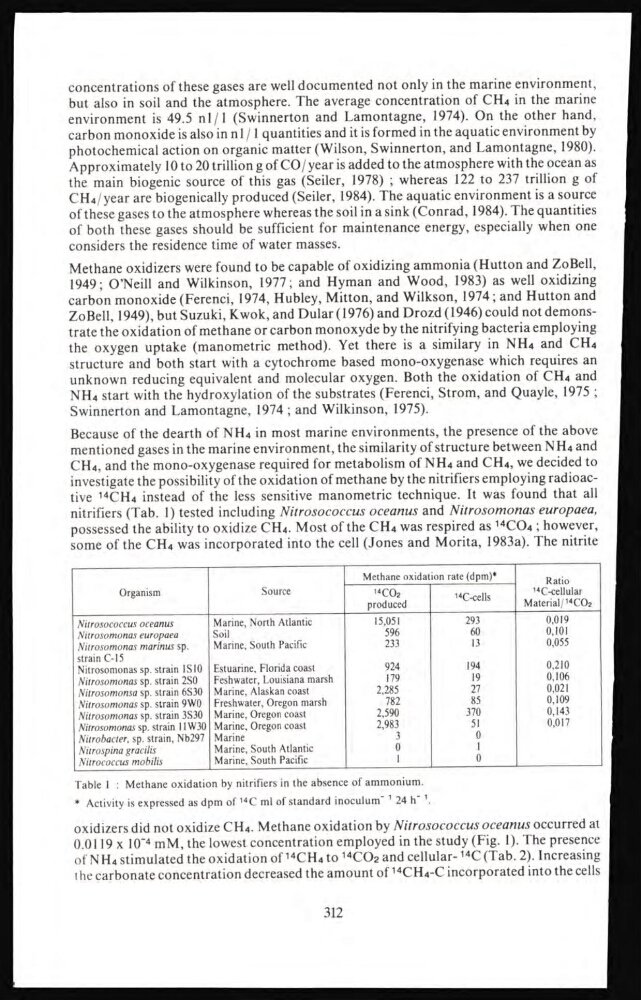
14 CH 4 instead of the less sensitive manometric technique. It was found that all
nitrifiers (Tab. 1) tested including Nitrosococcus oceanus and Nitrosomonas europaea,
possessed the ability to oxidize CH
4
. Most of the CH
4
was respired as 14CO
4
; however,
some of the CH 4 was incorporated into the cell (Jones and Morita, 1983a). The nitrite
Methane oxidation rate (dpm)*
Ratio
Organism
Source
14 CO 2
produced
14 C-cells
14 C-cellular
Material/ 14 CO 2
Nitrosococcus oceanus
Marine, North Atlantic
15,051
293
0,019
Nitrosomonas europaea
Soil
596
60
0,101
Nitrosomonas marinus sp.
Marine, South Pacific
233
13
0,055
strain C-15
Nitrosomonas sp. strain 1S10 Estuarine, Florida coast
924
194
0,210
Nitrosomonas sp. strain 2S0
Feshwater, Louisiana marsh
179
19
0,106
Nitrosomonsa sp. strain 6S30 Marine, Alaskan coast
2,285
27
0,021
Nitrosomonas sp. strain 9W0 Freshwater, Oregon marsh
782
85
0,109
Nitrosomonas sp. strain 3S30 Marine, Oregon coast
2,590
370
0,143
Nitrosomonas sp. strain 11W30 Marine, Oregon coast
2,983
51
0,017
Nitrobacter, sp. strain, Nb297 Marine
3
0
Nitrospina gracilis
Marine, South Atlantic
0
1
0
Nitrococcus mobilis
Marine, South Pacific
1
Table 1 : Methane oxidation by nitrifiers in the absence of ammonium.
* Activity is expressed as dpm of 14 C ml of standard inoculum 1 24 h 1
oxidizers did not oxidize CH
4
. Methane oxidation by Nitrosococcus oceanus occurred at
0.0119 x 10 -4 mM, the lowest concentration employed in the study (Fig. 1). The presence
of NH 4 stimulated the oxidation of 14 CH
4
to 14 CO
2
and cellular- 14 C (Tab. 2). Increasing
the carbonate concentration decreased the amount of 14CH
4
-C incorporated into the cells
312
but also in soil and the atmosphere. The average concentration of CH
4
in the marine
environment is 49.5 n1/1 (Swinnerton and Lamontagne, 1974). On the other hand,
carbon monoxide is also in n 1 /1 quantities and it is formed in the aquatic environment by
photochemical action on organic matter (Wilson, Swinnerton, and Lamontagne, 1980).
Approximately 10 to 20 trillion g of CO/ year is added to the atmosphere with the ocean as
the main biogenic source of this gas (Seiler, 1978) ; whereas 122 to 237 trillion g of
CH 4 /year are biogenically produced (Seiler, 1984). The aquatic environment is a source
of these gases to the atmosphere whereas the soil in a sink (Conrad, 1984). The quantities
of both these gases should be sufficient for maintenance energy, especially when one
considers the residence time of water masses.
Methane oxidizers were found to be capable of oxidizing ammonia (Hutton and ZoBell,
1949; O’Neill and Wilkinson, 1977; and Hyman and Wood, 1983) as well oxidizing
carbon monoxide (Ferenci, 1974, Hubley, Mitton, and Wilkson, 1974 ; and Hutton and
ZoBell, 1949), but Suzuki, Kwok, and Dular (1976) and Drozd (1946) could not demonstrate the oxidation of methane or carbon monoxyde by the nitrifying bacteria employing
the oxygen uptake (manometric method). Yet there is a similary in NH
4
and CH
4
structure and both start with a cytochrome based mono-oxygenase which requires an
unknown reducing equivalent and molecular oxygen. Both the oxidation of CH
4
and
NH 4 start with the hydroxylation of the substrates (Ferenci, Strom, and Quayle, 1975 ;
Swinnerton and Lamontagne, 1974 ; and Wilkinson, 1975).
Because of the dearth of NH
4
in most marine environments, the presence of the above
mentioned gases in the marine environment, the similarity of structure between NH
4
and
CH 4 , and the mono-oxygenase required for metabolism of NH
4
and CH
4
, we decided to
investigate the possibility of the oxidation of methane by the nitrifiers employing radioactive
14 CH 4 instead of the less sensitive manometric technique. It was found that all
nitrifiers (Tab. 1) tested including Nitrosococcus oceanus and Nitrosomonas europaea,
possessed the ability to oxidize CH
4
. Most of the CH
4
was respired as 14CO
4
; however,
some of the CH 4 was incorporated into the cell (Jones and Morita, 1983a). The nitrite
Methane oxidation rate (dpm)*
Ratio
Organism
Source
14 CO 2
produced
14 C-cells
14 C-cellular
Material/ 14 CO 2
Nitrosococcus oceanus
Marine, North Atlantic
15,051
293
0,019
Nitrosomonas europaea
Soil
596
60
0,101
Nitrosomonas marinus sp.
Marine, South Pacific
233
13
0,055
strain C-15
Nitrosomonas sp. strain 1S10 Estuarine, Florida coast
924
194
0,210
Nitrosomonas sp. strain 2S0
Feshwater, Louisiana marsh
179
19
0,106
Nitrosomonsa sp. strain 6S30 Marine, Alaskan coast
2,285
27
0,021
Nitrosomonas sp. strain 9W0 Freshwater, Oregon marsh
782
85
0,109
Nitrosomonas sp. strain 3S30 Marine, Oregon coast
2,590
370
0,143
Nitrosomonas sp. strain 11W30 Marine, Oregon coast
2,983
51
0,017
Nitrobacter, sp. strain, Nb297 Marine
3
0
Nitrospina gracilis
Marine, South Atlantic
0
1
0
Nitrococcus mobilis
Marine, South Pacific
1
Table 1 : Methane oxidation by nitrifiers in the absence of ammonium.
* Activity is expressed as dpm of 14 C ml of standard inoculum 1 24 h 1
oxidizers did not oxidize CH
4
. Methane oxidation by Nitrosococcus oceanus occurred at
0.0119 x 10 -4 mM, the lowest concentration employed in the study (Fig. 1). The presence
of NH 4 stimulated the oxidation of 14 CH
4
to 14 CO
2
and cellular- 14 C (Tab. 2). Increasing
the carbonate concentration decreased the amount of 14CH
4
-C incorporated into the cells
312