

Depth (mm)
Eh (mV)
O2 conc
n
(mg. I 1 )
NH< *
NO'*
NO/
0-10
♦320
8.7
50
19
95
10-20
♦200
1-6
460
25
85
20-30
♦50
N.D
510
N.D.
54
30-40
-103
N.D.
516
N.D.
N.D.
40-50
-I90
N.D.
530
N.D.
N.D,
* n mol ml
-1 interstitial water
N.D. : not detected
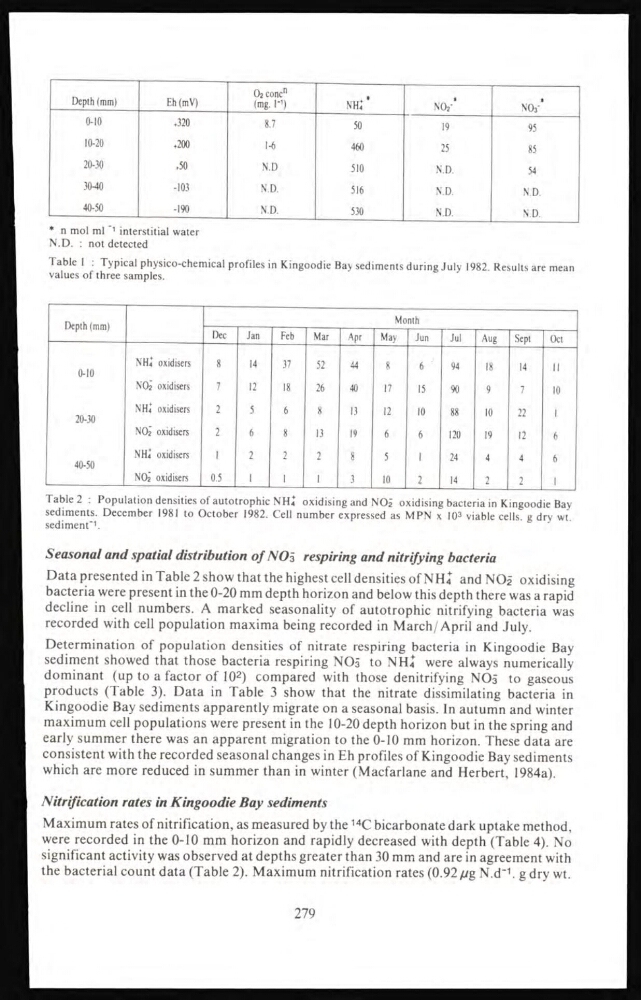
Table 1 : Typical physico-chemical profiles in Kingoodie Bay sediments during July 1982. Results are mean
values of three samples.
Depth (mm)
Month
Dec
Jan
Feb
Mar
Apr
May
Jun
Jul
Aug
Sept
Oct
0-10
NH +
4
oxidisers
8
14
37
52
44
8
6
94
18
14
11
NO 2 oxidisers
7
12
18
26
40
17
15
90
9
7
10
20-30
NH +
4 oxidisers
2
5
6
8
13
12
10
88
10
22
1
NO -
2 oxidisers
2
6
8
13
19
6
6
120
19
12
6
40-50
NH +
4 oxidisers
1
2
2
2
8
5
1
24
4
4
6
NO -
2 oxidisers
0.5
1
1
1
3
10
2
14
2
2
1
Table 2 . Population densities of autotrophic NH
+
4 oxidising and NO
-
2 oxidising bacteria in Kingoodie Bay
sediments. December 1981 to October 1982. Cell number expressed as MPN x 10
3
viable cells. g dry wt.
sediment' 1 .
Seasonal and spatial distribution of NO
-
3 respiring and nitrifying bacteria
Data presented in Table 2 show that the highest cell densities of NH
+
4 and NO
-
4 oxidising
bacteria were present in the 0-20 mm depth horizon and below this depth there was a rapid
decline in cell numbers. A marked seasonality of autotrophic nitrifying bacteria was
recorded with cell population maxima being recorded in March/April and July.
Determination of population densities of nitrate respiring bacteria in Kingoodie Bay
sediment showed that those bacteria respiring NO
-
3
to NH
+
4 were always numerically
dominant (up to a factor of 10
2 ) compared with those denitrifying NO
-
3
to gaseous
products (Table 3). Data in Table 3 show that the nitrate dissimilating bacteria in
Kingoodie Bay sediments apparently migrate on a seasonal basis. In autumn and winter
maximum cell populations were present in the 10-20 depth horizon but in the spring and
early summer there was an apparent migration to the 0-10 mm horizon. These data are
consistent with the recorded seasonal changes in Eh profiles of Kingoodie Bay sediments
which are more reduced in summer than in winter (Macfarlane and Herbert, 1984a).
Nitrification rates in Kingoodie Bay sediments
Maximum rates of nitrification, as measured by the
14 C bicarbonate dark uptake method,
were recorded in the 0-10 mm horizon and rapidly decreased with depth (Table 4). No
significant activity was observed at depths greater than 30 mm and are in agreement with
the bacterial count data (Table 2). Maximum nitrification rates (0.92 pg N.d
-1 . g dry wt.
279
Eh (mV)
O2 conc
n
(mg. I 1 )
NH< *
NO'*
NO/
0-10
♦320
8.7
50
19
95
10-20
♦200
1-6
460
25
85
20-30
♦50
N.D
510
N.D.
54
30-40
-103
N.D.
516
N.D.
N.D.
40-50
-I90
N.D.
530
N.D.
N.D,
* n mol ml
-1 interstitial water
N.D. : not detected
Table 1 : Typical physico-chemical profiles in Kingoodie Bay sediments during July 1982. Results are mean
values of three samples.
Depth (mm)
Month
Dec
Jan
Feb
Mar
Apr
May
Jun
Jul
Aug
Sept
Oct
0-10
NH +
4
oxidisers
8
14
37
52
44
8
6
94
18
14
11
NO 2 oxidisers
7
12
18
26
40
17
15
90
9
7
10
20-30
NH +
4 oxidisers
2
5
6
8
13
12
10
88
10
22
1
NO -
2 oxidisers
2
6
8
13
19
6
6
120
19
12
6
40-50
NH +
4 oxidisers
1
2
2
2
8
5
1
24
4
4
6
NO -
2 oxidisers
0.5
1
1
1
3
10
2
14
2
2
1
Table 2 . Population densities of autotrophic NH
+
4 oxidising and NO
-
2 oxidising bacteria in Kingoodie Bay
sediments. December 1981 to October 1982. Cell number expressed as MPN x 10
3
viable cells. g dry wt.
sediment' 1 .
Seasonal and spatial distribution of NO
-
3 respiring and nitrifying bacteria
Data presented in Table 2 show that the highest cell densities of NH
+
4 and NO
-
4 oxidising
bacteria were present in the 0-20 mm depth horizon and below this depth there was a rapid
decline in cell numbers. A marked seasonality of autotrophic nitrifying bacteria was
recorded with cell population maxima being recorded in March/April and July.
Determination of population densities of nitrate respiring bacteria in Kingoodie Bay
sediment showed that those bacteria respiring NO
-
3
to NH
+
4 were always numerically
dominant (up to a factor of 10
2 ) compared with those denitrifying NO
-
3
to gaseous
products (Table 3). Data in Table 3 show that the nitrate dissimilating bacteria in
Kingoodie Bay sediments apparently migrate on a seasonal basis. In autumn and winter
maximum cell populations were present in the 10-20 depth horizon but in the spring and
early summer there was an apparent migration to the 0-10 mm horizon. These data are
consistent with the recorded seasonal changes in Eh profiles of Kingoodie Bay sediments
which are more reduced in summer than in winter (Macfarlane and Herbert, 1984a).
Nitrification rates in Kingoodie Bay sediments
Maximum rates of nitrification, as measured by the
14 C bicarbonate dark uptake method,
were recorded in the 0-10 mm horizon and rapidly decreased with depth (Table 4). No
significant activity was observed at depths greater than 30 mm and are in agreement with
the bacterial count data (Table 2). Maximum nitrification rates (0.92 pg N.d
-1 . g dry wt.
279