

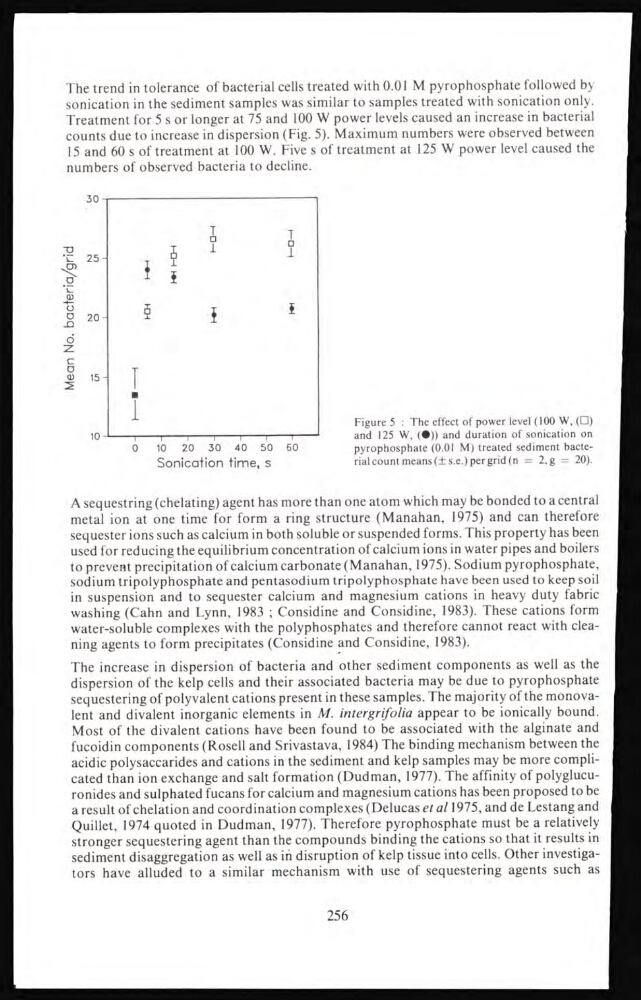
The trend in tolerance of bacterial cells treated with 0.01 M pyrophosphate followed by
sonication in the sediment samples was similar to samples treated with sonication only.
Treatment for 5 s or longer at 75 and 100 W power levels caused an increase in bacterial
counts due to increase in dispersion (Fig. 5). Maximum numbers were observed between
15 and 60 s of treatment at 100 W. Five s of treatment at 125 W power level caused the
numbers of observed bacteria to decline.
Figure 5 : The effect of power level (100 W, (□)
and 125 W, (•)) and duration of sonication on
pyrophosphate (0.01 M) treated sediment bacterial count means (±s.e.) per grid (n = 2, g = 20).
A sequestring (chelating) agent has more than one atom which may be bonded to a central
metal ion at one time for form a ring structure (Manahan, 1975) and can therefore
sequester ions such as calcium in both soluble or suspended forms. This property has been
used for reducing the equilibrium concentration of calcium ions in water pipes and boilers
to prevent precipitation of calcium carbonate (Manahan, 1975). Sodium pyrophosphate,
sodium tripolyphosphate and pentasodium tripolyphosphate have been used to keep soil
in suspension and to sequester calcium and magnesium cations in heavy duty fabric
washing (Cahn and Lynn, 1983 ; Considine and Considine, 1983). These cations form
water-soluble complexes with the polyphosphates and therefore cannot react with cleaning agents to form precipitates (Considine and Considine, 1983).
The increase in dispersion of bacteria and other sediment components as well as the
dispersion of the kelp cells and their associated bacteria may be due to pyrophosphate
sequestering of polyvalent cations present in these samples. The majority of the monovalent and divalent inorganic elements in M. intergrifolia appear to be ionically bound.
Most of the divalent cations have been found to be associated with the alginate and
fucoidin components (Rosell and Srivastava, 1984) The binding mechanism between the
acidic polysaccarides and cations in the sediment and kelp samples may be more complicated than ion exchange and salt formation (Dudman, 1977). The affinity of polyglucuronides and sulphated fucans for calcium and magnesium cations has been proposed to be
a result of chelation and coordination complexes (Delucas et al 1975, and de Lestang and
Quillet, 1974 quoted in Dudman, 1977). Therefore pyrophosphate must be a relatively
stronger sequestering agent than the compounds binding the cations so that it results in
sediment disaggregation as well as in disruption of kelp tissue into cells. Other investigators have alluded to a similar mechanism with use of sequestering agents such as
256
sonication in the sediment samples was similar to samples treated with sonication only.
Treatment for 5 s or longer at 75 and 100 W power levels caused an increase in bacterial
counts due to increase in dispersion (Fig. 5). Maximum numbers were observed between
15 and 60 s of treatment at 100 W. Five s of treatment at 125 W power level caused the
numbers of observed bacteria to decline.
Figure 5 : The effect of power level (100 W, (□)
and 125 W, (•)) and duration of sonication on
pyrophosphate (0.01 M) treated sediment bacterial count means (±s.e.) per grid (n = 2, g = 20).
A sequestring (chelating) agent has more than one atom which may be bonded to a central
metal ion at one time for form a ring structure (Manahan, 1975) and can therefore
sequester ions such as calcium in both soluble or suspended forms. This property has been
used for reducing the equilibrium concentration of calcium ions in water pipes and boilers
to prevent precipitation of calcium carbonate (Manahan, 1975). Sodium pyrophosphate,
sodium tripolyphosphate and pentasodium tripolyphosphate have been used to keep soil
in suspension and to sequester calcium and magnesium cations in heavy duty fabric
washing (Cahn and Lynn, 1983 ; Considine and Considine, 1983). These cations form
water-soluble complexes with the polyphosphates and therefore cannot react with cleaning agents to form precipitates (Considine and Considine, 1983).
The increase in dispersion of bacteria and other sediment components as well as the
dispersion of the kelp cells and their associated bacteria may be due to pyrophosphate
sequestering of polyvalent cations present in these samples. The majority of the monovalent and divalent inorganic elements in M. intergrifolia appear to be ionically bound.
Most of the divalent cations have been found to be associated with the alginate and
fucoidin components (Rosell and Srivastava, 1984) The binding mechanism between the
acidic polysaccarides and cations in the sediment and kelp samples may be more complicated than ion exchange and salt formation (Dudman, 1977). The affinity of polyglucuronides and sulphated fucans for calcium and magnesium cations has been proposed to be
a result of chelation and coordination complexes (Delucas et al 1975, and de Lestang and
Quillet, 1974 quoted in Dudman, 1977). Therefore pyrophosphate must be a relatively
stronger sequestering agent than the compounds binding the cations so that it results in
sediment disaggregation as well as in disruption of kelp tissue into cells. Other investigators have alluded to a similar mechanism with use of sequestering agents such as
256