

Effect of chemical reagents followed by Ultrasound
Microscopic examination of sediment and kelp disc samples treated with hydrochloric
acid, sodium hydroxide, sodium carbonate, sodium periodate and tetrasodium pyrophosphate followed by sonication, showed a greater disaggregation of sediment associated bacteria and detachment of epiphytic bacteria than those samples treated with
chemicals only. A change of pH or oxidation of polysaccharides by these reagents was
insufficient to release the bacterial cells.
Sediment suspensions treated with pyrophosphate at concentrations of 0.05 M or greater
formed a precipitate which greatly interfered with bacterial observations on the filter.
Samples treated with 0.01 M pyrophosphate followed by sonication resulted in an even
distribution of bacteria and other sediment components of the filters and a reduction in
colloidal material surrounding the bacterial cells. A concentration of < 0.001 M pyrophosphate did not enhance sonication-induced dispersion. Kelp discs treated with 0.01 M
pyrophosphate for 15 to 30 min followed by sonication at 100 w for 30 to 60 s dispersed
into unattached single cells or packets of 2 to 5 kelp cells. Observation of the residue after
filtration revealed an even dispersion of bacterial and kelp cells. The use of pyrophosphate (or sodium tripolyphosphate) followed by sonication has proven to be more
successful than the use of sonication alone, for dispersing bacterial flocs in activated
sludge (Pike et ai, 1972 ; Gayford and Richards, 1970 ; Banks and Walker, 1977).
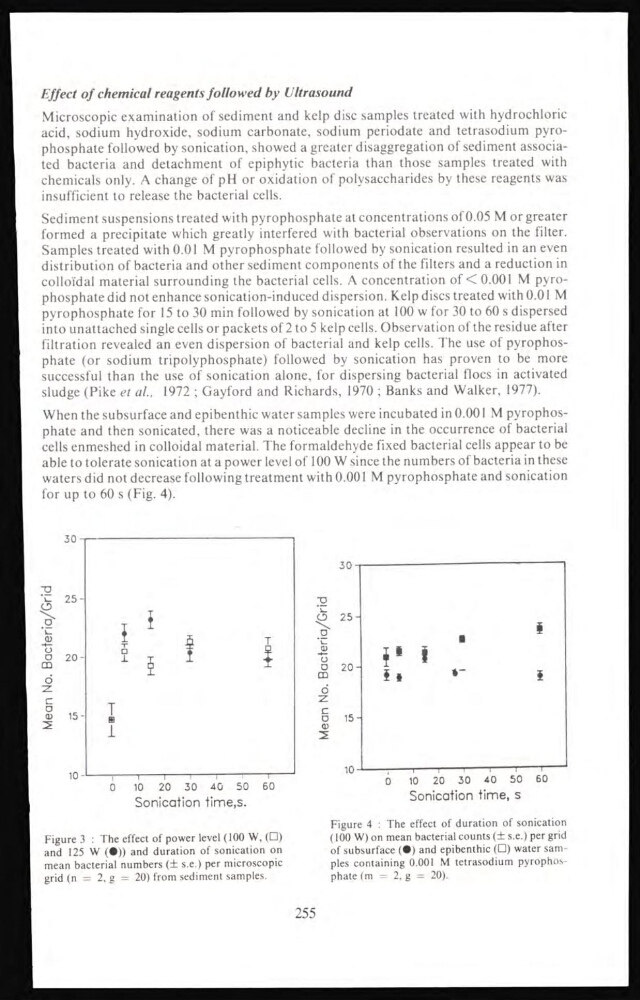
When the subsurface and epibenthic water samples were incubated in 0.001 M pyrophosphate and then sonicated, there was a noticeable decline in the occurrence of bacterial
cells enmeshed in colloidal material. The formaldehyde fixed bacterial cells appear to be
able to tolerate sonication at a power level of 100 W since the numbers of bacteria in these
waters did not decrease following treatment with 0.001 M pyrophosphate and sonication
for up to 60 s (Fig. 4).
Sonication time, s.
Figure 3 : The effect of power level (100 W, (□)
and 125 W (•)) and duration of sonication on
mean bacterial numbers (± s.e.) per microscopic
grid (n = 2, g = 20) from sediment samples.
Sonication time, s
Figure 4 : The effect of duration of sonication
( 100 W) on mean bacterial counts (± s.e.) per grid
of subsurface (•) and epibenthic (□) water samples containing 0.001 M tetrasodium pyrophosphate (m = 2, g = 20).
255
Microscopic examination of sediment and kelp disc samples treated with hydrochloric
acid, sodium hydroxide, sodium carbonate, sodium periodate and tetrasodium pyrophosphate followed by sonication, showed a greater disaggregation of sediment associated bacteria and detachment of epiphytic bacteria than those samples treated with
chemicals only. A change of pH or oxidation of polysaccharides by these reagents was
insufficient to release the bacterial cells.
Sediment suspensions treated with pyrophosphate at concentrations of 0.05 M or greater
formed a precipitate which greatly interfered with bacterial observations on the filter.
Samples treated with 0.01 M pyrophosphate followed by sonication resulted in an even
distribution of bacteria and other sediment components of the filters and a reduction in
colloidal material surrounding the bacterial cells. A concentration of < 0.001 M pyrophosphate did not enhance sonication-induced dispersion. Kelp discs treated with 0.01 M
pyrophosphate for 15 to 30 min followed by sonication at 100 w for 30 to 60 s dispersed
into unattached single cells or packets of 2 to 5 kelp cells. Observation of the residue after
filtration revealed an even dispersion of bacterial and kelp cells. The use of pyrophosphate (or sodium tripolyphosphate) followed by sonication has proven to be more
successful than the use of sonication alone, for dispersing bacterial flocs in activated
sludge (Pike et ai, 1972 ; Gayford and Richards, 1970 ; Banks and Walker, 1977).
When the subsurface and epibenthic water samples were incubated in 0.001 M pyrophosphate and then sonicated, there was a noticeable decline in the occurrence of bacterial
cells enmeshed in colloidal material. The formaldehyde fixed bacterial cells appear to be
able to tolerate sonication at a power level of 100 W since the numbers of bacteria in these
waters did not decrease following treatment with 0.001 M pyrophosphate and sonication
for up to 60 s (Fig. 4).
Sonication time, s.
Figure 3 : The effect of power level (100 W, (□)
and 125 W (•)) and duration of sonication on
mean bacterial numbers (± s.e.) per microscopic
grid (n = 2, g = 20) from sediment samples.
Sonication time, s
Figure 4 : The effect of duration of sonication
( 100 W) on mean bacterial counts (± s.e.) per grid
of subsurface (•) and epibenthic (□) water samples containing 0.001 M tetrasodium pyrophosphate (m = 2, g = 20).
255