

RESULTS AND DISCUSSION
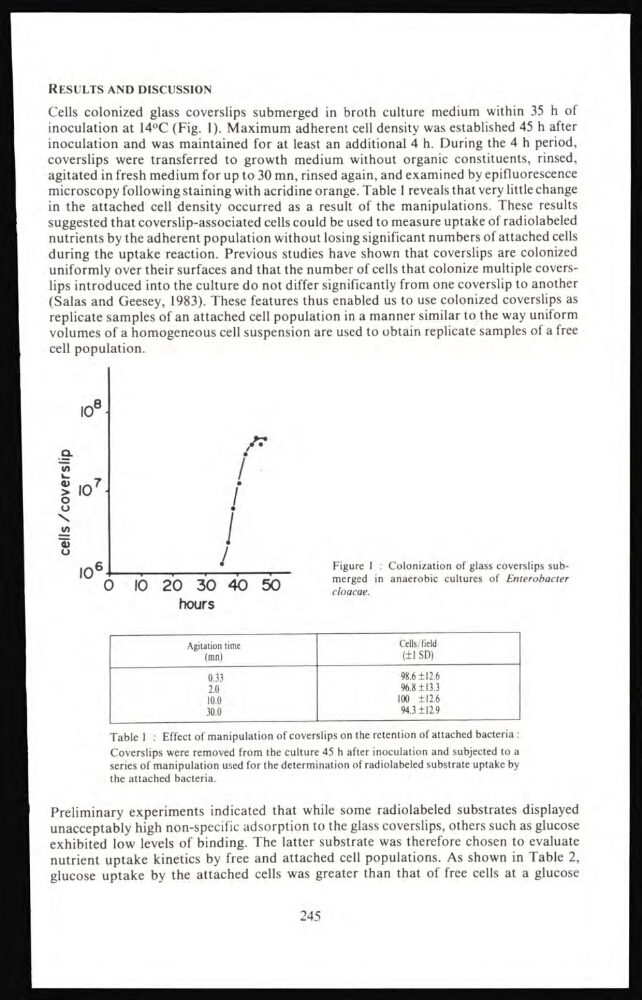
Cells colonized glass coverslips submerged in broth culture medium within 35 h of
inoculation at 14°C (Fig. 1). Maximum adherent cell density was established 45 h after
inoculation and was maintained for at least an additional 4 h. During the 4 h period,
coverslips were transferred to growth medium without organic constituents, rinsed,
agitated in fresh medium for up to 30 mn, rinsed again, and examined by epifluorescence
microscopy following staining with acridine orange. Table 1 reveals that very little change
in the attached cell density occurred as a result of the manipulations. These results
suggested that coverslip-associated cells could be used to measure uptake of radiolabeled
nutrients by the adherent population without losing significant numbers of attached cells
during the uptake reaction. Previous studies have shown that coverslips are colonized
uniformly over their surfaces and that the number of cells that colonize multiple coverslips introduced into the culture do not differ significantly from one coverslip to another
(Salas and Geesey, 1983). These features thus enabled us to use colonized coverslips as
replicate samples of an attached cell population in a manner similar to the way uniform
volumes of a homogeneous cell suspension are used to obtain replicate samples of a free
cell population.
hours
Figure 1 : Colonization of glass coverslips submerged in anaerobic cultures of Enterobacter
cloacae.
Agitation time
Cells/field
(mn)
(±1 SD)
0.33
98.6 ±12.6
2.0
96.8 ±13.3
10.0
100 ±12.6
30.0
94.3 ±12.9
Table 1 : Effect of manipulation of coverslips on the retention of attached bacteria :
Coverslips were removed from the culture 45 h after inoculation and subjected to a
series of manipulation used for the determination of radiolabeled substrate uptake by
the attached bacteria.
Preliminary experiments indicated that while some radiolabeled substrates displayed
unacceptably high non-specific adsorption to the glass coverslips, others such as glucose
exhibited low levels of binding. The latter substrate was therefore chosen to evaluate
nutrient uptake kinetics by free and attached cell populations. As shown in Table 2,
glucose uptake by the attached cells was greater than that of free cells at a glucose
245
Cells colonized glass coverslips submerged in broth culture medium within 35 h of
inoculation at 14°C (Fig. 1). Maximum adherent cell density was established 45 h after
inoculation and was maintained for at least an additional 4 h. During the 4 h period,
coverslips were transferred to growth medium without organic constituents, rinsed,
agitated in fresh medium for up to 30 mn, rinsed again, and examined by epifluorescence
microscopy following staining with acridine orange. Table 1 reveals that very little change
in the attached cell density occurred as a result of the manipulations. These results
suggested that coverslip-associated cells could be used to measure uptake of radiolabeled
nutrients by the adherent population without losing significant numbers of attached cells
during the uptake reaction. Previous studies have shown that coverslips are colonized
uniformly over their surfaces and that the number of cells that colonize multiple coverslips introduced into the culture do not differ significantly from one coverslip to another
(Salas and Geesey, 1983). These features thus enabled us to use colonized coverslips as
replicate samples of an attached cell population in a manner similar to the way uniform
volumes of a homogeneous cell suspension are used to obtain replicate samples of a free
cell population.
hours
Figure 1 : Colonization of glass coverslips submerged in anaerobic cultures of Enterobacter
cloacae.
Agitation time
Cells/field
(mn)
(±1 SD)
0.33
98.6 ±12.6
2.0
96.8 ±13.3
10.0
100 ±12.6
30.0
94.3 ±12.9
Table 1 : Effect of manipulation of coverslips on the retention of attached bacteria :
Coverslips were removed from the culture 45 h after inoculation and subjected to a
series of manipulation used for the determination of radiolabeled substrate uptake by
the attached bacteria.
Preliminary experiments indicated that while some radiolabeled substrates displayed
unacceptably high non-specific adsorption to the glass coverslips, others such as glucose
exhibited low levels of binding. The latter substrate was therefore chosen to evaluate
nutrient uptake kinetics by free and attached cell populations. As shown in Table 2,
glucose uptake by the attached cells was greater than that of free cells at a glucose
245