

the overall population was in a decline phase (Fig. 3). One possible cause for such
observations would be harvesting by the expanding protozoan assemblage (Fig. 3) which
kept the bacterial assemblage in check. In general, considering the relatively rapid growth
of the bacterial populations, some persistent loss mechanism (grazing?) must be present in
the Duplin, since bacterial biomass showed no long term increase over the two sampling
periods.
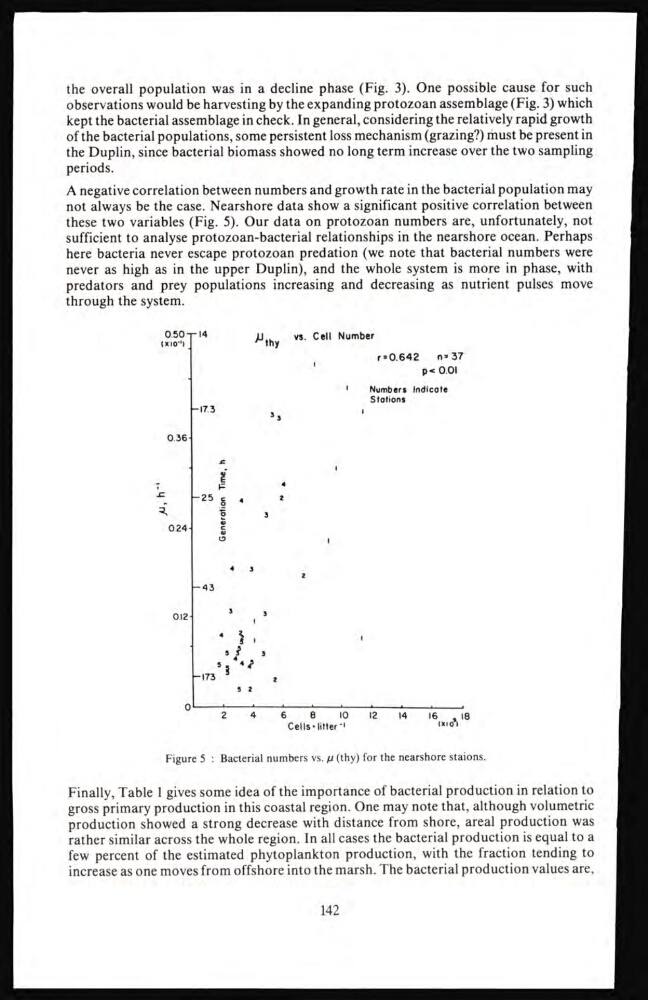
A negative correlation between numbers and growth rate in the bacterial population may
not always be the case. Nearshore data show a significant positive correlation between
these two variables (Fig. 5). Our data on protozoan numbers are, unfortunately, not
sufficient to analyse protozoan-bacterial relationships in the nearshore ocean. Perhaps
here bacteria never escape protozoan predation (we note that bacterial numbers were
never as high as in the upper Duplin), and the whole system is more in phase, with
predators and prey populations increasing and decreasing as nutrient pulses move
through the system.
Figure 5 : Bacterial numbers vs. µ (thy) for the nearshore staions.
Finally, Table 1 gives some idea of the importance of bacterial production in relation to
gross primary production in this coastal region. One may note that, although volumetric
production showed a strong decrease with distance from shore, areal production was
rather similar across the whole region. In all cases the bacterial production is equal to a
few percent of the estimated phytoplankton production, with the fraction tending to
increase as one moves from offshore into the marsh. The bacterial production values are,
142
observations would be harvesting by the expanding protozoan assemblage (Fig. 3) which
kept the bacterial assemblage in check. In general, considering the relatively rapid growth
of the bacterial populations, some persistent loss mechanism (grazing?) must be present in
the Duplin, since bacterial biomass showed no long term increase over the two sampling
periods.
A negative correlation between numbers and growth rate in the bacterial population may
not always be the case. Nearshore data show a significant positive correlation between
these two variables (Fig. 5). Our data on protozoan numbers are, unfortunately, not
sufficient to analyse protozoan-bacterial relationships in the nearshore ocean. Perhaps
here bacteria never escape protozoan predation (we note that bacterial numbers were
never as high as in the upper Duplin), and the whole system is more in phase, with
predators and prey populations increasing and decreasing as nutrient pulses move
through the system.
Figure 5 : Bacterial numbers vs. µ (thy) for the nearshore staions.
Finally, Table 1 gives some idea of the importance of bacterial production in relation to
gross primary production in this coastal region. One may note that, although volumetric
production showed a strong decrease with distance from shore, areal production was
rather similar across the whole region. In all cases the bacterial production is equal to a
few percent of the estimated phytoplankton production, with the fraction tending to
increase as one moves from offshore into the marsh. The bacterial production values are,
142