

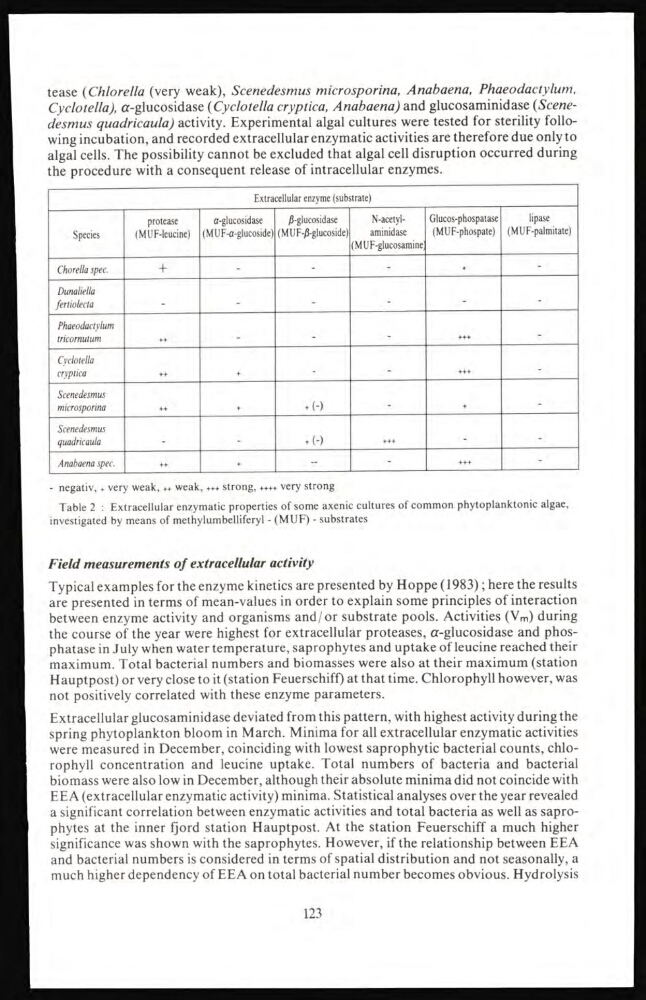
tease (Chlorella (very weak), Scenedesmus microsporina, Anabaena, Phaeodactylum,
Cyclotella), a-glucosidase (Cyclotella cryptica, Anabaena) and glucosaminidase (Scenedesmus quadricaula) activity. Experimental algal cultures were tested for sterility following incubation, and recorded extracellular enzymatic activities are therefore due only to
algal cells. The possibility cannot be excluded that algal cell disruption occurred during
the procedure with a consequent release of intracellular enzymes.
Extracellular enzyme (substrate)
Species
protease
(MUF-leucine)
a-glucosidase
(MUF-α-glucoside)
β-glucosidase
(MUF-β-glucoside)
N-acetylaminidase
(MUF-glucosamine
Glucos-phospatase
(MUF-phospate)
lipase
(MUF-palmitate)
Chorella spec.
+
-
-
-
+
-
Dunaliella
fertiolecta
.
_
_
-
-
-
Phaeodactylum
tricornutum
_
_
-
+++
-
Cyclotella
cryptica
++
+
_
-
+++
-
Scenedesmus
microsporina
++
+
♦ (-)
-
+
-
Scenedesmus
quadricaula
_
♦ (-)
+++
-
-
Anabaena spec.
++
+
-
-
+++
-
- negativ, + very weak, ++ weak, +++ strong, ++++ very strong
Table 2 : Extracellular enzymatic properties of some axenic cultures of common phytoplanktonic algae,
investigated by means of methylumbelliferyl - (MUF) - substrates
Field measurements of extracellular activity
Typical examples for the enzyme kinetics are presented by Hoppe (1983) ; here the results
are presented in terms of mean-values in order to explain some principles of interaction
between enzyme activity and organisms and/or substrate pools. Activities (V
m
) during
the course of the year were highest for extracellular proteases, a-glucosidase and phosphatase in July when water temperature, saprophytes and uptake of leucine reached their
maximum. Total bacterial numbers and biomasses were also at their maximum (station
Hauptpost) or very close to it (station Feuerschiff) at that time. Chlorophyll however, was
not positively correlated with these enzyme parameters.
Extracellular glucosaminidase deviated from this pattern, with highest activity during the
spring phytoplankton bloom in March. Minima for all extracellular enzymatic activities
were measured in December, coinciding with lowest saprophytic bacterial counts, chlorophyll concentration and leucine uptake. Total numbers of bacteria and bacterial
biomass were also low in December, although their absolute minima did not coincide with
EEA (extracellular enzymatic activity) minima. Statistical analyses over the year revealed
a significant correlation between enzymatic activities and total bacteria as well as saprophytes at the inner fjord station Hauptpost. At the station Feuerschiff a much higher
significance was shown with the saprophytes. However, if the relationship between EEA
and bacterial numbers is considered in terms of spatial distribution and not seasonally, a
much higher dependency of EEA on total bacterial number becomes obvious. Hydrolysis
123
Cyclotella), a-glucosidase (Cyclotella cryptica, Anabaena) and glucosaminidase (Scenedesmus quadricaula) activity. Experimental algal cultures were tested for sterility following incubation, and recorded extracellular enzymatic activities are therefore due only to
algal cells. The possibility cannot be excluded that algal cell disruption occurred during
the procedure with a consequent release of intracellular enzymes.
Extracellular enzyme (substrate)
Species
protease
(MUF-leucine)
a-glucosidase
(MUF-α-glucoside)
β-glucosidase
(MUF-β-glucoside)
N-acetylaminidase
(MUF-glucosamine
Glucos-phospatase
(MUF-phospate)
lipase
(MUF-palmitate)
Chorella spec.
+
-
-
-
+
-
Dunaliella
fertiolecta
.
_
_
-
-
-
Phaeodactylum
tricornutum
_
_
-
+++
-
Cyclotella
cryptica
++
+
_
-
+++
-
Scenedesmus
microsporina
++
+
♦ (-)
-
+
-
Scenedesmus
quadricaula
_
♦ (-)
+++
-
-
Anabaena spec.
++
+
-
-
+++
-
- negativ, + very weak, ++ weak, +++ strong, ++++ very strong
Table 2 : Extracellular enzymatic properties of some axenic cultures of common phytoplanktonic algae,
investigated by means of methylumbelliferyl - (MUF) - substrates
Field measurements of extracellular activity
Typical examples for the enzyme kinetics are presented by Hoppe (1983) ; here the results
are presented in terms of mean-values in order to explain some principles of interaction
between enzyme activity and organisms and/or substrate pools. Activities (V
m
) during
the course of the year were highest for extracellular proteases, a-glucosidase and phosphatase in July when water temperature, saprophytes and uptake of leucine reached their
maximum. Total bacterial numbers and biomasses were also at their maximum (station
Hauptpost) or very close to it (station Feuerschiff) at that time. Chlorophyll however, was
not positively correlated with these enzyme parameters.
Extracellular glucosaminidase deviated from this pattern, with highest activity during the
spring phytoplankton bloom in March. Minima for all extracellular enzymatic activities
were measured in December, coinciding with lowest saprophytic bacterial counts, chlorophyll concentration and leucine uptake. Total numbers of bacteria and bacterial
biomass were also low in December, although their absolute minima did not coincide with
EEA (extracellular enzymatic activity) minima. Statistical analyses over the year revealed
a significant correlation between enzymatic activities and total bacteria as well as saprophytes at the inner fjord station Hauptpost. At the station Feuerschiff a much higher
significance was shown with the saprophytes. However, if the relationship between EEA
and bacterial numbers is considered in terms of spatial distribution and not seasonally, a
much higher dependency of EEA on total bacterial number becomes obvious. Hydrolysis
123