

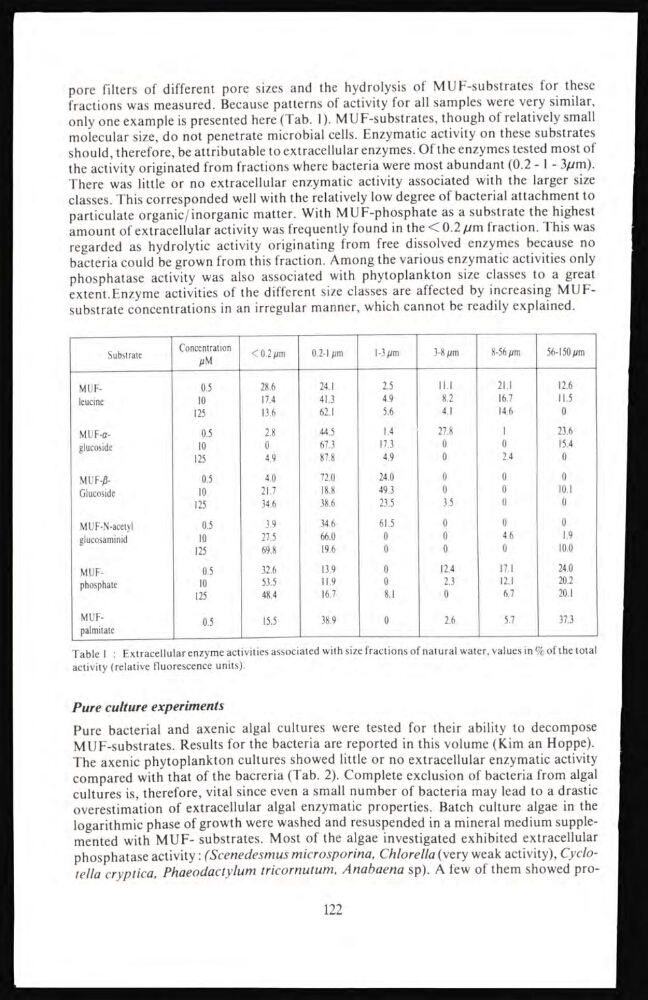
pore filters of different pore sizes and the hydrolysis of MUF-substrates for these
fractions was measured. Because patterns of activity for all samples were very similar,
only one example is presented here (Tab. 1). MUF-substrates, though of relatively small
molecular size, do not penetrate microbial cells. Enzymatic activity on these substrates
should, therefore, be attributable to extracellular enzymes. Of the enzymes tested most of
the activity originated from fractions where bacteria were most abundant (0.2 - 1 - 3µm).
There was little or no extracellular enzymatic activity associated with the larger size
classes. This corresponded well with the relatively low degree of bacterial attachment to
particulate organic/inorganic matter. With MUF-phosphate as a substrate the highest
amount of extracellular activity was frequently found in the < 0.2 µm fraction. This was
regarded as hydrolytic activity originating from free dissolved enzymes because no
bacteria could be grown from this fraction. Among the various enzymatic activities only
phosphatase activity was also associated with phytoplankton size classes to a great
extent. Enzyme activities of the different size classes are affected by increasing MUFsubstrate concentrations in an irregular manner, which cannot be readily explained.
Substrate
Concentration
µM
<0.2 µm
0.2-1 µm
1 -3 µm
3-8 µm
8-56 µm
56-150 µ m
MUF0.5
28.6
24.1
2.5
11.1
21.1
12.6
leucine
10
17.4
41.3
4.9
8.2
16.7
11.5
125
13.6
62.1
5.6
4.1
14.6
0
MUF-α0.5
2.8
44.5
1.4
27.8
1
23.6
glucoside
10
0
67.3
17.3
0
0
15.4
125
4.9
87.8
4.9
0
2.4
0
MUF-β0.5
4.0
72.0
24.0
0
0
0
Glucoside
10
21.7
18.8
49.3
0
0
10.1
125
34.6
38.6
23.5
3.5
0
0
MUF-N-acetyl
0.5
3.9
34.6
61.5
0
0
0
glucosaminid
10
27.5
66.0
0
0
4.6
1.9
125
69.8
19.6
0
0
0
10.0
MUF0.5
32.6
13.9
0
12.4
17.1
24.0
phosphate
10
53.5
11.9
0
2.3
12.1
20.2
125
48.4
16.7
8.1
0
6.7
20.1
MUF0.5
15.5
38.9
0
2.6
5.7
37.3
palmitate
1
Table 1 : Extracellular enzyme activities associated with size fractions of natural water, values in % of the total
activity (relative fluorescence units).
Pure culture experiments
Pure bacterial and axenic algal cultures were tested for their ability to decompose
MUF-substrates. Results for the bacteria are reported in this volume (Kim an Hoppe).
The axenic phytoplankton cultures showed little or no extracellular enzymatic activity
compared with that of the bacreria (Tab. 2). Complete exclusion of bacteria from algal
cultures is, therefore, vital since even a small number of bacteria may lead to a drastic
overestimation of extracellular algal enzymatic properties. Batch culture algae in the
logarithmic phase of growth were washed and resuspended in a mineral medium supplemented with MUF- substrates. Most of the algae investigated exhibited extracellular
phosphatase activity : (Scenedesmus microsporina, Chlorella (very weak activity), Cyclotella crvptica, Phaeodactylum tricornutum, Anabaena sp). A few of them showed pro122
fractions was measured. Because patterns of activity for all samples were very similar,
only one example is presented here (Tab. 1). MUF-substrates, though of relatively small
molecular size, do not penetrate microbial cells. Enzymatic activity on these substrates
should, therefore, be attributable to extracellular enzymes. Of the enzymes tested most of
the activity originated from fractions where bacteria were most abundant (0.2 - 1 - 3µm).
There was little or no extracellular enzymatic activity associated with the larger size
classes. This corresponded well with the relatively low degree of bacterial attachment to
particulate organic/inorganic matter. With MUF-phosphate as a substrate the highest
amount of extracellular activity was frequently found in the < 0.2 µm fraction. This was
regarded as hydrolytic activity originating from free dissolved enzymes because no
bacteria could be grown from this fraction. Among the various enzymatic activities only
phosphatase activity was also associated with phytoplankton size classes to a great
extent. Enzyme activities of the different size classes are affected by increasing MUFsubstrate concentrations in an irregular manner, which cannot be readily explained.
Substrate
Concentration
µM
<0.2 µm
0.2-1 µm
1 -3 µm
3-8 µm
8-56 µm
56-150 µ m
MUF0.5
28.6
24.1
2.5
11.1
21.1
12.6
leucine
10
17.4
41.3
4.9
8.2
16.7
11.5
125
13.6
62.1
5.6
4.1
14.6
0
MUF-α0.5
2.8
44.5
1.4
27.8
1
23.6
glucoside
10
0
67.3
17.3
0
0
15.4
125
4.9
87.8
4.9
0
2.4
0
MUF-β0.5
4.0
72.0
24.0
0
0
0
Glucoside
10
21.7
18.8
49.3
0
0
10.1
125
34.6
38.6
23.5
3.5
0
0
MUF-N-acetyl
0.5
3.9
34.6
61.5
0
0
0
glucosaminid
10
27.5
66.0
0
0
4.6
1.9
125
69.8
19.6
0
0
0
10.0
MUF0.5
32.6
13.9
0
12.4
17.1
24.0
phosphate
10
53.5
11.9
0
2.3
12.1
20.2
125
48.4
16.7
8.1
0
6.7
20.1
MUF0.5
15.5
38.9
0
2.6
5.7
37.3
palmitate
1
Table 1 : Extracellular enzyme activities associated with size fractions of natural water, values in % of the total
activity (relative fluorescence units).
Pure culture experiments
Pure bacterial and axenic algal cultures were tested for their ability to decompose
MUF-substrates. Results for the bacteria are reported in this volume (Kim an Hoppe).
The axenic phytoplankton cultures showed little or no extracellular enzymatic activity
compared with that of the bacreria (Tab. 2). Complete exclusion of bacteria from algal
cultures is, therefore, vital since even a small number of bacteria may lead to a drastic
overestimation of extracellular algal enzymatic properties. Batch culture algae in the
logarithmic phase of growth were washed and resuspended in a mineral medium supplemented with MUF- substrates. Most of the algae investigated exhibited extracellular
phosphatase activity : (Scenedesmus microsporina, Chlorella (very weak activity), Cyclotella crvptica, Phaeodactylum tricornutum, Anabaena sp). A few of them showed pro122