

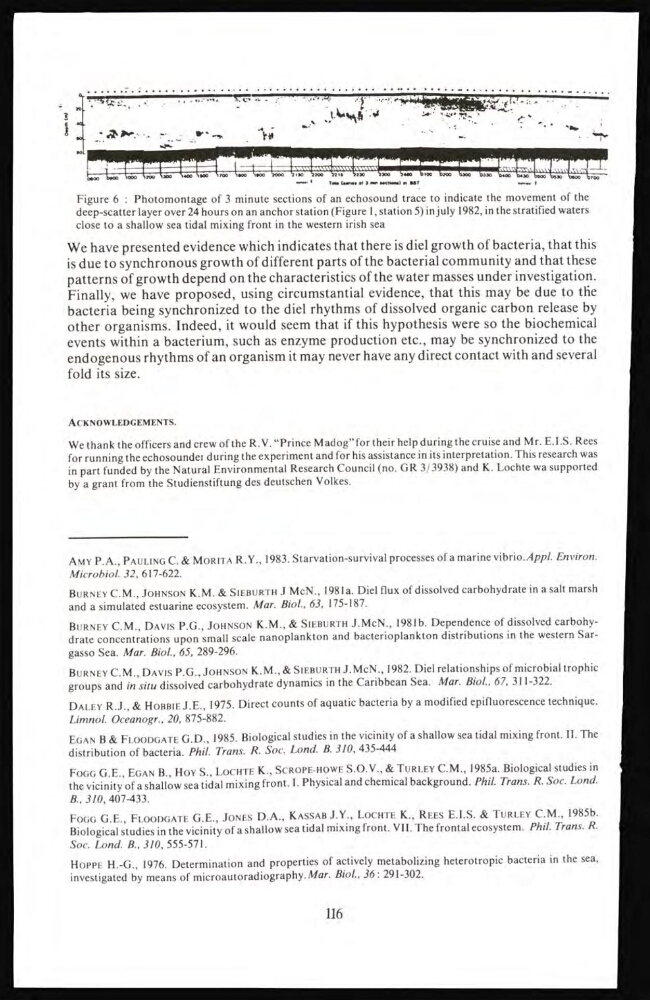
Figure 6 : Photomontage of 3 minute sections of an echosound trace to indicate the movement of the
deep-scatter layer over 24 hours on an anchor station (Figure 1, station 5) in july 1982, in the stratified waters
close to a shallow sea tidal mixing front in the western irish sea
We have presented evidence which indicates that there is diel growth of bacteria, that this
is due to synchronous growth of different parts of the bacterial community and that these
patterns of growth depend on the characteristics of the water masses under investigation.
Finally, we have proposed, using circumstantial evidence, that this may be due to the
bacteria being synchronized to the diel rhythms of dissolved organic carbon release by
other organisms. Indeed, it would seem that if this hypothesis were so the biochemical
events within a bacterium, such as enzyme production etc., may be synchronized to the
endogenous rhythms of an organism it may never have any direct contact with and several
fold its size.
ACKNOWLEDGEMENTS.
We thank the officers and crew of the R.V. “Prince Madog” for their help during the cruise and Mr. E.I.S. Rees
for running the echosounder during the experiment and for his assistance in its interpretation. This research was
in part funded by the Natural Environmental Research Council (no. GR 3/3938) and K. Lochte wa supported
by a grant from the Studienstiftung des deutschen Volkes.
AMY P.A., PAULING C. & MORITA R.Y., 1983. Starvation-survival processes of a marine vibrio. Appl. Environ.
Microbiol. 32, 617-622.
BURNEY C.M., JOHNSON K.M. & SIEBURTH J McN., 1981a. Diel flux of dissolved carbohydrate in a salt marsh
and a simulated estuarine ecosystem. Mar. Biol., 63, 175-187.
BURNEY C.M., DAVIS P.G., JOHNSON K.M., & SIEBURTH J.MCN., 1981b. Dependence of dissolved carbohydrate concentrations upon small scale nanoplankton and bacterioplankton distributions in the western Sargasso Sea. Mar. Biol., 65, 289-296.
BURNEY C.M., DAVIS P.G., JOHNSON K.M., & SIEBURTH J.MCN., 1982. Diel relationships of microbial trophic
groups and in situ dissolved carbohydrate dynamics in the Caribbean Sea. Mar. Biol, 67, 311-322.
DALEY R.J., & HOBBIE J.E., 1975. Direct counts of aquatic bacteria by a modified epifluorescence technique.
Limnol. Oceanogr., 20, 875-882.
EGAN B & FLOODGATE G.D., 1985. Biological studies in the vicinity of a shallow sea tidal mixing front. II. The
distribution of bacteria. Phil. Trans. R. Soc. Lond. B. 310, 435-444
FOGG G E EGAN B., HOY S., LOCHTE K., SCROPE-HOWE S.O.V., & TURLEY C.M., 1985a. Biological studies in
the vicinity of a shallow sea tidal mixing front. I. Physical and chemical background. Phil. Trans. R. Soc. Lond.
B.. 310, 407-433.
FOGG G.E., FLOODGATE G.E., JONES D.A., KASSAB J.Y., LOCHTE K., REES E.I.S. & TURLEY C.M., 1985b.
Biological studies in the vicinity of a shallow sea tidal mixing front. VII. The frontal ecosystem. Phil. Trans. R.
Soc. Lond. B., 310, 555-571.
HOPPE H.-G., 1976. Determination and properties of actively metabolizing heterotropic bacteria in the sea,
investigated by means of microautoradiography.Mar. Biol., 36: 291-302.
116
deep-scatter layer over 24 hours on an anchor station (Figure 1, station 5) in july 1982, in the stratified waters
close to a shallow sea tidal mixing front in the western irish sea
We have presented evidence which indicates that there is diel growth of bacteria, that this
is due to synchronous growth of different parts of the bacterial community and that these
patterns of growth depend on the characteristics of the water masses under investigation.
Finally, we have proposed, using circumstantial evidence, that this may be due to the
bacteria being synchronized to the diel rhythms of dissolved organic carbon release by
other organisms. Indeed, it would seem that if this hypothesis were so the biochemical
events within a bacterium, such as enzyme production etc., may be synchronized to the
endogenous rhythms of an organism it may never have any direct contact with and several
fold its size.
ACKNOWLEDGEMENTS.
We thank the officers and crew of the R.V. “Prince Madog” for their help during the cruise and Mr. E.I.S. Rees
for running the echosounder during the experiment and for his assistance in its interpretation. This research was
in part funded by the Natural Environmental Research Council (no. GR 3/3938) and K. Lochte wa supported
by a grant from the Studienstiftung des deutschen Volkes.
AMY P.A., PAULING C. & MORITA R.Y., 1983. Starvation-survival processes of a marine vibrio. Appl. Environ.
Microbiol. 32, 617-622.
BURNEY C.M., JOHNSON K.M. & SIEBURTH J McN., 1981a. Diel flux of dissolved carbohydrate in a salt marsh
and a simulated estuarine ecosystem. Mar. Biol., 63, 175-187.
BURNEY C.M., DAVIS P.G., JOHNSON K.M., & SIEBURTH J.MCN., 1981b. Dependence of dissolved carbohydrate concentrations upon small scale nanoplankton and bacterioplankton distributions in the western Sargasso Sea. Mar. Biol., 65, 289-296.
BURNEY C.M., DAVIS P.G., JOHNSON K.M., & SIEBURTH J.MCN., 1982. Diel relationships of microbial trophic
groups and in situ dissolved carbohydrate dynamics in the Caribbean Sea. Mar. Biol, 67, 311-322.
DALEY R.J., & HOBBIE J.E., 1975. Direct counts of aquatic bacteria by a modified epifluorescence technique.
Limnol. Oceanogr., 20, 875-882.
EGAN B & FLOODGATE G.D., 1985. Biological studies in the vicinity of a shallow sea tidal mixing front. II. The
distribution of bacteria. Phil. Trans. R. Soc. Lond. B. 310, 435-444
FOGG G E EGAN B., HOY S., LOCHTE K., SCROPE-HOWE S.O.V., & TURLEY C.M., 1985a. Biological studies in
the vicinity of a shallow sea tidal mixing front. I. Physical and chemical background. Phil. Trans. R. Soc. Lond.
B.. 310, 407-433.
FOGG G.E., FLOODGATE G.E., JONES D.A., KASSAB J.Y., LOCHTE K., REES E.I.S. & TURLEY C.M., 1985b.
Biological studies in the vicinity of a shallow sea tidal mixing front. VII. The frontal ecosystem. Phil. Trans. R.
Soc. Lond. B., 310, 555-571.
HOPPE H.-G., 1976. Determination and properties of actively metabolizing heterotropic bacteria in the sea,
investigated by means of microautoradiography.Mar. Biol., 36: 291-302.
116