

Biomarkers
Introduction
Organic matter in the estuaries has different origins (Thoumelin et al.,
1997; Bodineau et al., 1998). It may come from estuarine, from marine
or from freshwater phytoplankton. It may also come from terrestrial
plants (Kollatukudy & Walton, 1973) or from domestic wastewaters
(Quéméneur & Marty, 1994). Most of this organic matter is in detrital
form. One of the characteristics of macrotidal estuaries is the presence of
a zone of high turbidities known as Estuarine Turbidity Maximum
(ETM). ETM develops because of the accumulation of organic matter
brought either by freshwaters and marine waters. The influence of
ETM on the estuarine ecosystem is still little known. In this work, we
studied the diet of two organisms, the copepod Eurytemora affinis and
the white shrimp Palaemon longirostris which develop in the oligohaline
zone (0.5
affinis varies between 10 000 and 200 000 ind.m - 3 and the maximum
development is observed in spring. Lower abundances have been determined for Palaemon longirostris (400-1 300 ind.100 m
-3 ) with a maximum in autumn (Mouny & Dauvin, 1996).
Materials and methods
Sampling
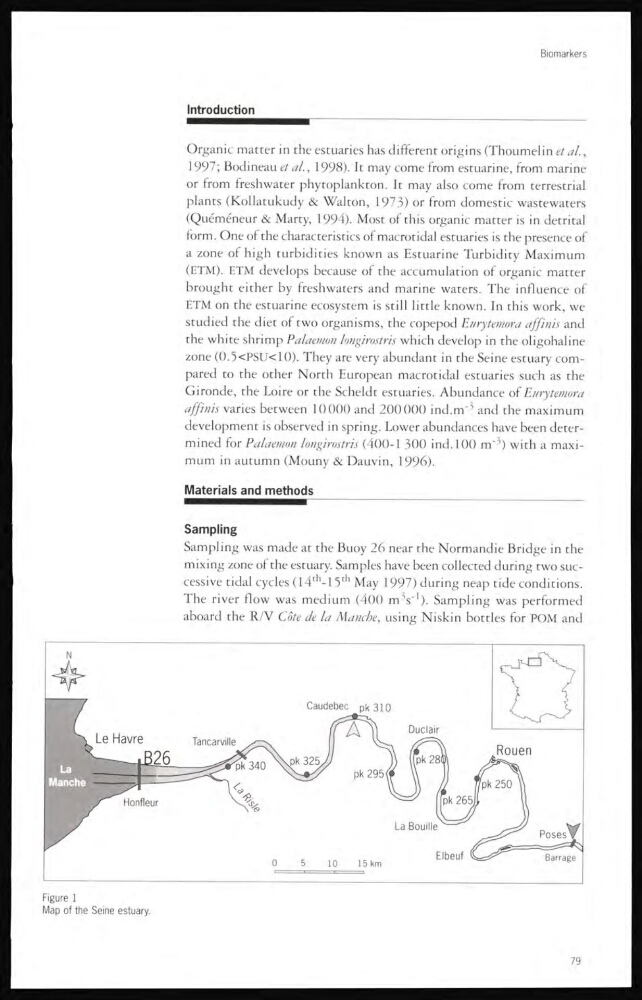
Sampling was made at the Buoy 20 near the Normandie Bridge in the
mixing zone of the estuary. Samples have been collected during two successive tidal cycles (14
th -15
th May 1997) during neap tide conditions.
The river flow was medium (400 m
3 s - 1 ). Sampling was performed
aboard the R/V Côte de la Manche, using Niskin bottles for POM and
Figure 1
Map of the Seine estuary.
79
Introduction
Organic matter in the estuaries has different origins (Thoumelin et al.,
1997; Bodineau et al., 1998). It may come from estuarine, from marine
or from freshwater phytoplankton. It may also come from terrestrial
plants (Kollatukudy & Walton, 1973) or from domestic wastewaters
(Quéméneur & Marty, 1994). Most of this organic matter is in detrital
form. One of the characteristics of macrotidal estuaries is the presence of
a zone of high turbidities known as Estuarine Turbidity Maximum
(ETM). ETM develops because of the accumulation of organic matter
brought either by freshwaters and marine waters. The influence of
ETM on the estuarine ecosystem is still little known. In this work, we
studied the diet of two organisms, the copepod Eurytemora affinis and
the white shrimp Palaemon longirostris which develop in the oligohaline
zone (0.5
affinis varies between 10 000 and 200 000 ind.m - 3 and the maximum
development is observed in spring. Lower abundances have been determined for Palaemon longirostris (400-1 300 ind.100 m
-3 ) with a maximum in autumn (Mouny & Dauvin, 1996).
Materials and methods
Sampling
Sampling was made at the Buoy 20 near the Normandie Bridge in the
mixing zone of the estuary. Samples have been collected during two successive tidal cycles (14
th -15
th May 1997) during neap tide conditions.
The river flow was medium (400 m
3 s - 1 ). Sampling was performed
aboard the R/V Côte de la Manche, using Niskin bottles for POM and
Figure 1
Map of the Seine estuary.
79