

Biomarkers
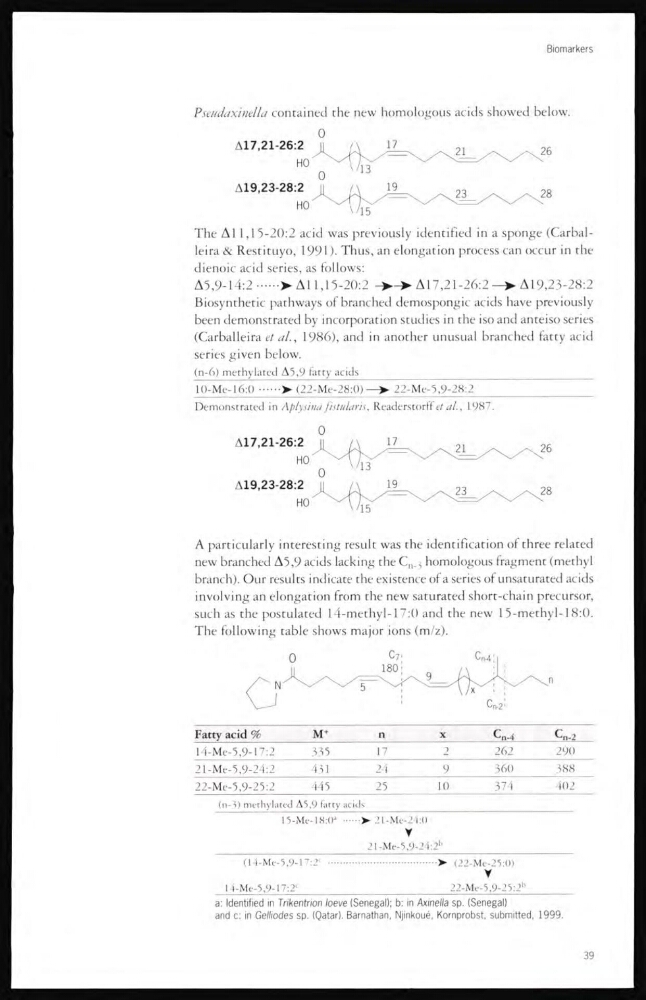
Pseudaxinella contained the new homologous acids showed below.
The Δ11,15-20:2 acid was previously identified in a sponge (Carballeira & Restituyo, 1991). Thus, an elongation process can occur in the
dienoic acid series, as follows:
Δ5,9-14:2→Δ11,15-20:2→→Δ17,21-26:2→Δ19,23-28:2
Biosynthetic pathways of branched demospongic acids have previously
been demonstrated by incorporation studies in the iso and anteiso series
(Carballeira et al., 1986), and m another unusual branched fatty acid
series given below.
(n-6) methylated A5,9 fatty acids
10-Me-16:0 → (22-Me-28:0) → 22-Me-5,9-28:2
Demonstrated in Aplysina fistularis, Readerstorff et al., 1987.
A particularly interesting result was the identification of three related
new branched Δ5,9 acids lacking the C
n-3
homologous fragment (methyl
branch). Our results indicate the existence of a series of unsaturated acids
involving an elongation from the new saturated short-chain precursor,
such as the postulated 14-methyl-17:0 and the new 15-methyl-18:0.
The following table shows major ions (m z).
Fatty acid %
M +
n
X
C n-4
C n-2
14-Me-5,9-17:2
335
17
2
202
290
21-Me-5,9-24:2
431
24
9
360
388
22-Me-5,9-25:2
445
25
10
374
402
(n-3) methylated Δ5,9 fatty acids
15-Me-18:0 a
→ 21-Me-24:0
↓
21-Me-5,9-24:2 b
(14-Me-5,9-17:2 c
→ (22-Me-25:0)
↓
14-Me-5,9-17:2 c
22-Me-5,9-25:2 b
a: Identified in Trikentrion loeve (Senegal); b: in Axmella sp. (benegal)
and c: in Gelliodes sp. (Qatar). Barnathan, Njinkoué, Kornprobst, submitted, 1999.
39
Pseudaxinella contained the new homologous acids showed below.
The Δ11,15-20:2 acid was previously identified in a sponge (Carballeira & Restituyo, 1991). Thus, an elongation process can occur in the
dienoic acid series, as follows:
Δ5,9-14:2→Δ11,15-20:2→→Δ17,21-26:2→Δ19,23-28:2
Biosynthetic pathways of branched demospongic acids have previously
been demonstrated by incorporation studies in the iso and anteiso series
(Carballeira et al., 1986), and m another unusual branched fatty acid
series given below.
(n-6) methylated A5,9 fatty acids
10-Me-16:0 → (22-Me-28:0) → 22-Me-5,9-28:2
Demonstrated in Aplysina fistularis, Readerstorff et al., 1987.
A particularly interesting result was the identification of three related
new branched Δ5,9 acids lacking the C
n-3
homologous fragment (methyl
branch). Our results indicate the existence of a series of unsaturated acids
involving an elongation from the new saturated short-chain precursor,
such as the postulated 14-methyl-17:0 and the new 15-methyl-18:0.
The following table shows major ions (m z).
Fatty acid %
M +
n
X
C n-4
C n-2
14-Me-5,9-17:2
335
17
2
202
290
21-Me-5,9-24:2
431
24
9
360
388
22-Me-5,9-25:2
445
25
10
374
402
(n-3) methylated Δ5,9 fatty acids
15-Me-18:0 a
→ 21-Me-24:0
↓
21-Me-5,9-24:2 b
(14-Me-5,9-17:2 c
→ (22-Me-25:0)
↓
14-Me-5,9-17:2 c
22-Me-5,9-25:2 b
a: Identified in Trikentrion loeve (Senegal); b: in Axmella sp. (benegal)
and c: in Gelliodes sp. (Qatar). Barnathan, Njinkoué, Kornprobst, submitted, 1999.
39