

Marme lipids
of the liposomes was subjected to aggregation (275 ± 50 pm). Liposome
dilution with sea water induced the immediate formation of large
aggregates as revealed by the increased turbidity of the preparation
and granulometry measurements (9.3 ± 5.5 µm). Aggregation was
confirmed by optical microscopy observations. Fast initial aggregation
was probably due to the interaction of phospholipids with divalent
cations in the sea water. However, the aggregates did not extent as a
function of time and no sedimentation was observed, at least, at the lipid
concentrations studied in this work.
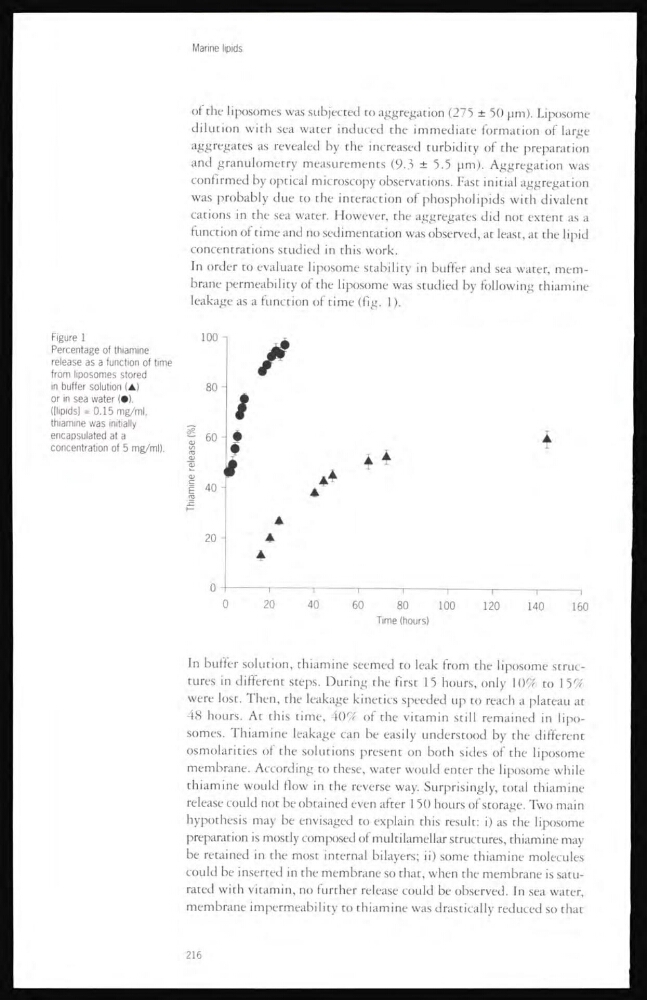
In order to evaluate liposome stability in buffer and sea water, membrane permeability of the liposome was studied by following thiamine
leakage as a function of time (fig. 1).
Figure 1
Percentage of thiamine
release as a function of time
from liposomes stored
in buffer solution (▲)
or in sea water (•).
([lipids] = 0.15 mg/ml,
thiamine was initially
encapsulated at a
concentration of 5 mg/ml).
In buffer solution, thiamine seemed to leak from the liposome structures in different steps. During the first 15 hours, only 10% to 15%
were lost. Then, the leakage kinetics speeded up to reach a plateau at
48 hours. At this time, 40% of the vitamin still remained in liposomes. Thiamine leakage can be easily understood by the different
osmolarities of the solutions present on both sicles of the liposome
membrane. According to these, water would enter the liposome while
thiamine would flow in the reverse way. Surprisingly, total thiamine
release could not be obtained even after 150 hours of storage. Two main
hypothesis may be envisaged to explain this result: i) as the liposome
preparation is mostly composed of multilamellar structures, thiamine may
be retained in the most internal bilayers; ii) some thiamine molecules
could be inserted in the membrane so that, when the membrane is saturated with vitamin, no further release could be observed. In sea water,
membrane impermeability to thiamine was drastically reduced so that
216
of the liposomes was subjected to aggregation (275 ± 50 pm). Liposome
dilution with sea water induced the immediate formation of large
aggregates as revealed by the increased turbidity of the preparation
and granulometry measurements (9.3 ± 5.5 µm). Aggregation was
confirmed by optical microscopy observations. Fast initial aggregation
was probably due to the interaction of phospholipids with divalent
cations in the sea water. However, the aggregates did not extent as a
function of time and no sedimentation was observed, at least, at the lipid
concentrations studied in this work.
In order to evaluate liposome stability in buffer and sea water, membrane permeability of the liposome was studied by following thiamine
leakage as a function of time (fig. 1).
Figure 1
Percentage of thiamine
release as a function of time
from liposomes stored
in buffer solution (▲)
or in sea water (•).
([lipids] = 0.15 mg/ml,
thiamine was initially
encapsulated at a
concentration of 5 mg/ml).
In buffer solution, thiamine seemed to leak from the liposome structures in different steps. During the first 15 hours, only 10% to 15%
were lost. Then, the leakage kinetics speeded up to reach a plateau at
48 hours. At this time, 40% of the vitamin still remained in liposomes. Thiamine leakage can be easily understood by the different
osmolarities of the solutions present on both sicles of the liposome
membrane. According to these, water would enter the liposome while
thiamine would flow in the reverse way. Surprisingly, total thiamine
release could not be obtained even after 150 hours of storage. Two main
hypothesis may be envisaged to explain this result: i) as the liposome
preparation is mostly composed of multilamellar structures, thiamine may
be retained in the most internal bilayers; ii) some thiamine molecules
could be inserted in the membrane so that, when the membrane is saturated with vitamin, no further release could be observed. In sea water,
membrane impermeability to thiamine was drastically reduced so that
216