

Marine lipids
most convenient lipase and alcohol are determined. Then, the effect of
the presence of EPA, PAL or EPA methyl ester on ARA methyl ester synthesis is examined.
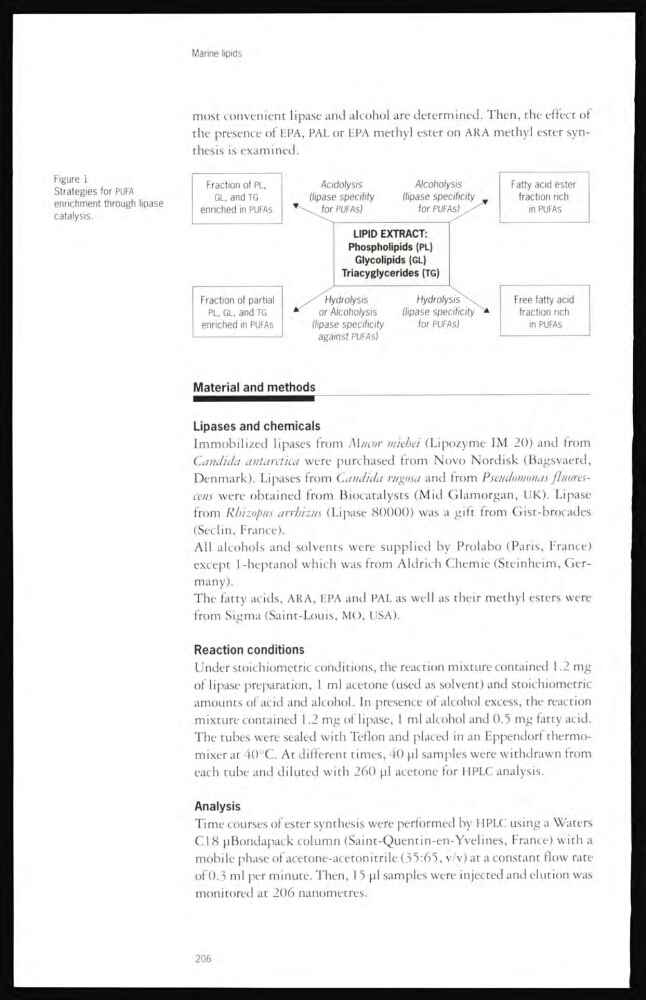
Figure 1
Strategies for PUFA
enrichment through lipase
catalysis.
Material and methods
Lipases and chemicals
Immobilized lipases from Mucor miehei (Lipozyme IM 20) and from
Candida antarctica were purchased from Novo Nordisk (Bagsvaerd,
Denmark). Lipases from Candida rugosa and from Pseudomonas flnorescens were obtained from Biocatalysts (Mid Glamorgan, UK). Lipase
from Rhizopus arrhizus (Lipase 80000) was a gift from Gist-brocades
(Seclin, France).
All alcohols and solvents were supplied by Prolabo (Paris, France)
except 1-heptanol which was from Aldrich Chemie (Steinheim, Germany).
The fatty acicls, ARA, EPA and PAL as well as their methyl esters were
from Sigma (Saint-Louis, MO, USA).
Reaction conditions
Under stoichiometric conditions, the reaction mixture contained 1.2 mg
of lipase preparation, 1 ml acetone (used as solvent) and stoichiometric
amounts of acid and alcohol. In presence of alcohol excess, the reaction
mixture contained 1.2 mg of lipase, 1 ml alcohol and 0.5 mg fatty acid.
The tubes were sealed with Teflon and placed in an Eppendorf thermomixer at 40°C. At different times, 40 pl samples were withdrawn from
each tube and diluted with 260 pl acetone for HPLC analysis.
Analysis
Time courses of ester synthesis were performed by HPLC using a Waters
C18 pBondapack column (Saint-Quentin-en-Yvelines, France) with a
mobile phase of acetone-acetonitrile (35:65, v/v) at a constant flow rate
of 0.3 ml per minute. Then, 15 µl samples werc injected and elution was
monitored at 206 nanometres.
206
most convenient lipase and alcohol are determined. Then, the effect of
the presence of EPA, PAL or EPA methyl ester on ARA methyl ester synthesis is examined.
Figure 1
Strategies for PUFA
enrichment through lipase
catalysis.
Material and methods
Lipases and chemicals
Immobilized lipases from Mucor miehei (Lipozyme IM 20) and from
Candida antarctica were purchased from Novo Nordisk (Bagsvaerd,
Denmark). Lipases from Candida rugosa and from Pseudomonas flnorescens were obtained from Biocatalysts (Mid Glamorgan, UK). Lipase
from Rhizopus arrhizus (Lipase 80000) was a gift from Gist-brocades
(Seclin, France).
All alcohols and solvents were supplied by Prolabo (Paris, France)
except 1-heptanol which was from Aldrich Chemie (Steinheim, Germany).
The fatty acicls, ARA, EPA and PAL as well as their methyl esters were
from Sigma (Saint-Louis, MO, USA).
Reaction conditions
Under stoichiometric conditions, the reaction mixture contained 1.2 mg
of lipase preparation, 1 ml acetone (used as solvent) and stoichiometric
amounts of acid and alcohol. In presence of alcohol excess, the reaction
mixture contained 1.2 mg of lipase, 1 ml alcohol and 0.5 mg fatty acid.
The tubes were sealed with Teflon and placed in an Eppendorf thermomixer at 40°C. At different times, 40 pl samples were withdrawn from
each tube and diluted with 260 pl acetone for HPLC analysis.
Analysis
Time courses of ester synthesis were performed by HPLC using a Waters
C18 pBondapack column (Saint-Quentin-en-Yvelines, France) with a
mobile phase of acetone-acetonitrile (35:65, v/v) at a constant flow rate
of 0.3 ml per minute. Then, 15 µl samples werc injected and elution was
monitored at 206 nanometres.
206