

Function and metabolism
by measuring the DHA balance and organ partitioning in growing rats
using the whole bocly fatty acid balance methocl (Cunnane & Anclerson, 1997), and compared it with that of a-linolenic acid.
Materials and methods
Twelve female pregnant Wistar rats from a (n-3) fatty acid-deficient lineage were used as previously described (Guesnet et al., 1997). One week
before parturition, they were randomly divided into two dietary groups
(n = 6). Both groups received a semi-purified cliet containing 5 weight %
fat: the first one received about 200 mg 18:3 (n-3)/100 g diet (i.e. 4.6
weight % of total fatty acids) by addition of linseed oil (Novance, France), and the second one about 200 mg 22:6 (n-3)/100 g diet (i.e. 4.2
weight % of total fatty acids) by addition of a DHA-rich microalgae oil
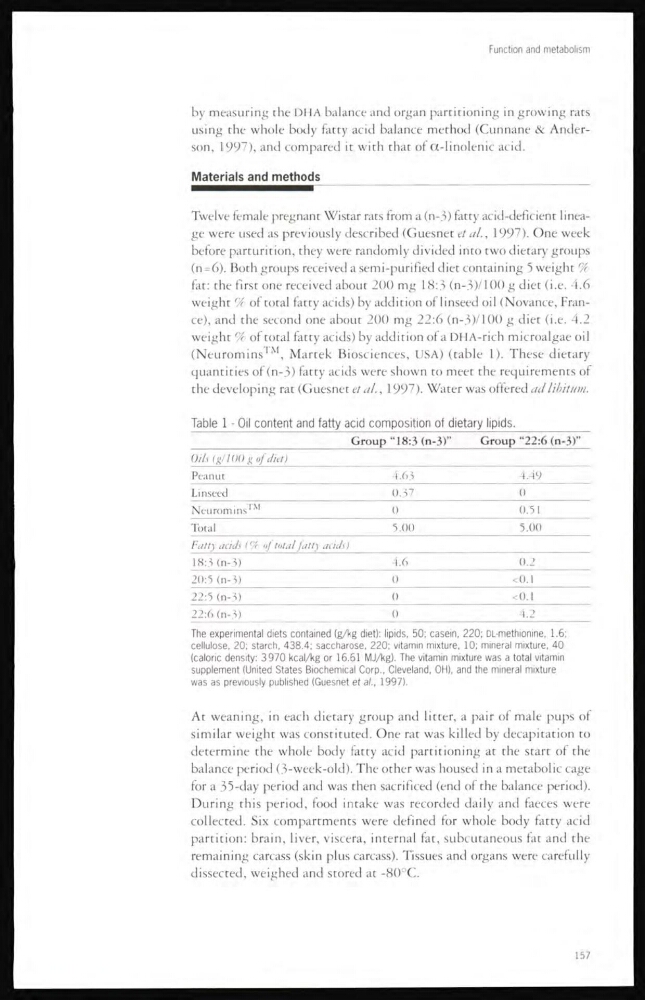
(Neuromins™, Martek Biosciences, USA) (table 1). These dietary
quantities of (n-3) fatty acids were shown to meet the requirements of
the developing rat (Guesnet et al., 1997). Water was offered adlibitum.
Table 1 - Oil content and fatty acid composition of dietary lipids.
Group “18:3 (n-3)”
Group “22:6 (n-3)”
Oils (g/100 g of diet)
Peanut
4.63
4.49
Linseed
0.37
0
Neuromins™
0
0.51
Total
5.00
5.00
Fatty actds (% of total fatty acids)
18:3 (n-3)
4.6
0.2
20:5 (n-3)
0
<0.1
22:5 (n-3)
0
<0.1
22:6 (n-3)
0
4.2
The experimental diets contained (g/kg diet): lipids, 50; casein, 220; DL-methionine, 1.6;
cellulose, 20; starch, 438.4; saccharose, 220; vitamin mixture, 10; mineral mixture, 40
(caloric density: 3970 kcalAg or 16.61 MJ/kg). The vltamin mixture was a total vitamin
supplement (United States Biochemical Corp., Cleveland, OH), and the mineral mixture
was as previously published (Guesnet et al., 1997).
At weaning, in each dietary group and litter, a pair of male pups of
similar weight was constituted. One rat was killed by decapitation to
determine the whole body fatty acid partitioning at the start of the
balance period (3-week-old). The other was housed in a metabolic cage
for a 35-day period and was then sacrificed (end of the balance period).
During this period, food intake was recorded daily and faeces were
collected. Six compartments were defined for whole body fatty acid
partition: brain, liver, viscera, internal fat, subcutaneous fat and the
remaining carcass (skin plus carcass). Tissues and organs were carefully
dissected, weighed and stored at -80°C.
157
by measuring the DHA balance and organ partitioning in growing rats
using the whole bocly fatty acid balance methocl (Cunnane & Anclerson, 1997), and compared it with that of a-linolenic acid.
Materials and methods
Twelve female pregnant Wistar rats from a (n-3) fatty acid-deficient lineage were used as previously described (Guesnet et al., 1997). One week
before parturition, they were randomly divided into two dietary groups
(n = 6). Both groups received a semi-purified cliet containing 5 weight %
fat: the first one received about 200 mg 18:3 (n-3)/100 g diet (i.e. 4.6
weight % of total fatty acids) by addition of linseed oil (Novance, France), and the second one about 200 mg 22:6 (n-3)/100 g diet (i.e. 4.2
weight % of total fatty acids) by addition of a DHA-rich microalgae oil
(Neuromins™, Martek Biosciences, USA) (table 1). These dietary
quantities of (n-3) fatty acids were shown to meet the requirements of
the developing rat (Guesnet et al., 1997). Water was offered adlibitum.
Table 1 - Oil content and fatty acid composition of dietary lipids.
Group “18:3 (n-3)”
Group “22:6 (n-3)”
Oils (g/100 g of diet)
Peanut
4.63
4.49
Linseed
0.37
0
Neuromins™
0
0.51
Total
5.00
5.00
Fatty actds (% of total fatty acids)
18:3 (n-3)
4.6
0.2
20:5 (n-3)
0
<0.1
22:5 (n-3)
0
<0.1
22:6 (n-3)
0
4.2
The experimental diets contained (g/kg diet): lipids, 50; casein, 220; DL-methionine, 1.6;
cellulose, 20; starch, 438.4; saccharose, 220; vitamin mixture, 10; mineral mixture, 40
(caloric density: 3970 kcalAg or 16.61 MJ/kg). The vltamin mixture was a total vitamin
supplement (United States Biochemical Corp., Cleveland, OH), and the mineral mixture
was as previously published (Guesnet et al., 1997).
At weaning, in each dietary group and litter, a pair of male pups of
similar weight was constituted. One rat was killed by decapitation to
determine the whole body fatty acid partitioning at the start of the
balance period (3-week-old). The other was housed in a metabolic cage
for a 35-day period and was then sacrificed (end of the balance period).
During this period, food intake was recorded daily and faeces were
collected. Six compartments were defined for whole body fatty acid
partition: brain, liver, viscera, internal fat, subcutaneous fat and the
remaining carcass (skin plus carcass). Tissues and organs were carefully
dissected, weighed and stored at -80°C.
157