

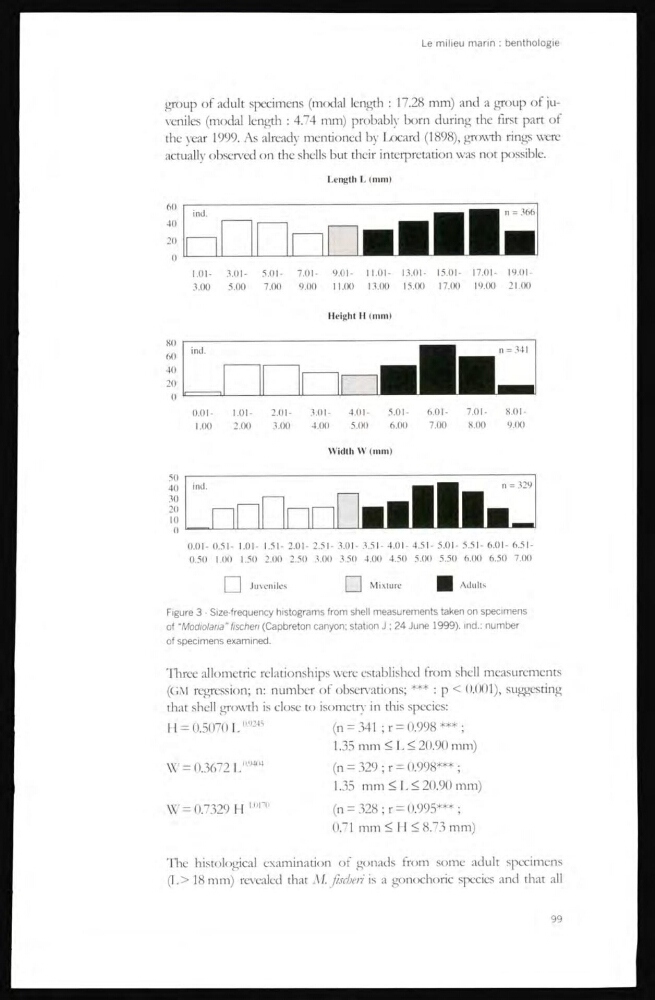
group of adult specimens (modal length : 17.28 mm) and a group of juveniles (modal length : 4.74 mm) probably born during the first part of
the year 1999. As already mentioned by Locard (1898), growth rings were
actually observed on the shells but their interpretation was not possible.
Figure 3 - Size-frequency histograms from shell measurements taken on specimens
of “Modiolaria" fischeri (Capbreton canyon; station J ; 24 June 1999). ind.: number
of specimens examined.
Three allometric relationships were established from shell measurements
(GM regression; n: number of observations; *** : p < 0.001), suggesting
that shell growth is close to isometry in this species:
H = 0.5070 L 0.9245
(n = 341 ; r= 0.998 *** ;
1.35 mm < L < 20.90 mm)
W = 0.3672 L 0.9404
(n = 329 ; r = 11.998*** ;
1.35 mm < L < 20.90 mm)
W= 0.7329 H
1.0170
(n= 328 ;r= 0.995***;
0.71 mm < H < 8.73 mm)
The histological examinarion of gonads from some adult specimens
(L> 18 mm) revealed that M. fischeri is a gonochoric species and that all
99
the year 1999. As already mentioned by Locard (1898), growth rings were
actually observed on the shells but their interpretation was not possible.
Figure 3 - Size-frequency histograms from shell measurements taken on specimens
of “Modiolaria" fischeri (Capbreton canyon; station J ; 24 June 1999). ind.: number
of specimens examined.
Three allometric relationships were established from shell measurements
(GM regression; n: number of observations; *** : p < 0.001), suggesting
that shell growth is close to isometry in this species:
H = 0.5070 L 0.9245
(n = 341 ; r= 0.998 *** ;
1.35 mm < L < 20.90 mm)
W = 0.3672 L 0.9404
(n = 329 ; r = 11.998*** ;
1.35 mm < L < 20.90 mm)
W= 0.7329 H
1.0170
(n= 328 ;r= 0.995***;
0.71 mm < H < 8.73 mm)
The histological examinarion of gonads from some adult specimens
(L> 18 mm) revealed that M. fischeri is a gonochoric species and that all
99