

Figure 1 - Location of the sampling stations from “Le Travailleur” expedition and Oxybent IX cruise in the SE
of the bay of Biscay.
Contaminated by surficial mud due to side sled reversal during towing on
the bottom, the net samples contained an abundant populaüon of a
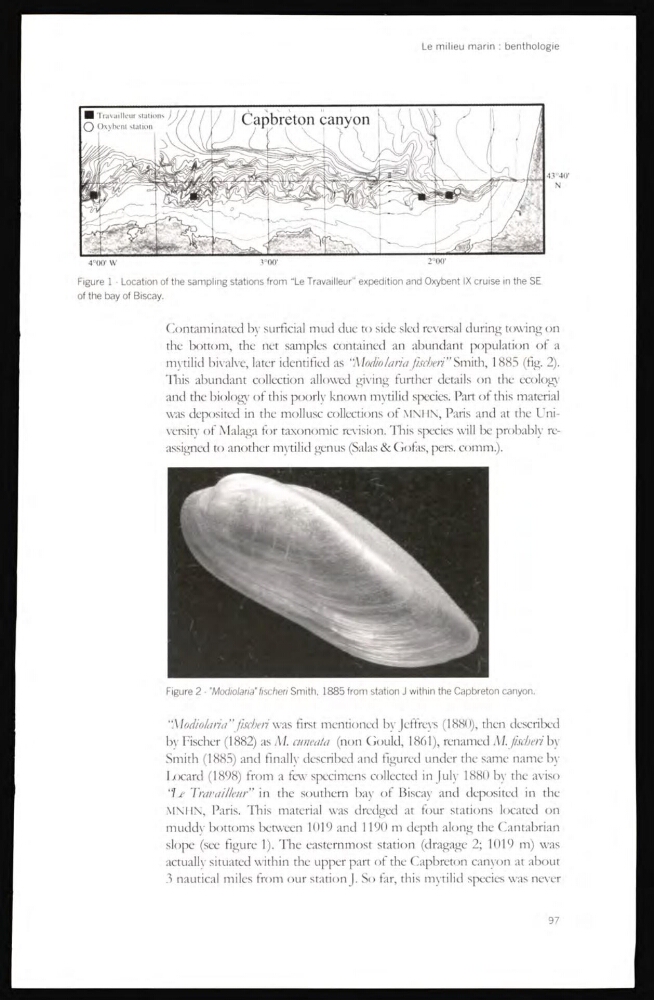
mytilid bivalve, later identified as “Modiolaria fischeri” Smith, 1885 (fig. 2).
This abundant collection allowed giving further details on the ecolog)'
and the biology of this poorly known mvtilid species. Part of this material
was deposited in the mollusc collections of MNHN, Paris and at the Universitv of Malaga for taxonomic revision. This species will be probably reassigned to another mytilid genus (Salas & Gotas, pers. comm.).
Figure 2 - "Modiolaria" fischeri Smith, 1885 from station J within the Capbreton canyon.
'Modiolaria” fischeri was first mentioned by Jeffreys (1880), then described
by Fischer (1882) as M. cuneata (non (Gould, 1861), renamed M. fischeri by
Smith (1885) and finally described and figured under the same name by
Ixicard (1898) from a few specimens collected in July 1880 by the aviso
“Le Trvailleur” in the southern bay of Biscuy and deposited in the
MNHN, Paris. This material was dredged at four stations located on
muddy bottoms between 1019 and 1190 m depth along the Cantabrian
slope (see figure 1). The eastemmost station (dragage 2; 1019 m) was
actually situated within the upper part of the Capbreton canv on at about
3 nautical miles from our station J. So far, this mytilid species was never
97
of the bay of Biscay.
Contaminated by surficial mud due to side sled reversal during towing on
the bottom, the net samples contained an abundant populaüon of a
mytilid bivalve, later identified as “Modiolaria fischeri” Smith, 1885 (fig. 2).
This abundant collection allowed giving further details on the ecolog)'
and the biology of this poorly known mvtilid species. Part of this material
was deposited in the mollusc collections of MNHN, Paris and at the Universitv of Malaga for taxonomic revision. This species will be probably reassigned to another mytilid genus (Salas & Gotas, pers. comm.).
Figure 2 - "Modiolaria" fischeri Smith, 1885 from station J within the Capbreton canyon.
'Modiolaria” fischeri was first mentioned by Jeffreys (1880), then described
by Fischer (1882) as M. cuneata (non (Gould, 1861), renamed M. fischeri by
Smith (1885) and finally described and figured under the same name by
Ixicard (1898) from a few specimens collected in July 1880 by the aviso
“Le Trvailleur” in the southern bay of Biscuy and deposited in the
MNHN, Paris. This material was dredged at four stations located on
muddy bottoms between 1019 and 1190 m depth along the Cantabrian
slope (see figure 1). The eastemmost station (dragage 2; 1019 m) was
actually situated within the upper part of the Capbreton canv on at about
3 nautical miles from our station J. So far, this mytilid species was never
97