

isopods ranked first at bathyal depths, at least during the first part of the
vear (Elizalde, 1994; Elizalde et al., 1993; unpublished data).
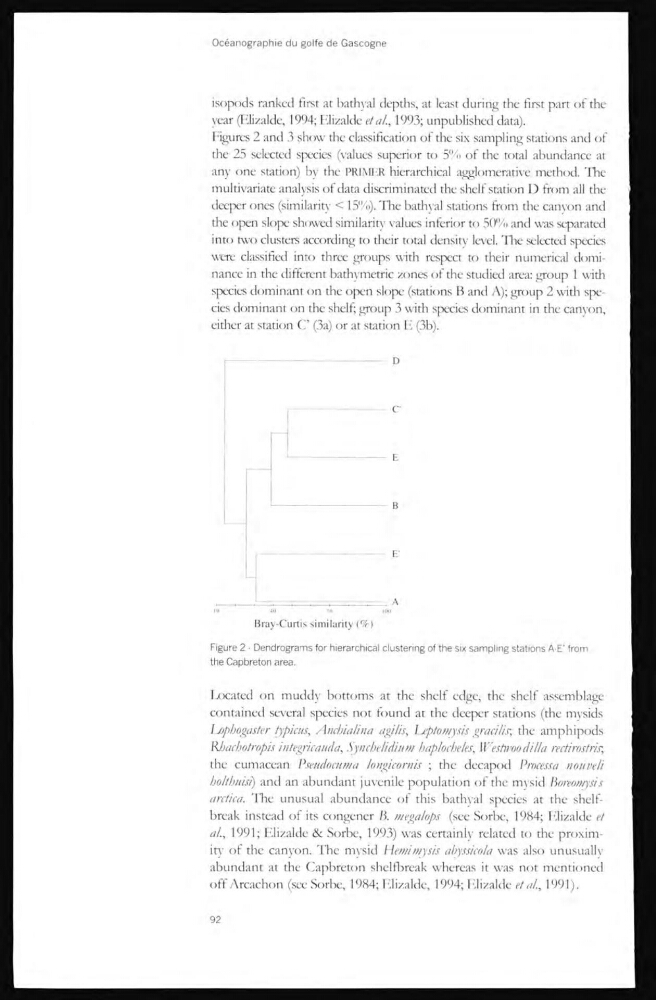
Figures 2 and 3 show the classificadon of the six sampling stations and of
the 25 selected species (values superior to 5% of the total abundance at
any one station) by the PRIMER hierarchical agglomerative method. The
multivariate analysis of data discriminated the shelf station D from all the
deeper ones (similarity < 15%). The bathyal stations from the canyon and
the open slope showed similarity values inferior to 50% and was separated
into two clusters according to their total density level. The selected species
were classified into three groups with respect to their numerical dominance in the different bathymetric zones of the studied area; group 1 with
species dominant on the open slope (stations B and A); group 2 with species dominant on the shelf; group 3 with species dominant in the canyon,
either at station C’ (3a) or at station E (3b).
Bray-Curtis similarity (%)
Figure 2 - Dendrograms for hierarchical clustering of the six sampiing stations A-E' from
the Capbreton area.
Located on muddy bottoms at the shelf edge, the shelf assemblage
contained several species not found at the deeper stations (the m\ sids
Lophogaster typicus, Anchialina agilis, Leptomysis gracilis, the amphipods
Rhachotropis integricauda, Synchelidium haplocheles, Westwoodilla rectirostris,
the cumacean Pseudocuma longicornis ; the decapod Processa nouveli
holthuisî) and an abundant juvenile population of the mysid Boreomysis
arctica. The unusual abundancc of this bathval species at the shelfbreak instead of its congener B. megalops (see Sorbe, 1984; Elizalde et
al., 1991; Elizalde & Sorbe, 1993) was certainly related to the proximity of the canyon. The mysid Hemimysis ahyssicola was also unusually
abundant at the Capbreton shelfbreak whereas it was not mentioned
off Arcachon (see Sorbe, 1984; Elizalde, 1994; Elizalde et al, 1991).
92
vear (Elizalde, 1994; Elizalde et al., 1993; unpublished data).
Figures 2 and 3 show the classificadon of the six sampling stations and of
the 25 selected species (values superior to 5% of the total abundance at
any one station) by the PRIMER hierarchical agglomerative method. The
multivariate analysis of data discriminated the shelf station D from all the
deeper ones (similarity < 15%). The bathyal stations from the canyon and
the open slope showed similarity values inferior to 50% and was separated
into two clusters according to their total density level. The selected species
were classified into three groups with respect to their numerical dominance in the different bathymetric zones of the studied area; group 1 with
species dominant on the open slope (stations B and A); group 2 with species dominant on the shelf; group 3 with species dominant in the canyon,
either at station C’ (3a) or at station E (3b).
Bray-Curtis similarity (%)
Figure 2 - Dendrograms for hierarchical clustering of the six sampiing stations A-E' from
the Capbreton area.
Located on muddy bottoms at the shelf edge, the shelf assemblage
contained several species not found at the deeper stations (the m\ sids
Lophogaster typicus, Anchialina agilis, Leptomysis gracilis, the amphipods
Rhachotropis integricauda, Synchelidium haplocheles, Westwoodilla rectirostris,
the cumacean Pseudocuma longicornis ; the decapod Processa nouveli
holthuisî) and an abundant juvenile population of the mysid Boreomysis
arctica. The unusual abundancc of this bathval species at the shelfbreak instead of its congener B. megalops (see Sorbe, 1984; Elizalde et
al., 1991; Elizalde & Sorbe, 1993) was certainly related to the proximity of the canyon. The mysid Hemimysis ahyssicola was also unusually
abundant at the Capbreton shelfbreak whereas it was not mentioned
off Arcachon (see Sorbe, 1984; Elizalde, 1994; Elizalde et al, 1991).
92