

In this paper, new data on the distribution of dissolved uranium along the
Gironde estuary (SW France) are presented and interpreted in an attempt to
improve our understanding of the physical and chemical transformations
controlling the fate of dissolved uranium within the estuary’s mixing zone.
The Gironde estuan' is the product of the confluence of the Garonne
and Dordogne rivers. Mean annual water discharge is 24 X 10
9 m
3 .yr
-1
and solid discharge 2.2 X 10
12 grammes per year. The Gironde can be
considered as a partially mixed, macrotidal estuary with a relatively long
flushing time (ranging from 20 days in flood to 86 days during low water discharge). Hydrodynamic mechanisms in the Gironde estuary produce a well-developed turbidity maximum, with suspended matter concentrations ranging from 0.1 to 10 gramme per litre. During certain
periods, a fluid mud layer, where turbidity reaches 400 g 1
-1 , accumulates on the estuary bottom. The total sediment mass of these two mrbidity accumulations is twice the annual riverine solid discharge, and
greatly favours solid-liquid interactions pbaz-Poulichet et aL, 1084; Kraepiel et al.,1997).
Material and methods
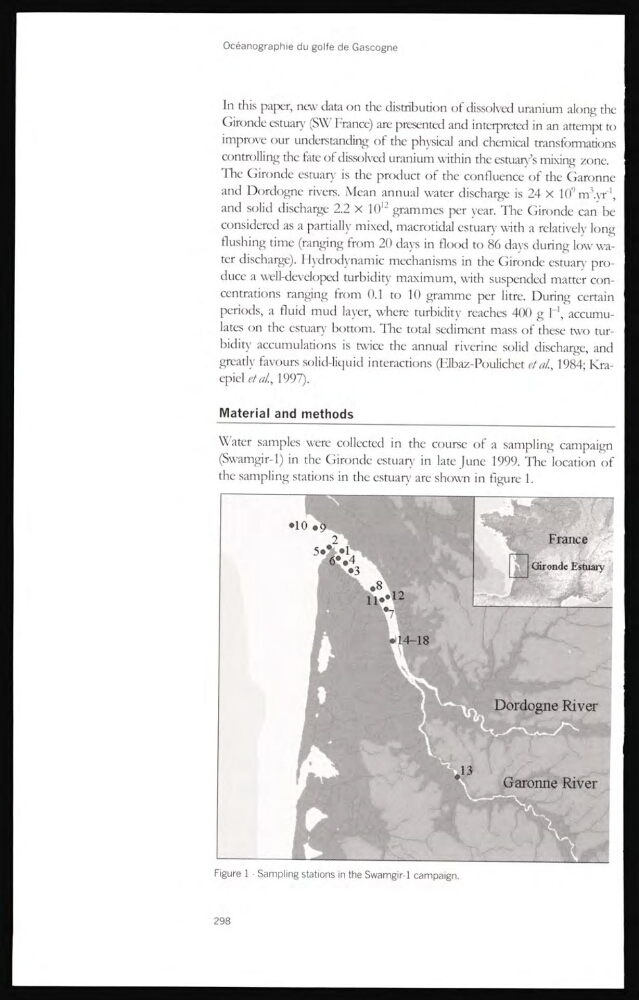
Water samples were collected in the course of a sampling campaign
(Swamgir-1 ) in the Gironde estuary in late June 1999. The location of
the sampling stations in the estuary are shown in figure 1.
Figure 1 - Sampling stations in the Swamgir-1 campaign.
298
Gironde estuary (SW France) are presented and interpreted in an attempt to
improve our understanding of the physical and chemical transformations
controlling the fate of dissolved uranium within the estuary’s mixing zone.
The Gironde estuan' is the product of the confluence of the Garonne
and Dordogne rivers. Mean annual water discharge is 24 X 10
9 m
3 .yr
-1
and solid discharge 2.2 X 10
12 grammes per year. The Gironde can be
considered as a partially mixed, macrotidal estuary with a relatively long
flushing time (ranging from 20 days in flood to 86 days during low water discharge). Hydrodynamic mechanisms in the Gironde estuary produce a well-developed turbidity maximum, with suspended matter concentrations ranging from 0.1 to 10 gramme per litre. During certain
periods, a fluid mud layer, where turbidity reaches 400 g 1
-1 , accumulates on the estuary bottom. The total sediment mass of these two mrbidity accumulations is twice the annual riverine solid discharge, and
greatly favours solid-liquid interactions pbaz-Poulichet et aL, 1084; Kraepiel et al.,1997).
Material and methods
Water samples were collected in the course of a sampling campaign
(Swamgir-1 ) in the Gironde estuary in late June 1999. The location of
the sampling stations in the estuary are shown in figure 1.
Figure 1 - Sampling stations in the Swamgir-1 campaign.
298