

Simultaneous high frequency measurements of current velocity and SPM
were obtained using the POST (Profile of sediment transport) system
(Christie et al., 1997) which was deployed in the bottom one metre of the
water column. Tliis consisted of four two-channel miniaturized electromagnetic current meters (Emcm) and ftve oprical backscatter sensors;
data was recorded continuously at 18 I Iz. All measurements were made
within an Eulerian reference frame. The instrumentation, which was
mounted onto a metal bedframe, was aligned with the ambient current
flow by a tail fin, and lowered on to the estuary bed from the CNRS vessel
“Côte d’Aquitaine”. A tilt-roll sensor together with a fluxgate compass provided digital orientation information. Complementary vertical profiles
of temperature, salinity, and turbidity were collected, together with
gravimetric calibration data obtained by Niskin bottles.
Results and discussion
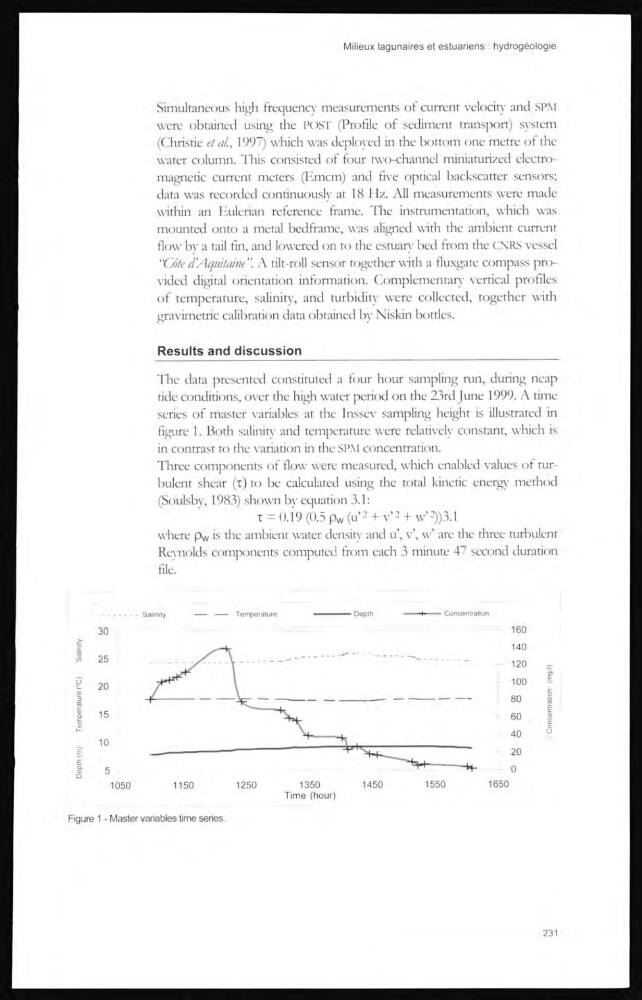
The data presented constituted a four hour sampling run, during neap
tide conditions, over the high water period on the 23rd June 1999. A time
series of master variables at the Inssev sampling height is illustrated in
ftgure 1. Both salinity and temperature were relatively constant, which is
in contrast to the variation in the SPM concentration.
Three components of flow were measured, which enabled values of turbulent shear (T) to be calculated using the total ldnetic energy method
(Soulsby, 1983) sh< >wn by equation 3.1 :
τ = 0.19 (0.5 ρ w (u - + v’ 2 + w >2 ))3.1
where p
w
is the ambient water density and u’, v’, w’ are the three turbulent
Reynolds components computed from each 3 minute 47 second duration
file.
Figure 1 - Master variables time series.
231
were obtained using the POST (Profile of sediment transport) system
(Christie et al., 1997) which was deployed in the bottom one metre of the
water column. Tliis consisted of four two-channel miniaturized electromagnetic current meters (Emcm) and ftve oprical backscatter sensors;
data was recorded continuously at 18 I Iz. All measurements were made
within an Eulerian reference frame. The instrumentation, which was
mounted onto a metal bedframe, was aligned with the ambient current
flow by a tail fin, and lowered on to the estuary bed from the CNRS vessel
“Côte d’Aquitaine”. A tilt-roll sensor together with a fluxgate compass provided digital orientation information. Complementary vertical profiles
of temperature, salinity, and turbidity were collected, together with
gravimetric calibration data obtained by Niskin bottles.
Results and discussion
The data presented constituted a four hour sampling run, during neap
tide conditions, over the high water period on the 23rd June 1999. A time
series of master variables at the Inssev sampling height is illustrated in
ftgure 1. Both salinity and temperature were relatively constant, which is
in contrast to the variation in the SPM concentration.
Three components of flow were measured, which enabled values of turbulent shear (T) to be calculated using the total ldnetic energy method
(Soulsby, 1983) sh< >wn by equation 3.1 :
τ = 0.19 (0.5 ρ w (u - + v’ 2 + w >2 ))3.1
where p
w
is the ambient water density and u’, v’, w’ are the three turbulent
Reynolds components computed from each 3 minute 47 second duration
file.
Figure 1 - Master variables time series.
231