

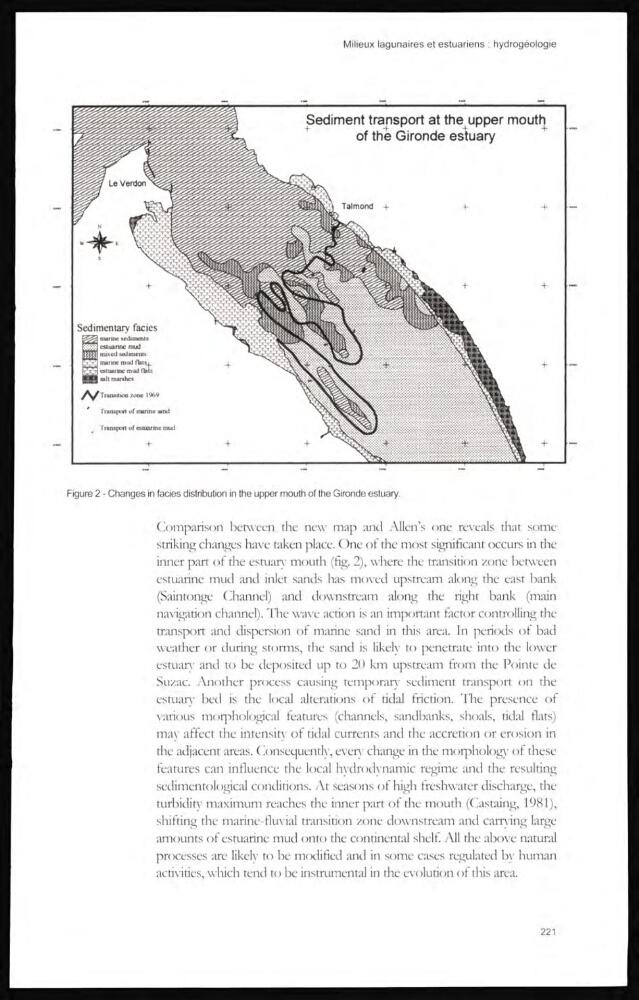
Figure 2 - Changes in facies distribution in the upper mouth of the Gironde estuary.
Comparison between the new map and Allen’s one reveals that some
striking changes have taken place. One of the most significant occurs in the
inner part of the estuary mouth (fig. 2), where the transition zone between
estuarine mud and inlet sands has moved upstream along the east bank
(Saintonge Channel) and downstream along the right bank (main
navigation channel). 'Ihe wave action is an important factor controlling the
transport and dispersion of marine sand in this area. In periods of bad
weather or during sti irms, the sand is likely to penetrate into the lower
estuarv and to be deposited up to 20 km upstream from the Pointe de
Suzac. Another process causing temporary sediment transport on the
estuary bed is the local alterations of tidal friction. The presence of
various morphological features (channels, sandbanks, shoals, tidal fkts)
may affect the intensity of tidal currents and the accretion or erosion in
the adjacent areas. Consequently, even change in the morphologt' of these
features can influence the local hydrodynamic regime and the resulting
sedimentological conditions. At seasons of high freshwater discharge, the
turbidity maximum reaches the inner part of the mouth (( iastaing, 1981),
shifting the marine-fluvial transition zone downstream and cartying large
amounts of estuarine mud onto the contdnental shelf. All the above natural
processes are likely to be modified and in some cases regulated by human
activities, which tend to be instrumental in the evolution of this area.
221
Comparison between the new map and Allen’s one reveals that some
striking changes have taken place. One of the most significant occurs in the
inner part of the estuary mouth (fig. 2), where the transition zone between
estuarine mud and inlet sands has moved upstream along the east bank
(Saintonge Channel) and downstream along the right bank (main
navigation channel). 'Ihe wave action is an important factor controlling the
transport and dispersion of marine sand in this area. In periods of bad
weather or during sti irms, the sand is likely to penetrate into the lower
estuarv and to be deposited up to 20 km upstream from the Pointe de
Suzac. Another process causing temporary sediment transport on the
estuary bed is the local alterations of tidal friction. The presence of
various morphological features (channels, sandbanks, shoals, tidal fkts)
may affect the intensity of tidal currents and the accretion or erosion in
the adjacent areas. Consequently, even change in the morphologt' of these
features can influence the local hydrodynamic regime and the resulting
sedimentological conditions. At seasons of high freshwater discharge, the
turbidity maximum reaches the inner part of the mouth (( iastaing, 1981),
shifting the marine-fluvial transition zone downstream and cartying large
amounts of estuarine mud onto the contdnental shelf. All the above natural
processes are likely to be modified and in some cases regulated by human
activities, which tend to be instrumental in the evolution of this area.
221