

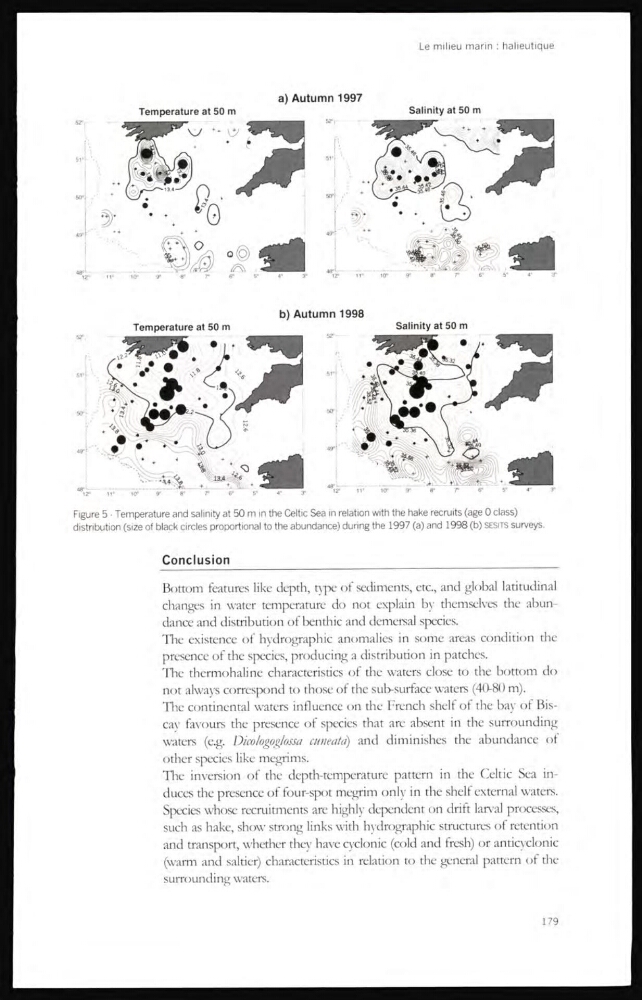
a) Autumn 1997
b) Autumn 1998
Figure 5 - Temperature and salinity at 50 m in the Celtic Sea in relation with the hake recruits (age 0 class)
distrîbution (size of black circles proportional to the abundance) during the 1997 (a) and 1998 (b) SESITS surveys.
Conclusion
Bottom features like depth, type of sediments, etc., and global latitudinal
changes in water temperature do not explain by themselves the abundance and distribution of benthic and demersal species.
The existence of hydrographic anomalies in some areas condition the
presence of the species, producing a distribution in patches.
The thermohaline characteristics of the waters close to the bottom do
not always correspond to those of the sub-surface waters (40-80 m).
The continental waters influence on the French shelf of the bay of Biscay favours the presence of species that are absent in the surrounding
waters (e.g. Dicologoglossa cuneata) and diminishes the abundance of
other species like megrims.
The inversion of the depth-temperature pattern in the Celtic Sea induces the presence of four-spot megrim only in the shelf external waters.
Species whose recruitments are highly dependent on drift larval processes,
such as hake, show strong links with hydrographic structures of retention
and transport, whether they have cyclonic (cold and fresh) or anticyclonic
(warm and saltier) characteristics in relation to the general pattern of the
surrounding waters.
179
b) Autumn 1998
Figure 5 - Temperature and salinity at 50 m in the Celtic Sea in relation with the hake recruits (age 0 class)
distrîbution (size of black circles proportional to the abundance) during the 1997 (a) and 1998 (b) SESITS surveys.
Conclusion
Bottom features like depth, type of sediments, etc., and global latitudinal
changes in water temperature do not explain by themselves the abundance and distribution of benthic and demersal species.
The existence of hydrographic anomalies in some areas condition the
presence of the species, producing a distribution in patches.
The thermohaline characteristics of the waters close to the bottom do
not always correspond to those of the sub-surface waters (40-80 m).
The continental waters influence on the French shelf of the bay of Biscay favours the presence of species that are absent in the surrounding
waters (e.g. Dicologoglossa cuneata) and diminishes the abundance of
other species like megrims.
The inversion of the depth-temperature pattern in the Celtic Sea induces the presence of four-spot megrim only in the shelf external waters.
Species whose recruitments are highly dependent on drift larval processes,
such as hake, show strong links with hydrographic structures of retention
and transport, whether they have cyclonic (cold and fresh) or anticyclonic
(warm and saltier) characteristics in relation to the general pattern of the
surrounding waters.
179