

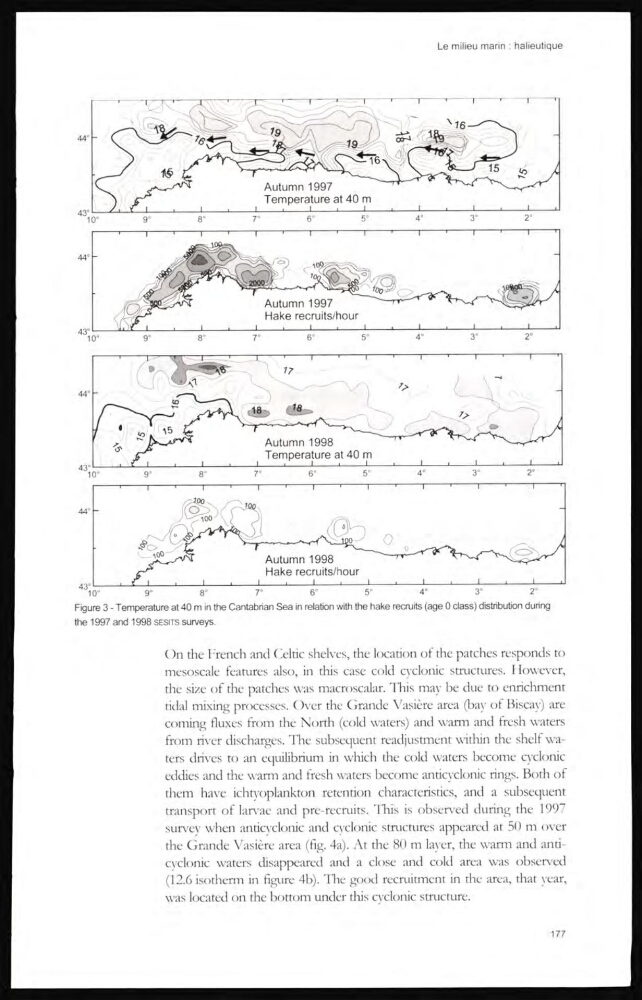
Figure 3 - Temperature at 40 m in the Cantabrian Sea in relation with the hake recoiits (age 0 dass) distribution during
the 1997 and 1998 SESITS surveys.
On the French and Celtic shelves, the location of the patches responds to
mesoscale features also, in this case cold cyclonic structures. However,
the size of the patches was macroscalar. This may be due to enrichment
tidal mixing processes. Over the Grande Vasière area (bay of Biscay) are
coming fluxes from the North (cold waters) and warm and fresh waters
from river discharges. The subsequent readjustment within the shelf waters drives to an equilibrium in which the cold waters become cyclonic
eddies and the warm and fresh waters become anticyclonic rings. Both of
them have ichtyoplankton retention characteristics, and a subsequent
transport of larvae and pre-recruits. This is observed during the 1997
survey when anticyclonic and cvclonic structures appeared at 50 m over
the Grande Vasière area (fig. 4a). At the 80 m layer, the warm and anticyclonic waters disappeared and a close ;ind cold area was observed
(12.6 isotherm in figure 4b). The good recruitment in the area, that year,
was located on the bottom under this cyclonic strucmre.
177
the 1997 and 1998 SESITS surveys.
On the French and Celtic shelves, the location of the patches responds to
mesoscale features also, in this case cold cyclonic structures. However,
the size of the patches was macroscalar. This may be due to enrichment
tidal mixing processes. Over the Grande Vasière area (bay of Biscay) are
coming fluxes from the North (cold waters) and warm and fresh waters
from river discharges. The subsequent readjustment within the shelf waters drives to an equilibrium in which the cold waters become cyclonic
eddies and the warm and fresh waters become anticyclonic rings. Both of
them have ichtyoplankton retention characteristics, and a subsequent
transport of larvae and pre-recruits. This is observed during the 1997
survey when anticyclonic and cvclonic structures appeared at 50 m over
the Grande Vasière area (fig. 4a). At the 80 m layer, the warm and anticyclonic waters disappeared and a close ;ind cold area was observed
(12.6 isotherm in figure 4b). The good recruitment in the area, that year,
was located on the bottom under this cyclonic strucmre.
177