

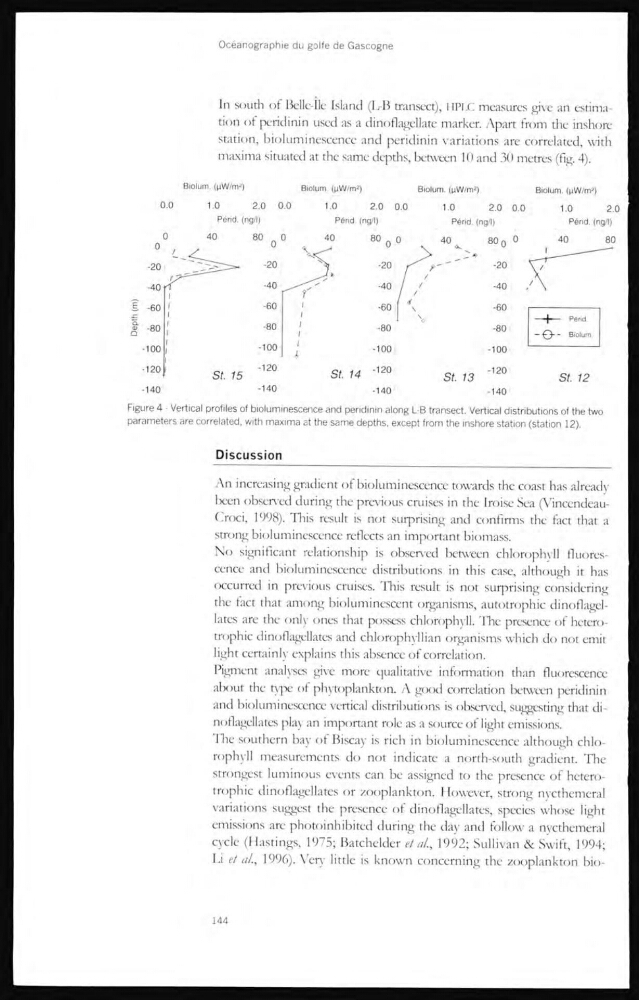
In south of Belle-Île Island (L-B transect), HPLC measures give an estimation of peridinin used as a dinoflagellate marker. Apart from the inshore
station, bioluminescence and peridinin variations are correlated, with
maxima situated at the same depths, between 10 and 30 metres (fig. 4).
Figure 4 - Vertical profiles of bioluminescence and peridinin along L-B transect. Vertical distrlbutions of the two
parameters are correlated, with maxima at the same depths, except from the inshore station (station 12).
Discussion
An increasing gradient of bioluminescence towards the coast has already
bcen obseived during the previous cmises in the Iroise Sea (VincendeauCroci, 1998). This result is not surprising and confirms the fact that a
strong bioluminescence reflects an important biomass.
No significant relationship is obsened between chlorophyll fluorescence and bioluminescence distributions in this case, although it has
occurred in previous cruises. This result is not surprising considering
the fact that among biolumincscent organisms, autotrophic dinoflagellates are the only ones that possess chlorophyll. The presence of heterotrophic dinoflagellates and chlorophyllian organisms which do not emit
light certainly explains this absence of correlation.
Pigment analyses give more qualitative information than fluorescence
about the type of phytoplankton. A good correlation between peridinin
and bioluminescence vertical distributions is observed, suggesting that dinoflagellates play an important role as a source of light emissions.
The southern bay of Biscay is rich in bioluminescence although chlorophyll measurements do not indicate a north-south gradient. The
strongest luminous events can be assigned to the presence of heterotrophic dinoflagellates or zooplankton. However, strong nycthemeral
variations suggest the presence of dinoflagellates, species whose light
emissions are photoinhibited during the dav and tollow a nycthemeral
cvcle (Hastings, 1975; Batchelder et al, 1992; Sullivan & Swift, 1994;
Li et al., 1996). Very little is known concerning the zooplankton bio144
station, bioluminescence and peridinin variations are correlated, with
maxima situated at the same depths, between 10 and 30 metres (fig. 4).
Figure 4 - Vertical profiles of bioluminescence and peridinin along L-B transect. Vertical distrlbutions of the two
parameters are correlated, with maxima at the same depths, except from the inshore station (station 12).
Discussion
An increasing gradient of bioluminescence towards the coast has already
bcen obseived during the previous cmises in the Iroise Sea (VincendeauCroci, 1998). This result is not surprising and confirms the fact that a
strong bioluminescence reflects an important biomass.
No significant relationship is obsened between chlorophyll fluorescence and bioluminescence distributions in this case, although it has
occurred in previous cruises. This result is not surprising considering
the fact that among biolumincscent organisms, autotrophic dinoflagellates are the only ones that possess chlorophyll. The presence of heterotrophic dinoflagellates and chlorophyllian organisms which do not emit
light certainly explains this absence of correlation.
Pigment analyses give more qualitative information than fluorescence
about the type of phytoplankton. A good correlation between peridinin
and bioluminescence vertical distributions is observed, suggesting that dinoflagellates play an important role as a source of light emissions.
The southern bay of Biscay is rich in bioluminescence although chlorophyll measurements do not indicate a north-south gradient. The
strongest luminous events can be assigned to the presence of heterotrophic dinoflagellates or zooplankton. However, strong nycthemeral
variations suggest the presence of dinoflagellates, species whose light
emissions are photoinhibited during the dav and tollow a nycthemeral
cvcle (Hastings, 1975; Batchelder et al, 1992; Sullivan & Swift, 1994;
Li et al., 1996). Very little is known concerning the zooplankton bio144