

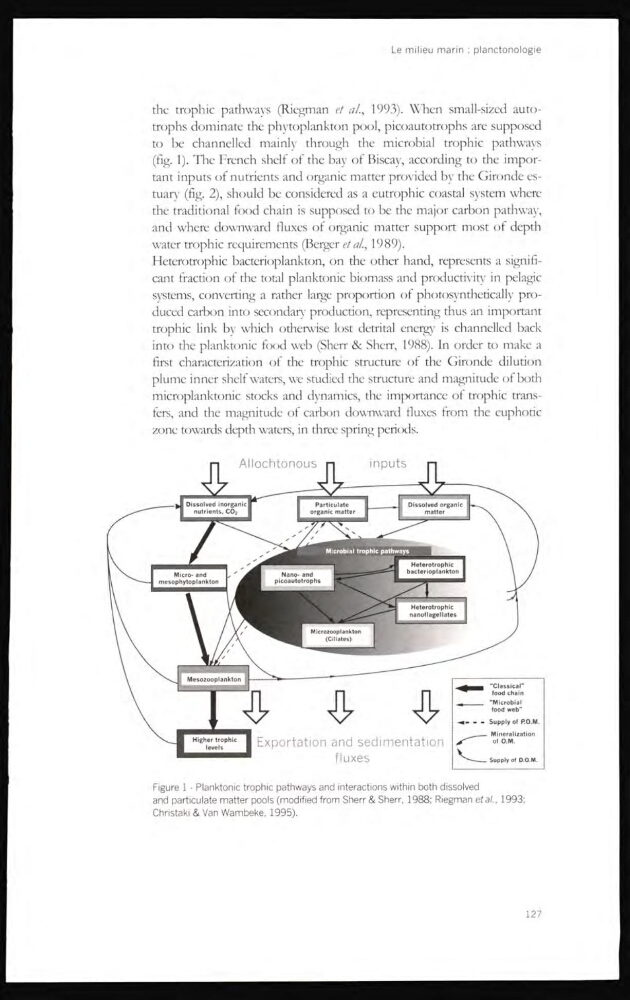
the trophic pathways (Riegman et al., 1993). When small-sized autotrophs dominate the phytoplankton pool, picoautotrophs are supposed
to be channelled mainly through the microbial trophic pathways
(fig. 1). The French shelf of the bay of Biscay, according to the important inputs of nutrients and organic matter provided by the Gironde estuary (fig. 2), should be considered as a eutrophic coastal system where
the traditional food chain is supposed to be the major carbon pathway,
and where downward fluxes of organic matter support most of depth
water trophic requirements (Berger et ai, 1989).
Heterotrophic bacterioplankton, on the other hand, represents a significant fraction of the total planktonic biomass and productivity 7 in pelagic
systems, converting a rather large proportion of photosynthetically produced carbon into secondaryf production, representing thus an important
trophic link by which otherwise lost detrital energy is channelled back
into the planktonic food web (Sherr & Sherr, 1988). In order to make a
first characterizatk >n of the trophic stmcture of the Gironde dilution
plume inner shelf waters, we studied the structure and magnitude of both
microplanktonic stocks and dynamics, the importance of trophic transfers, and the magnitude of carbon downward fluxes from the euphotic
zone towards depth waters, in three spring periods.
Figure 1 - Planktonic trophic pathways and interactions within both dissolved
and particulate matter pools (modified from Sherr & Sherr, 1988; Riegman etal., 1993;
Christaki & Van Wambeke, 1995).
127
to be channelled mainly through the microbial trophic pathways
(fig. 1). The French shelf of the bay of Biscay, according to the important inputs of nutrients and organic matter provided by the Gironde estuary (fig. 2), should be considered as a eutrophic coastal system where
the traditional food chain is supposed to be the major carbon pathway,
and where downward fluxes of organic matter support most of depth
water trophic requirements (Berger et ai, 1989).
Heterotrophic bacterioplankton, on the other hand, represents a significant fraction of the total planktonic biomass and productivity 7 in pelagic
systems, converting a rather large proportion of photosynthetically produced carbon into secondaryf production, representing thus an important
trophic link by which otherwise lost detrital energy is channelled back
into the planktonic food web (Sherr & Sherr, 1988). In order to make a
first characterizatk >n of the trophic stmcture of the Gironde dilution
plume inner shelf waters, we studied the structure and magnitude of both
microplanktonic stocks and dynamics, the importance of trophic transfers, and the magnitude of carbon downward fluxes from the euphotic
zone towards depth waters, in three spring periods.
Figure 1 - Planktonic trophic pathways and interactions within both dissolved
and particulate matter pools (modified from Sherr & Sherr, 1988; Riegman etal., 1993;
Christaki & Van Wambeke, 1995).
127