

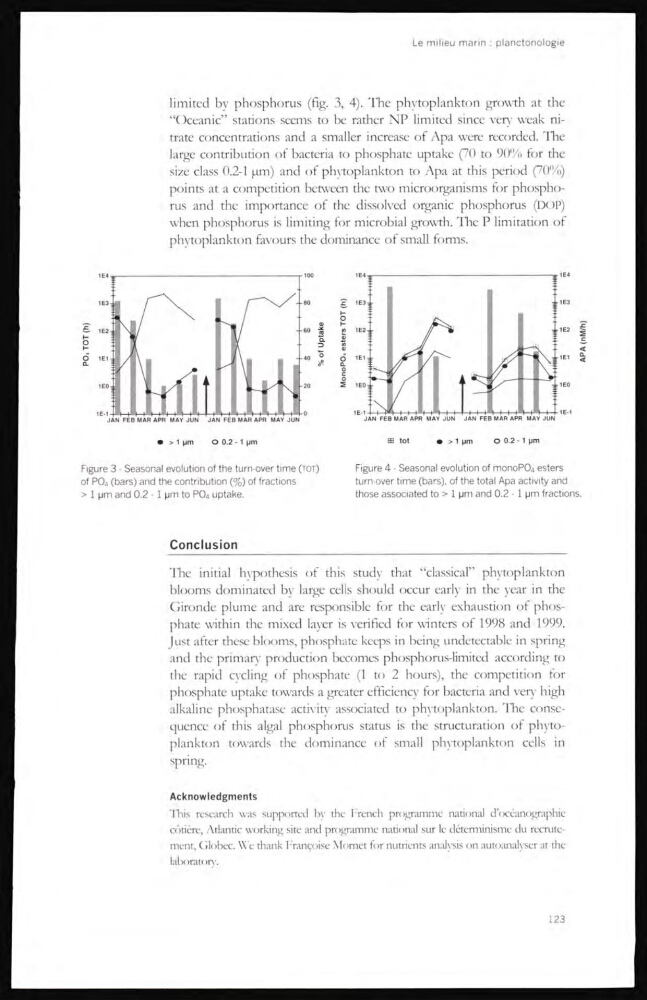
limited by phosphorus (fig. 3, 4). The phytoplankton growth at the
“Oceanic” stations seems to be rather NP limited since very weak nitrate concentrations and a smaller increase of Apa were recorded. The
large contribution of bacteria to phosphate uptake (70 to 90% for the
size class 0.2-1 pm) and of phytoplankton to Apa at this period (70%)
points at a competition between the two microorganisms for phosphorus and the importance of the dissolved organic phosphorus (DOP)
when phosphorus is limiting for microbial growth. The P limitation of
phytoplankton favours the dominance of small forms.
Figure 3 - Seasonal evolution of the turn-over time (TOT)
of PO 4 (bars) and the contribution (%) of fractions
> 1 µm and 0.2 - 1 pm to PO 4 uptake.
Figure 4 - Seasonal evolution of monoPO 4 esters
turn-over time (bars), of the total Apa activity and
those associated to > 1 pm and 0.2 - 1 pm fractions.
Conclusion
The initial hypothesis of this study that “classical” phytoplankton
blooms dominated by large cells should occur early in the year in the
Gironde plume and are responsible for the early exhaustion of phosphate within the mixed layer is verified for winters of 1998 and 1999.
Just after these blooms, phosphate keeps in being undetectable in spring
and the primary production becomes phosphorus-limited according to
the rapid cycling of phosphate (1 to 2 hours), the competition for
phosphate uptake towards a greater efficiency for bacteria and very high
alkaline phosphatase activity associated to phytoplankton. The consequence of this algal phosphorus status is the structuration of phytoplankton towards the dominance of small phytoplankton cells in
spring.
Acknowledgments
This research was supported by the French programme naüonal d’océanographie
côtière, Adantic working sitc and programme national sut le déterrrunismc du recrutement, Globec. We thank Françoise Momet for nutricnts analysis on autoanalyser at the
laboratory.
123
“Oceanic” stations seems to be rather NP limited since very weak nitrate concentrations and a smaller increase of Apa were recorded. The
large contribution of bacteria to phosphate uptake (70 to 90% for the
size class 0.2-1 pm) and of phytoplankton to Apa at this period (70%)
points at a competition between the two microorganisms for phosphorus and the importance of the dissolved organic phosphorus (DOP)
when phosphorus is limiting for microbial growth. The P limitation of
phytoplankton favours the dominance of small forms.
Figure 3 - Seasonal evolution of the turn-over time (TOT)
of PO 4 (bars) and the contribution (%) of fractions
> 1 µm and 0.2 - 1 pm to PO 4 uptake.
Figure 4 - Seasonal evolution of monoPO 4 esters
turn-over time (bars), of the total Apa activity and
those associated to > 1 pm and 0.2 - 1 pm fractions.
Conclusion
The initial hypothesis of this study that “classical” phytoplankton
blooms dominated by large cells should occur early in the year in the
Gironde plume and are responsible for the early exhaustion of phosphate within the mixed layer is verified for winters of 1998 and 1999.
Just after these blooms, phosphate keeps in being undetectable in spring
and the primary production becomes phosphorus-limited according to
the rapid cycling of phosphate (1 to 2 hours), the competition for
phosphate uptake towards a greater efficiency for bacteria and very high
alkaline phosphatase activity associated to phytoplankton. The consequence of this algal phosphorus status is the structuration of phytoplankton towards the dominance of small phytoplankton cells in
spring.
Acknowledgments
This research was supported by the French programme naüonal d’océanographie
côtière, Adantic working sitc and programme national sut le déterrrunismc du recrutement, Globec. We thank Françoise Momet for nutricnts analysis on autoanalyser at the
laboratory.
123