

3. THE EXPERIMENTAL ANALYSIS OF VISUAL BEHAVIOR
67
peripheral mechanisms required for the final classification (i.e., some
measurement of individual line orientation must precede or participate
in the determination of parallelness ) . The implications of this argument
for a theoretical approach to visual coding is discussed in some detail
by Sutherland ( 1968).
These discussions of the circle-square discrimination have supposed
that curved and straight lines are easily distinguished. Ingle (1971)
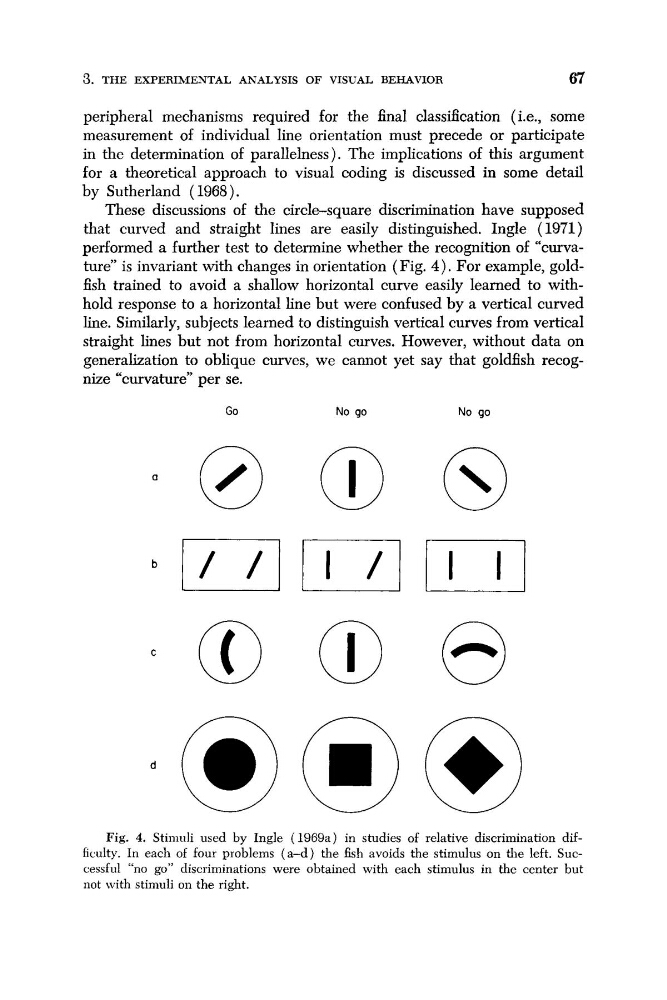
performed a further test to determine whether the recognition of “curvature” is invariant with changes in orientation (Fig. 4). For example, goldfish trained to avoid a shallow horizontal curve easily learned to withhold response to a horizontal line but were confused by a vertical curved
line. Similarly, subjects learned to distinguish vertical curves from vertical
straight lines but not from horizontal curves. However, without data on
generalization to oblique curves, we cannot yet say that goldfish recognize “curvature” per se.
Go
No go
C
@ G I
No go
(3
Fig. 4. Stimuli used by Ingle (1969a) in studies of relative discrimination difficulty. In each of four problems (a-d) the fish avoids the stimulus on the left. Successful “no go” discriminations were obtained with each stimulus in the center but
not with stimuli on the right.
67
peripheral mechanisms required for the final classification (i.e., some
measurement of individual line orientation must precede or participate
in the determination of parallelness ) . The implications of this argument
for a theoretical approach to visual coding is discussed in some detail
by Sutherland ( 1968).
These discussions of the circle-square discrimination have supposed
that curved and straight lines are easily distinguished. Ingle (1971)
performed a further test to determine whether the recognition of “curvature” is invariant with changes in orientation (Fig. 4). For example, goldfish trained to avoid a shallow horizontal curve easily learned to withhold response to a horizontal line but were confused by a vertical curved
line. Similarly, subjects learned to distinguish vertical curves from vertical
straight lines but not from horizontal curves. However, without data on
generalization to oblique curves, we cannot yet say that goldfish recognize “curvature” per se.
Go
No go
C
@ G I
No go
(3
Fig. 4. Stimuli used by Ingle (1969a) in studies of relative discrimination difficulty. In each of four problems (a-d) the fish avoids the stimulus on the left. Successful “no go” discriminations were obtained with each stimulus in the center but
not with stimuli on the right.