

46
4 0 -
3 0 -
2 0 -
0T. TOMITA
Meon =611? 2 3 m p
N 105 (74 % )
,
I
M e a n = 4 6 2 A 1 5 m p
N = 2 3 (16%)
4 0 0
500
6 0 0
700 ’
G
Meon = 529 2 14 m p
0
N=14 (10%)
0
: o
1
1
I
1
400
500
6 0 0
700
n
E
3
400
500
6 0 0
700
Wavelength ( m p )
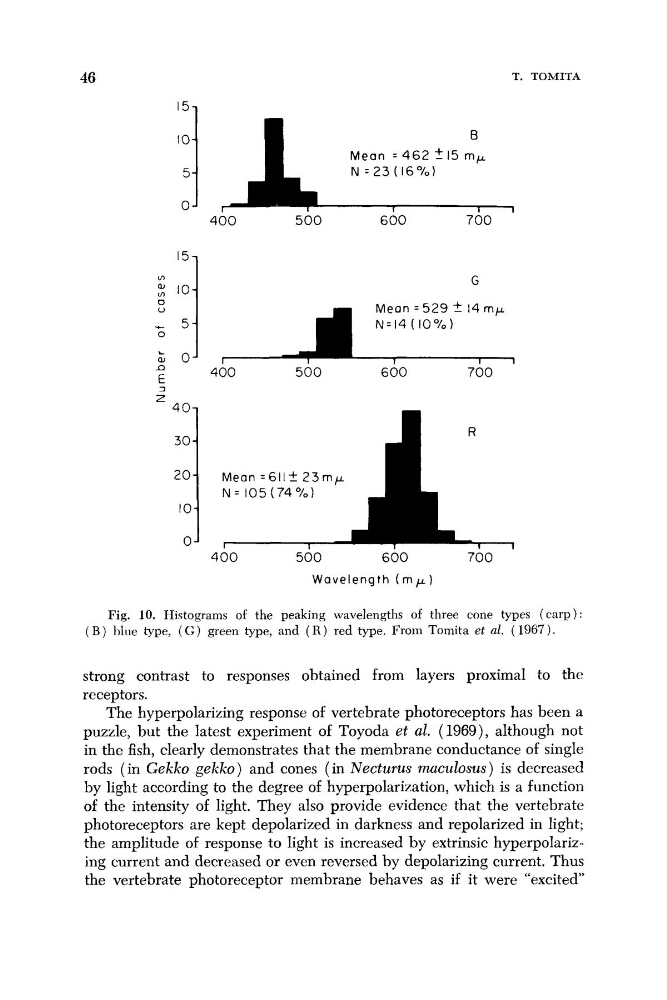
Fig. 10. Histograms of the peaking wavelengths of three cone types ( c a r p ) :
( B ) blue type, ( G ) green type, and ( R ) red type. From Tomita et al. (1967).
strong contrast to responses obtained from layers proximal to the
receptors.
The hyperpolarizing response of vertebrate photoreceptors has been a
puzzle, but the latest experiment of Toyoda et al. (1969), although not
in the fish, clearly demonstrates that the membrane conductance of single
rods (in Gekko gekko) and cones (in Necturus muculosus) is decreased
by light according to the degree of hyperpolarization, which is a function
of the intensity of light. They also provide evidence that the vertebrate
photoreceptors are kept depolarized in darkness and repolarized in light;
the amplitude of response to light is increased by extrinsic hyperpolarizing current and decreased or even reversed by depolarizing current. Thus
the vertebrate photoreceptor membrane behaves as if it were “excited
4 0 -
3 0 -
2 0 -
0T. TOMITA
Meon =611? 2 3 m p
N 105 (74 % )
,
I
M e a n = 4 6 2 A 1 5 m p
N = 2 3 (16%)
4 0 0
500
6 0 0
700 ’
G
Meon = 529 2 14 m p
0
N=14 (10%)
0
: o
1
1
I
1
400
500
6 0 0
700
n
E
3
400
500
6 0 0
700
Wavelength ( m p )
Fig. 10. Histograms of the peaking wavelengths of three cone types ( c a r p ) :
( B ) blue type, ( G ) green type, and ( R ) red type. From Tomita et al. (1967).
strong contrast to responses obtained from layers proximal to the
receptors.
The hyperpolarizing response of vertebrate photoreceptors has been a
puzzle, but the latest experiment of Toyoda et al. (1969), although not
in the fish, clearly demonstrates that the membrane conductance of single
rods (in Gekko gekko) and cones (in Necturus muculosus) is decreased
by light according to the degree of hyperpolarization, which is a function
of the intensity of light. They also provide evidence that the vertebrate
photoreceptors are kept depolarized in darkness and repolarized in light;
the amplitude of response to light is increased by extrinsic hyperpolarizing current and decreased or even reversed by depolarizing current. Thus
the vertebrate photoreceptor membrane behaves as if it were “excited