

546
M. V. L. BENNETT
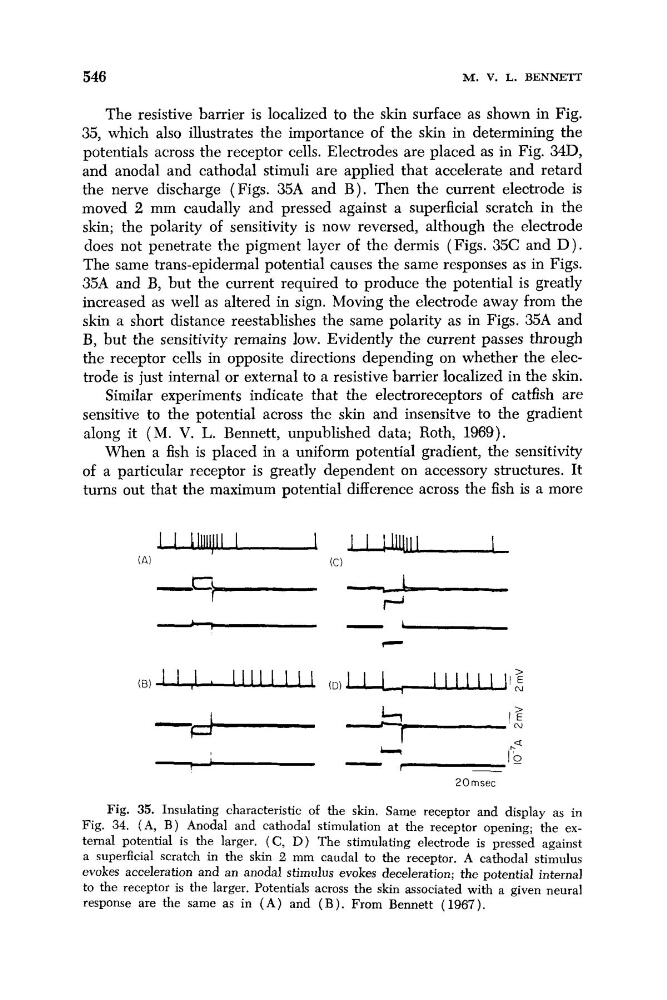
The resistive barrier is localized to the skin surface as shown in Fig.
35, which also illustrates the importance of the skin in determining the
potentials across the receptor cells. Electrodes are placed as in Fig. 34D,
and anodal and cathodal stimuli are applied that accelerate and retard
the nerve discharge (Figs. 35A and B). Then the current electrode is
moved 2 mm caudally and pressed against a superficial scratch in the
skin; the polarity of sensitivity is now reversed, although the electrode
does not penetrate the pigment layer of the dermis (Figs. 35C and D ) .
The same trans-epidermal potential causes the same responses as in Figs.
35A and B, but the current required to produce the potential is greatly
increased as well as altered in sign. Moving the electrode away from the
skin a short distance reestablishes the same polarity as in Figs. 35A and
B, but the sensitivity remains low. Evidently the current passes through
the receptor cells in opposite directions depending on whether the electrode is just internal or external to a resistive barrier localized in the skin.
Similar experiments indicate that the electroreceptors of catfish are
sensitive to the potential across the skin and insensitve to the gradient
along it (M. V. L. Bennett, unpublished data; Roth, 1969).
When a fish is placed in a uniform potential gradient, the sensitivity
of a particular receptor is greatly dependent on accessory structures. It
turns out that the maximum potential difference across the fish is a more
I
-+
1
_ . I -
+
- L
c
>
E
‘ N
4
.;”
- ,
lo
-
20msec
Fig. 35. Insulating characteristic of the skin. Same receptor and display as in
Fig. 34. (A, B ) Anodal and cathodal stimulation at the receptor opening; the external potential is the larger. (C, D ) The stimulating electrode is pressed against
a superficial scratch in the skin 2 mm caudal to the receptor. A cathodal stimulus
evokes acceleration and an anodal stimulus evokes deceleration; the potential internal
to the receptor is the larger. Potentials across the skin associated with a given neural
response are the same as in ( A ) and ( B ) . From Bennett ( 1967).
M. V. L. BENNETT
The resistive barrier is localized to the skin surface as shown in Fig.
35, which also illustrates the importance of the skin in determining the
potentials across the receptor cells. Electrodes are placed as in Fig. 34D,
and anodal and cathodal stimuli are applied that accelerate and retard
the nerve discharge (Figs. 35A and B). Then the current electrode is
moved 2 mm caudally and pressed against a superficial scratch in the
skin; the polarity of sensitivity is now reversed, although the electrode
does not penetrate the pigment layer of the dermis (Figs. 35C and D ) .
The same trans-epidermal potential causes the same responses as in Figs.
35A and B, but the current required to produce the potential is greatly
increased as well as altered in sign. Moving the electrode away from the
skin a short distance reestablishes the same polarity as in Figs. 35A and
B, but the sensitivity remains low. Evidently the current passes through
the receptor cells in opposite directions depending on whether the electrode is just internal or external to a resistive barrier localized in the skin.
Similar experiments indicate that the electroreceptors of catfish are
sensitive to the potential across the skin and insensitve to the gradient
along it (M. V. L. Bennett, unpublished data; Roth, 1969).
When a fish is placed in a uniform potential gradient, the sensitivity
of a particular receptor is greatly dependent on accessory structures. It
turns out that the maximum potential difference across the fish is a more
I
-+
1
_ . I -
+
- L
c
>
E
‘ N
4
.;”
- ,
lo
-
20msec
Fig. 35. Insulating characteristic of the skin. Same receptor and display as in
Fig. 34. (A, B ) Anodal and cathodal stimulation at the receptor opening; the external potential is the larger. (C, D ) The stimulating electrode is pressed against
a superficial scratch in the skin 2 mm caudal to the receptor. A cathodal stimulus
evokes acceleration and an anodal stimulus evokes deceleration; the potential internal
to the receptor is the larger. Potentials across the skin associated with a given neural
response are the same as in ( A ) and ( B ) . From Bennett ( 1967).