

1 1, ELECTRORECEPTION
545
-+
I
r
-
I P
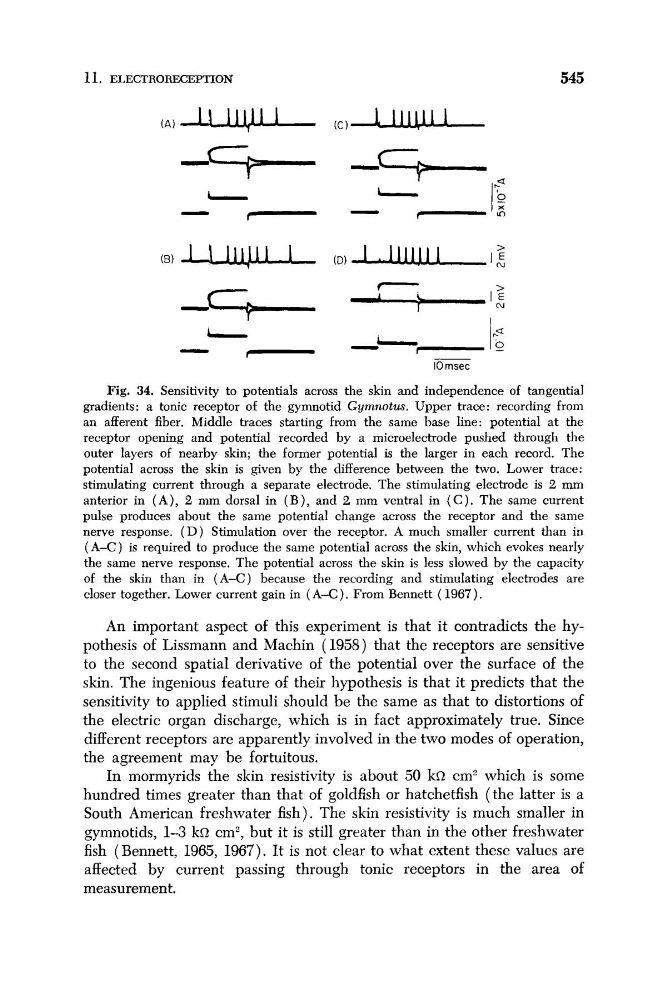
Fig. 34. Sensitivity to potentials across the skin and independence of tangential
gradients: a tonic receptor of the gymnotid Gymnotus. Upper trace: recording from
an afferent fiber. Middle traces starting from the same base line: potential at the
receptor opening and potential recorded by a microelectrode pushed through the
outer layers of nearby skin; the former potential is the larger in each record. The
potential across the skin is given by the difference between the two. Lower trace:
stimulating current through a separate electrode. The stimulating electrode is 2 mm
anterior in ( A ) , 2 mm dorsal in ( B ) , and 2 mm ventral in ( C ) . The same current
pulse produces about the same potential change across the receptor and the same
nerve response. ( D ) Stimulation over the receptor. A much smaller current than in
( A-C) is required to produce the same potential across the skin, which evokes nearly
the same nerve response. The potential across the skin is less slowed by the capacity
of the skin than in (A-C) because the recording and stimulating electrodes are
closer together. Lower current gain in (A-C). From Bennett (1967).
An important aspect of this experiment is that it contradicts the hypothesis of Lissmann and Machin (1958) that the receptors are sensitive
to the second spatial derivative of the potential over the surface of the
skin. The ingenious feature of their hypothesis is that it predicts that the
sensitivity to applied stimuli should be the same as that to distortions of
the electric organ discharge, which is in fact approximately true. Since
different receptors are apparently involved in the two modes of operation,
the agreement may be fortuitous.
In mormyrids the skin resistivity is about 50 kn cm2 which is some
hundred times greater than that of goldfish or hatchetfish (the latter is a
South American freshwater fish). The skin resistivity is much smaller in
gymnotids, 1-3 kn cm', but it is still greater than in the other freshwater
fish (Bennett, 1965, 1967). It is not clear to what extent these values are
affected by current passing through tonic receptors in the area of
measurement.
545
-+
I
r
-
I P
Fig. 34. Sensitivity to potentials across the skin and independence of tangential
gradients: a tonic receptor of the gymnotid Gymnotus. Upper trace: recording from
an afferent fiber. Middle traces starting from the same base line: potential at the
receptor opening and potential recorded by a microelectrode pushed through the
outer layers of nearby skin; the former potential is the larger in each record. The
potential across the skin is given by the difference between the two. Lower trace:
stimulating current through a separate electrode. The stimulating electrode is 2 mm
anterior in ( A ) , 2 mm dorsal in ( B ) , and 2 mm ventral in ( C ) . The same current
pulse produces about the same potential change across the receptor and the same
nerve response. ( D ) Stimulation over the receptor. A much smaller current than in
( A-C) is required to produce the same potential across the skin, which evokes nearly
the same nerve response. The potential across the skin is less slowed by the capacity
of the skin than in (A-C) because the recording and stimulating electrodes are
closer together. Lower current gain in (A-C). From Bennett (1967).
An important aspect of this experiment is that it contradicts the hypothesis of Lissmann and Machin (1958) that the receptors are sensitive
to the second spatial derivative of the potential over the surface of the
skin. The ingenious feature of their hypothesis is that it predicts that the
sensitivity to applied stimuli should be the same as that to distortions of
the electric organ discharge, which is in fact approximately true. Since
different receptors are apparently involved in the two modes of operation,
the agreement may be fortuitous.
In mormyrids the skin resistivity is about 50 kn cm2 which is some
hundred times greater than that of goldfish or hatchetfish (the latter is a
South American freshwater fish). The skin resistivity is much smaller in
gymnotids, 1-3 kn cm', but it is still greater than in the other freshwater
fish (Bennett, 1965, 1967). It is not clear to what extent these values are
affected by current passing through tonic receptors in the area of
measurement.