

11. ELECTRORECEPTION
541
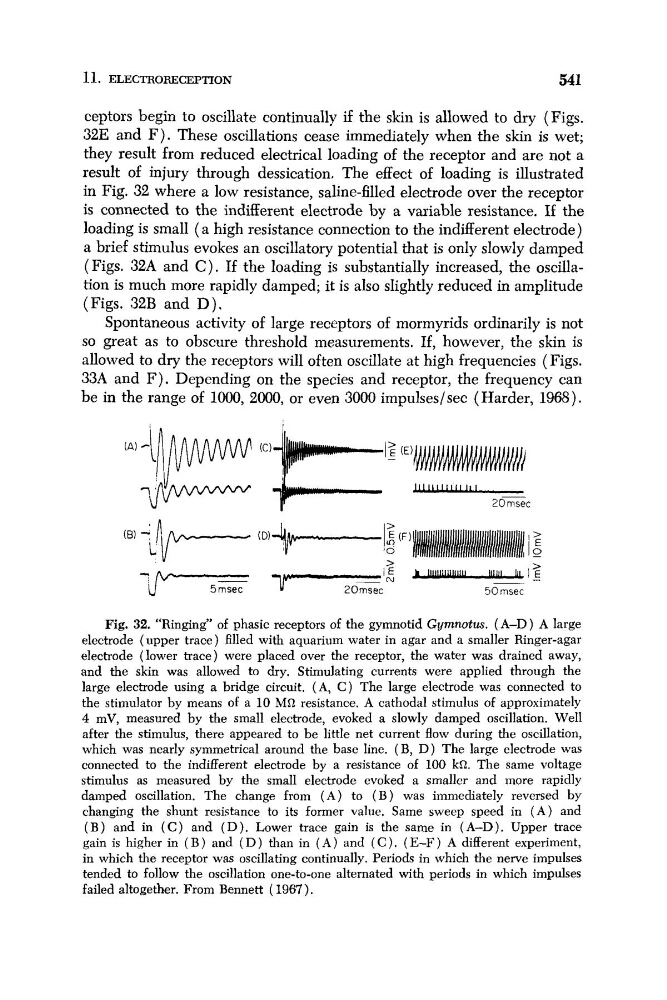
ceptors begin to oscillate continually if the skin is allowed to dry (Figs.
32E and F). These oscillations cease immediately when the skin is wet;
they result from reduced electrical loading of the receptor and are not a
result of injury through dessication, The effect of loading is illustrated
in Fig. 32 where a low resistance, saline-filled electrode over the receptor
is connected to the indifferent electrode by a variable resistance. If the
loading is small ( a high resistance connection to the indifferent electrode)
a brief stimulus evokes an oscillatory potential that is only slowly damped
(Figs. 32A and C). If the loading is substantially increased, the oscillation is much more rapidly damped; it is also slightly reduced in amplitude
(Figs. 32B and D ) .
Spontaneous activity of large receptors of mormyrids ordinarily is not
so great as to obscure threshold measurements. If, however, the skin is
allowed to dry the receptors will often oscillate at high frequencies (Figs.
33A and F). Depending on the species and receptor, the frequency can
be in the range of 1OO0, 2000, or even 3000 impulses/sec (Harder, 1968).
>
,
-15
r l l l l l l U l l r l l l l l l g
~
20msec
50msec
Fig. 32. “Ringing” of phasic receptors of the gymnotid Gymnotus. ( A-D) A large
electrode (upper trace ) filled with aquarium water in agar and a smaller Ringer-agar
electrode (lower trace) were placed over the receptor, the water was drained away,
and the skin was allowed to dry. Stimulating currents were applied through the
large electrode using a bridge circuit. (A, C ) The large electrode was connected to
the stimulator by means of a 10 M a resistance. A cathodal stimulus of approximately
4 mV, measured by the small electrode, evoked a slowly damped oscillation. Well
after the stimulus, there appeared to be little net current flow during the oscillation,
which was nearly symmetrical around the base line. (B, D ) The large electrode was
connected to the indifferent electrode by a resistance of 100 kn. The same voltage
stimulus as measured by the small electrode evoked a smaller and more rapidly
damped oscillation. The change from ( A ) to ( B ) was immediately reversed by
changing the shunt resistance to its former value. Same sweep speed in ( A ) and
( B ) and in ( C ) and ( D ) . Lower trace gain is the same in ( A-D). Upper trace
gain is higher in ( B ) and ( D ) than in ( A ) and ( C ) . ( E-F) A different experiment,
in which the receptor was oscillating continually. Periods in which the nerve impulses
tended to follow the oscillation one-to-one alternated with periods in which impulses
failed altogether. From Bennett ( 1967).
541
ceptors begin to oscillate continually if the skin is allowed to dry (Figs.
32E and F). These oscillations cease immediately when the skin is wet;
they result from reduced electrical loading of the receptor and are not a
result of injury through dessication, The effect of loading is illustrated
in Fig. 32 where a low resistance, saline-filled electrode over the receptor
is connected to the indifferent electrode by a variable resistance. If the
loading is small ( a high resistance connection to the indifferent electrode)
a brief stimulus evokes an oscillatory potential that is only slowly damped
(Figs. 32A and C). If the loading is substantially increased, the oscillation is much more rapidly damped; it is also slightly reduced in amplitude
(Figs. 32B and D ) .
Spontaneous activity of large receptors of mormyrids ordinarily is not
so great as to obscure threshold measurements. If, however, the skin is
allowed to dry the receptors will often oscillate at high frequencies (Figs.
33A and F). Depending on the species and receptor, the frequency can
be in the range of 1OO0, 2000, or even 3000 impulses/sec (Harder, 1968).
>
,
-15
r l l l l l l U l l r l l l l l l g
~
20msec
50msec
Fig. 32. “Ringing” of phasic receptors of the gymnotid Gymnotus. ( A-D) A large
electrode (upper trace ) filled with aquarium water in agar and a smaller Ringer-agar
electrode (lower trace) were placed over the receptor, the water was drained away,
and the skin was allowed to dry. Stimulating currents were applied through the
large electrode using a bridge circuit. (A, C ) The large electrode was connected to
the stimulator by means of a 10 M a resistance. A cathodal stimulus of approximately
4 mV, measured by the small electrode, evoked a slowly damped oscillation. Well
after the stimulus, there appeared to be little net current flow during the oscillation,
which was nearly symmetrical around the base line. (B, D ) The large electrode was
connected to the indifferent electrode by a resistance of 100 kn. The same voltage
stimulus as measured by the small electrode evoked a smaller and more rapidly
damped oscillation. The change from ( A ) to ( B ) was immediately reversed by
changing the shunt resistance to its former value. Same sweep speed in ( A ) and
( B ) and in ( C ) and ( D ) . Lower trace gain is the same in ( A-D). Upper trace
gain is higher in ( B ) and ( D ) than in ( A ) and ( C ) . ( E-F) A different experiment,
in which the receptor was oscillating continually. Periods in which the nerve impulses
tended to follow the oscillation one-to-one alternated with periods in which impulses
failed altogether. From Bennett ( 1967).