

538
M. V. L. BENNETT
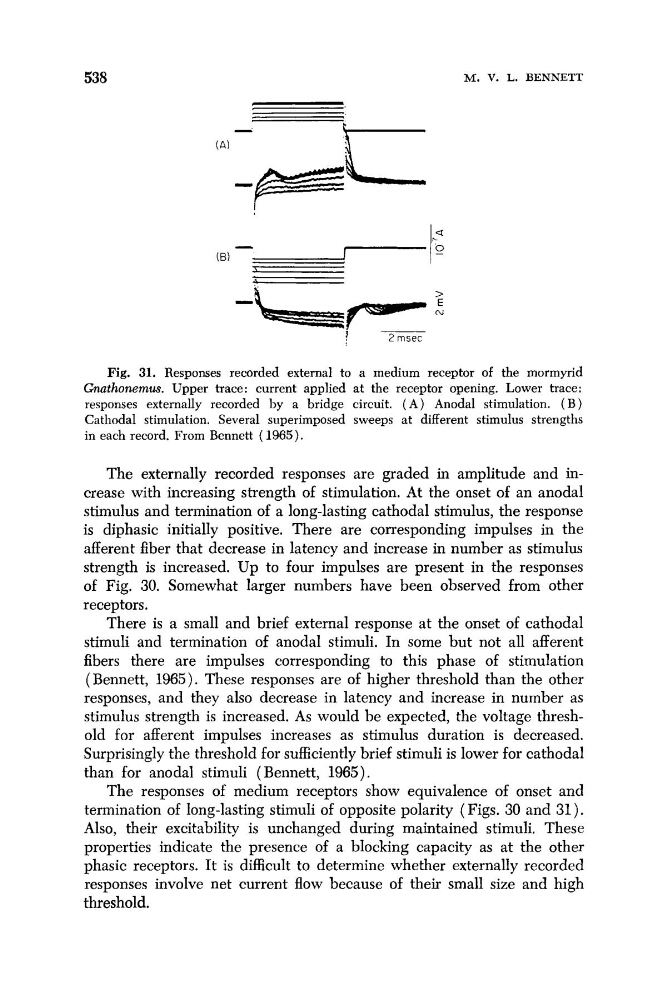
Fig. 31. Responses recorded external to a medium receptor of the mormyrid
Gnathonemu. Upper trace: current applied at the receptor opening. Lower trace:
responses externally recorded by a bridge circuit. ( A ) Anodal stimulation. ( B )
Cathodal stimulation. Several superimposed sweeps at different stimulus strengths
in each record. From Bennett ( 1965).
The externally recorded responses are graded in amplitude and increase with increasing strength of stimulation. At the onset of an anodal
stimulus and termination of a long-lasting cathodal stimulus, the response
is diphasic initially positive. There are corresponding impulses in the
afferent fiber that decrease in latency and increase in number as stimulus
strength is increased. Up to four impulses are present in the responses
of Fig. 30. Somewhat larger numbers have been observed from other
receptors.
There is a small and brief external response at the onset of cathodal
stimuli and termination of anodal stimuli. In some but not all afferent
fibers there are impulses corresponding to this phase of stimulation
(Bennett, 1965). These responses are of higher threshold than the other
responses, and they also decrease in latency and increase in number as
stimulus strength is increased. As would be expected, the voltage threshold for afferent impulses increases as stimulus duration is decreased.
Surprisingly the threshold for sufficiently brief stimuli is lower for cathodal
than for anodal stimuli (Bennett, 1965).
The responses of medium receptors show equivalence of onset and
termination of long-lasting stimuli of opposite polarity (Figs. 30 and 31).
Also, their excitability is unchanged during maintained stimuli, These
properties indicate the presence of a blocking capacity as at the other
phasic receptors. It is difficult to determine whether externally recorded
responses involve net current flow because of their small size and high
threshold.
M. V. L. BENNETT
Fig. 31. Responses recorded external to a medium receptor of the mormyrid
Gnathonemu. Upper trace: current applied at the receptor opening. Lower trace:
responses externally recorded by a bridge circuit. ( A ) Anodal stimulation. ( B )
Cathodal stimulation. Several superimposed sweeps at different stimulus strengths
in each record. From Bennett ( 1965).
The externally recorded responses are graded in amplitude and increase with increasing strength of stimulation. At the onset of an anodal
stimulus and termination of a long-lasting cathodal stimulus, the response
is diphasic initially positive. There are corresponding impulses in the
afferent fiber that decrease in latency and increase in number as stimulus
strength is increased. Up to four impulses are present in the responses
of Fig. 30. Somewhat larger numbers have been observed from other
receptors.
There is a small and brief external response at the onset of cathodal
stimuli and termination of anodal stimuli. In some but not all afferent
fibers there are impulses corresponding to this phase of stimulation
(Bennett, 1965). These responses are of higher threshold than the other
responses, and they also decrease in latency and increase in number as
stimulus strength is increased. As would be expected, the voltage threshold for afferent impulses increases as stimulus duration is decreased.
Surprisingly the threshold for sufficiently brief stimuli is lower for cathodal
than for anodal stimuli (Bennett, 1965).
The responses of medium receptors show equivalence of onset and
termination of long-lasting stimuli of opposite polarity (Figs. 30 and 31).
Also, their excitability is unchanged during maintained stimuli, These
properties indicate the presence of a blocking capacity as at the other
phasic receptors. It is difficult to determine whether externally recorded
responses involve net current flow because of their small size and high
threshold.