

11. ELECTRORECEPTION
537
receptor, but whether particular fibers end on one or both kinds of receptor cells has not been determined. The thresholds of medium receptors
can be quite high, 10 mV or more, but in the range of stimulation provided by the electric organ (Section V, B). The response of a medium
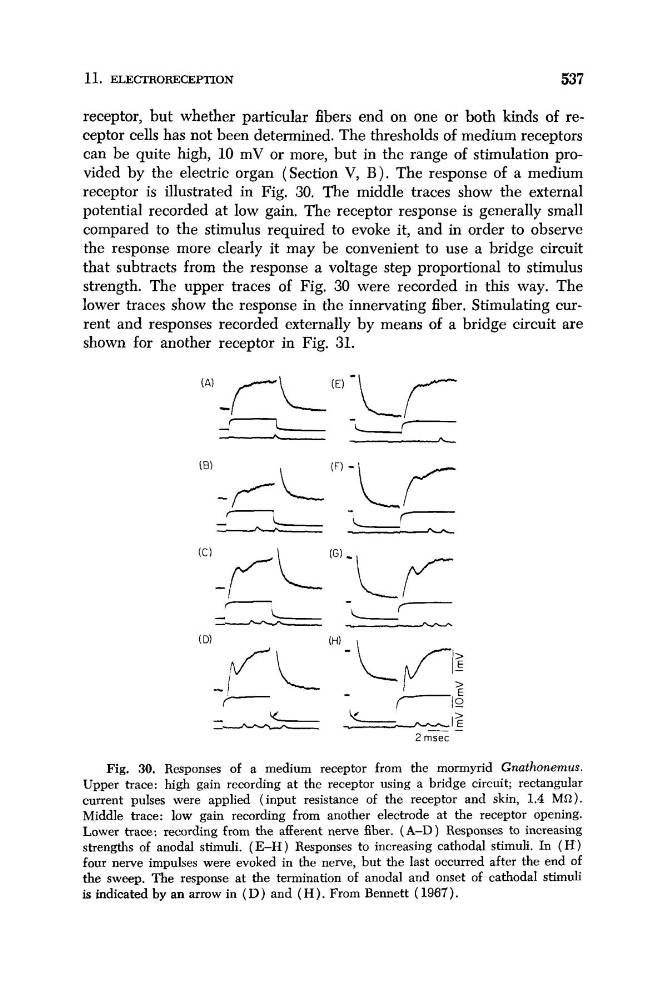
receptor is illustrated in Fig. 30. The middle traces show the external
potential recorded at low gain. The receptor response is generally small
compared to the stimulus required to evoke it, and in order to observe
the response more clearly it may be convenient to use a bridge circuit
that subtracts from the response a voltage step proportional to stimulus
strength. The upper traces of Fig. 30 were recorded in this way. The
lower traces show the response in the innervating fiber. Stimulating current and responses recorded externally by means of a bridge circuit are
shown for another receptor in Fig. 31.
Fig. 30. Responses of a medium receptor from the mormyrid Gnathonernus.
Upper trace: high gain recording at the receptor using a bridge circuit; rectangular
current pulses were applied (input resistance of the receptor and skin, 1.4 MO).
Middle trace: low gain recording from another electrode at the receptor opening.
Lower trace: recording from the afferent nerve fiber. ( A-D ) Responses to increasing
strengths of anodal stimuli. (E-H) Responses to increasing cathodal stimuli. In ( H )
four nerve impulses were evoked in the nerve, but the last occurred after the end of
the sweep. The response at the termination of anodal and onset of cathodal stimuli
is indicated by an arrow in ( D j and ( H j. From Bennett ( 1967).
537
receptor, but whether particular fibers end on one or both kinds of receptor cells has not been determined. The thresholds of medium receptors
can be quite high, 10 mV or more, but in the range of stimulation provided by the electric organ (Section V, B). The response of a medium
receptor is illustrated in Fig. 30. The middle traces show the external
potential recorded at low gain. The receptor response is generally small
compared to the stimulus required to evoke it, and in order to observe
the response more clearly it may be convenient to use a bridge circuit
that subtracts from the response a voltage step proportional to stimulus
strength. The upper traces of Fig. 30 were recorded in this way. The
lower traces show the response in the innervating fiber. Stimulating current and responses recorded externally by means of a bridge circuit are
shown for another receptor in Fig. 31.
Fig. 30. Responses of a medium receptor from the mormyrid Gnathonernus.
Upper trace: high gain recording at the receptor using a bridge circuit; rectangular
current pulses were applied (input resistance of the receptor and skin, 1.4 MO).
Middle trace: low gain recording from another electrode at the receptor opening.
Lower trace: recording from the afferent nerve fiber. ( A-D ) Responses to increasing
strengths of anodal stimuli. (E-H) Responses to increasing cathodal stimuli. In ( H )
four nerve impulses were evoked in the nerve, but the last occurred after the end of
the sweep. The response at the termination of anodal and onset of cathodal stimuli
is indicated by an arrow in ( D j and ( H j. From Bennett ( 1967).