

11. ELECTRORECEPTION
535
cause the system had been left somewhat depressed by the responses to
the onset of the stimuli.
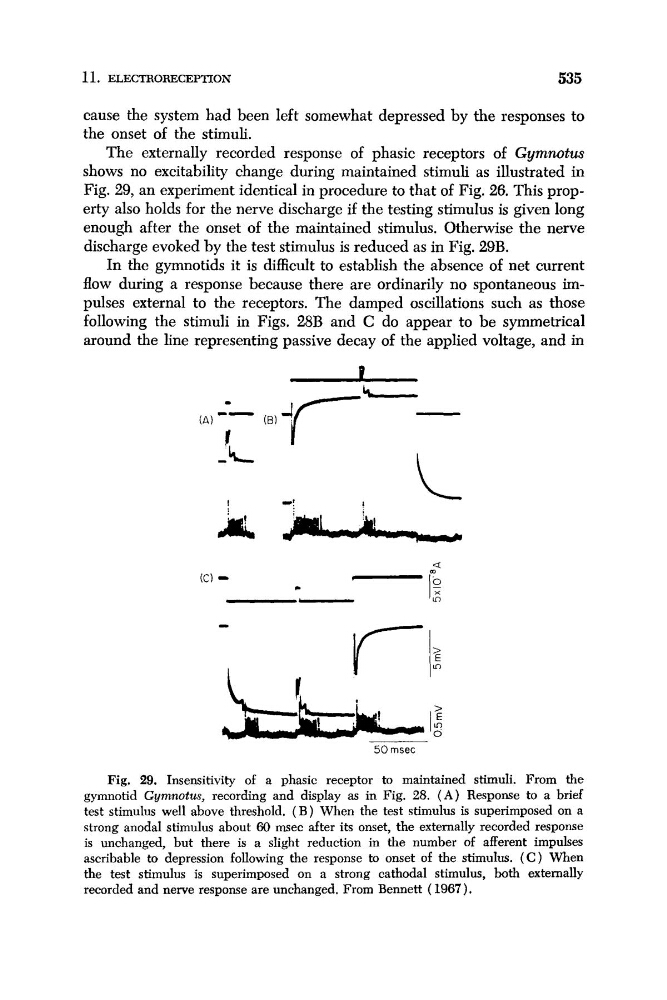
The externally recorded response of phasic receptors of Gymnotus
shows no excitability change during maintained stimuli as illustrated in
Fig. 29, an experiment identical in procedure to that of Fig. 26. This property also holds for the nerve discharge if the testing stimulus is given long
enough after the onset of the maintained stimulus. Otherwise the nerve
discharge evoked by the test stimulus is reduced as in Fig. 29B.
In the gymnotids it is difficult to establish the absence of net current
flow during a response because there are ordinarily no spontaneous impulses external to the receptors. The damped oscillations such as those
following the stimuli in Figs. 28B and C do appear to be symmetrical
around the line representing passive decay of the applied voltage, and in
a
(C) -
- 0
c
I
;
50 msec
Fig. 29. Insensitivity of a phasic receptor to maintained stimuli. From the
gymnotid Gymnotus, recording and display as in Fig. 28. ( A ) Response to a brief
test stimulus well above threshold, ( B ) When the test stimulus is superimposed on a
strong anodal stimulus about 60 msec after its onset, the externally recorded response
is unchanged, but there is a slight reduction in the number of afferent impulses
ascribable to depression following the response to onset of the stimulus. ( C ) When
the test stimulus is superimposed on a strong cathodal stimulus, both externally
recorded and nerve response are unchanged, From Bennett ( 1967).
535
cause the system had been left somewhat depressed by the responses to
the onset of the stimuli.
The externally recorded response of phasic receptors of Gymnotus
shows no excitability change during maintained stimuli as illustrated in
Fig. 29, an experiment identical in procedure to that of Fig. 26. This property also holds for the nerve discharge if the testing stimulus is given long
enough after the onset of the maintained stimulus. Otherwise the nerve
discharge evoked by the test stimulus is reduced as in Fig. 29B.
In the gymnotids it is difficult to establish the absence of net current
flow during a response because there are ordinarily no spontaneous impulses external to the receptors. The damped oscillations such as those
following the stimuli in Figs. 28B and C do appear to be symmetrical
around the line representing passive decay of the applied voltage, and in
a
(C) -
- 0
c
I
;
50 msec
Fig. 29. Insensitivity of a phasic receptor to maintained stimuli. From the
gymnotid Gymnotus, recording and display as in Fig. 28. ( A ) Response to a brief
test stimulus well above threshold, ( B ) When the test stimulus is superimposed on a
strong anodal stimulus about 60 msec after its onset, the externally recorded response
is unchanged, but there is a slight reduction in the number of afferent impulses
ascribable to depression following the response to onset of the stimulus. ( C ) When
the test stimulus is superimposed on a strong cathodal stimulus, both externally
recorded and nerve response are unchanged, From Bennett ( 1967).