

M. V. L. BENNETT
534
ULlllG
(
D
)
C (H) rp (L) il/i: - x
>
- - L - - .
I z
__
20rnsec
50 msec
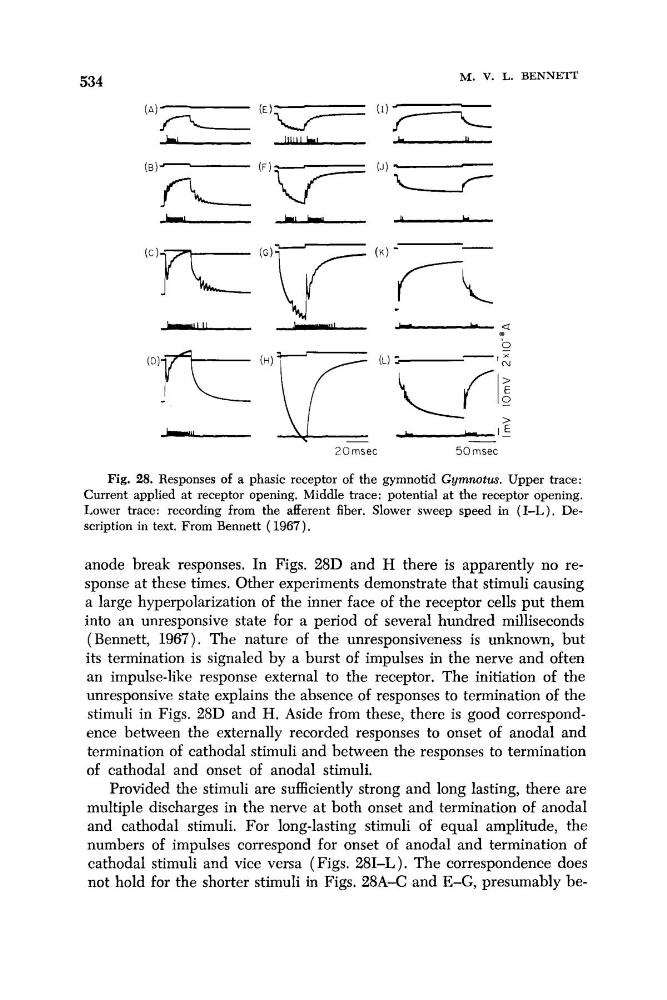
Fig. 28. Responses of a phasic receptor of the gymnotid Gymnotus. Upper trace:
Current applied at receptor opening. Middle trace: potential at the receptor opening.
Lower trace: recording from the afFerent fiber. Slower sweep speed in (I-L), Description in text. From Bennett ( 1967).
anode break responses. In Figs. 28D and H there is apparently no response at these times. Other experiments demonstrate that stimuli causing
a large hyperpolarization of the inner face of the receptor cells put them
into an unresponsive state for a period of several hundred milliseconds
(Bennett, 1967). The nature of the unresponsiveness is unknown, but
its termination is signaled by a burst of impulses in the nerve and often
an impulse-like response external to the receptor. The initiation of the
unresponsive state explains the absence of responses to termination of the
stimuli in Figs. 28D and H. Aside from these, there is good correspondence between the externally recorded responses to onset of anodal and
termination of cathodal stimuli and between the responses to termination
of cathodal and onset of anodal stimuli.
Provided the stimuli are sufficiently strong and long lasting, there are
multiple discharges in the nerve at both onset and termination of anodal
and cathodal stimuli. For long-lasting stimuli of equal amplitude, the
numbers of impulses correspond for onset of anodal and termination of
cathodal stimuli and vice versa (Figs. 281-L). The correspondence does
not hold for the shorter stimuli in Figs. 28A-C and E-G, presumably be-
534
ULlllG
(
D
)
C (H) rp (L) il/i: - x
>
- - L - - .
I z
__
20rnsec
50 msec
Fig. 28. Responses of a phasic receptor of the gymnotid Gymnotus. Upper trace:
Current applied at receptor opening. Middle trace: potential at the receptor opening.
Lower trace: recording from the afFerent fiber. Slower sweep speed in (I-L), Description in text. From Bennett ( 1967).
anode break responses. In Figs. 28D and H there is apparently no response at these times. Other experiments demonstrate that stimuli causing
a large hyperpolarization of the inner face of the receptor cells put them
into an unresponsive state for a period of several hundred milliseconds
(Bennett, 1967). The nature of the unresponsiveness is unknown, but
its termination is signaled by a burst of impulses in the nerve and often
an impulse-like response external to the receptor. The initiation of the
unresponsive state explains the absence of responses to termination of the
stimuli in Figs. 28D and H. Aside from these, there is good correspondence between the externally recorded responses to onset of anodal and
termination of cathodal stimuli and between the responses to termination
of cathodal and onset of anodal stimuli.
Provided the stimuli are sufficiently strong and long lasting, there are
multiple discharges in the nerve at both onset and termination of anodal
and cathodal stimuli. For long-lasting stimuli of equal amplitude, the
numbers of impulses correspond for onset of anodal and termination of
cathodal stimuli and vice versa (Figs. 281-L). The correspondence does
not hold for the shorter stimuli in Figs. 28A-C and E-G, presumably be-